When you pick up fencing pliers, you’re handling a versatile tool designed for gripping, twisting, cutting wire, and even removing staples.
Fencing pliers are essential for anyone working with wire fences, offering multiple functions in one tool.
To get the most from them, you need to understand the correct grip and leverage points.
Using the tool improperly can damage the wire or cause injury.
Mastering these techniques will improve your efficiency and safety on the job—starting with how you hold the pliers and position your hands.
Get to Know Your Fencing Pliers
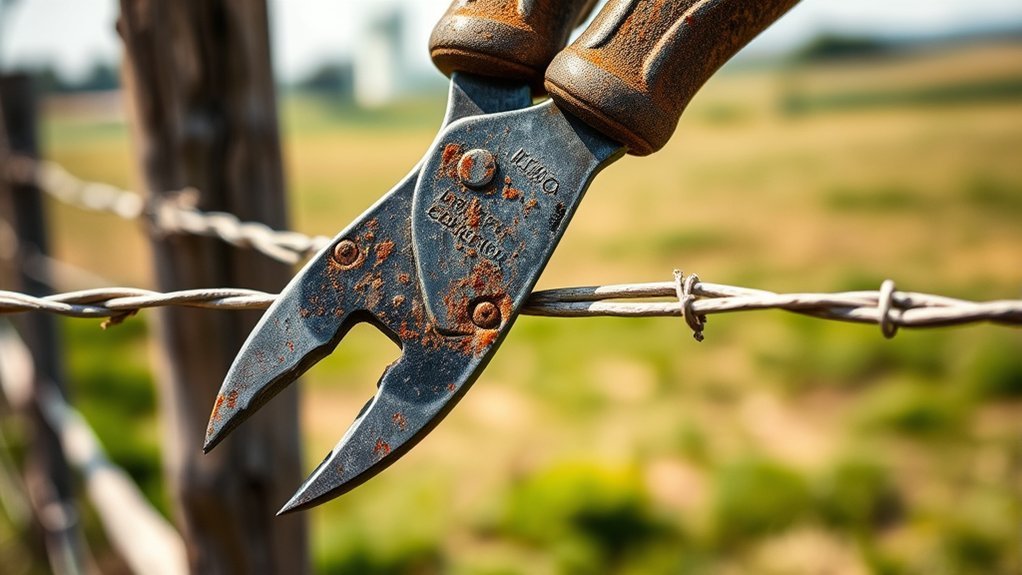
Fencing pliers are a specialized multi-tool designed to streamline wire fence installation and repair. You’ll find that fencing pliers feature several integrated tools: a hammerhead for driving staples, wire cutters for trimming fencing wire, gripping jaws for pulling and twisting wire, and a staple puller.
These combined features make fencing pliers indispensable for efficient fence work. Understanding fencing pliers types is essential; you’ll encounter variations like standard fencing pliers with a straight handle and fencing pliers with curved handles for enhanced leverage. Some models also include a wire crimper or a nail puller.
How to Hold and Use Fencing Pliers Safely
Although the tool combines multiple functions, you should always grip the pliers firmly near the pivot to maximize control and leverage. Adopting an ergonomic grip reduces fatigue and enhances precision, which is critical for safety precautions.
Keep your wrist aligned with your forearm to prevent strain.
| Safety Precautions | Ergonomic Grip Tips |
|---|---|
| Always wear gloves | Hold near pivot point |
| Inspect tool condition | Maintain wrist alignment |
| Keep fingers clear | Use dominant hand |
| Store safely after use | Apply steady pressure |
Grip and Twist Wire With Fencing Pliers
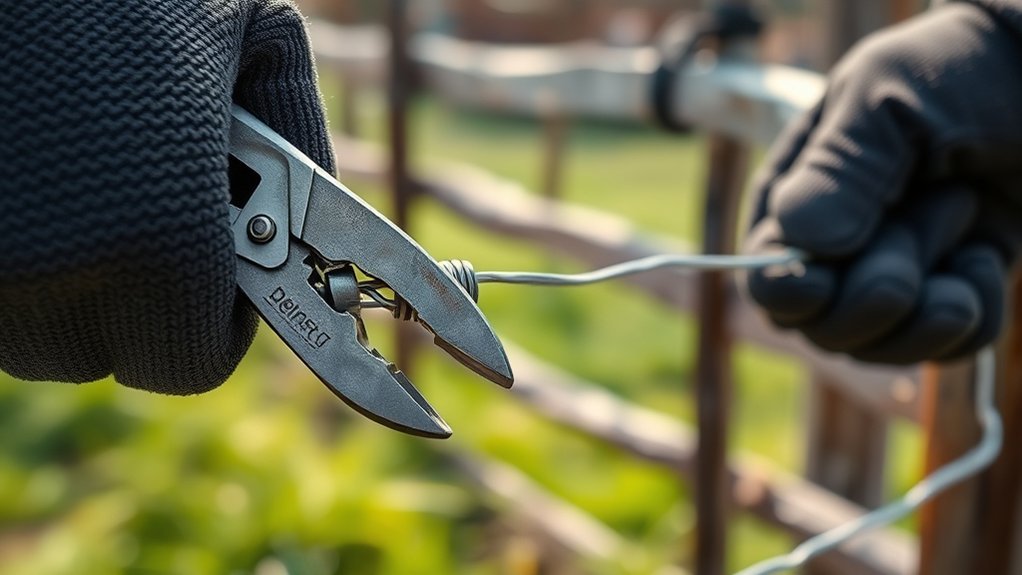
When you grip the wire firmly with the pliers‘ jaws near the pivot, you can apply controlled twisting force to secure or tighten fencing with accuracy. This technique is essential for effective wire tensioning techniques, especially across various fencing wire types like galvanized steel or high-tensile wire.
Position the pliers close to the wire’s anchor point to maximize leverage and prevent slippage.
Use the notch on the pliers to hold the wire securely without damaging it. Twist the wire steadily to increase tension evenly, avoiding weak points.
Adjust your grip based on the wire’s thickness and flexibility to maintain control.
Mastering this grip and twist method guarantees durable and professional fencing installation every time.
Cut Wire Safely With Fencing Pliers
Before cutting any wire, make sure you have a firm grip on the pliers and position the cutting blades correctly to avoid slippage or uneven cuts. Different wire types require specific cutting techniques for best results and safety. Use the cutting edge designed for the wire’s gauge and material to prevent damage to the tool and guarantee a clean cut.
| Wire Type | Recommended Cutting Technique |
|---|---|
| Galvanized | Apply steady pressure, cut mid-span |
| Barbed | Use firm, decisive cutting action |
| Electric | Verify insulation not damaged |
| High-tensile | Use multiple, controlled squeezes |
| Soft wire | Cut swiftly with minimal force |
Always maintain control and avoid twisting the pliers during the cut to preserve blade integrity and personal safety.
Remove and Install Staples With Fencing Pliers
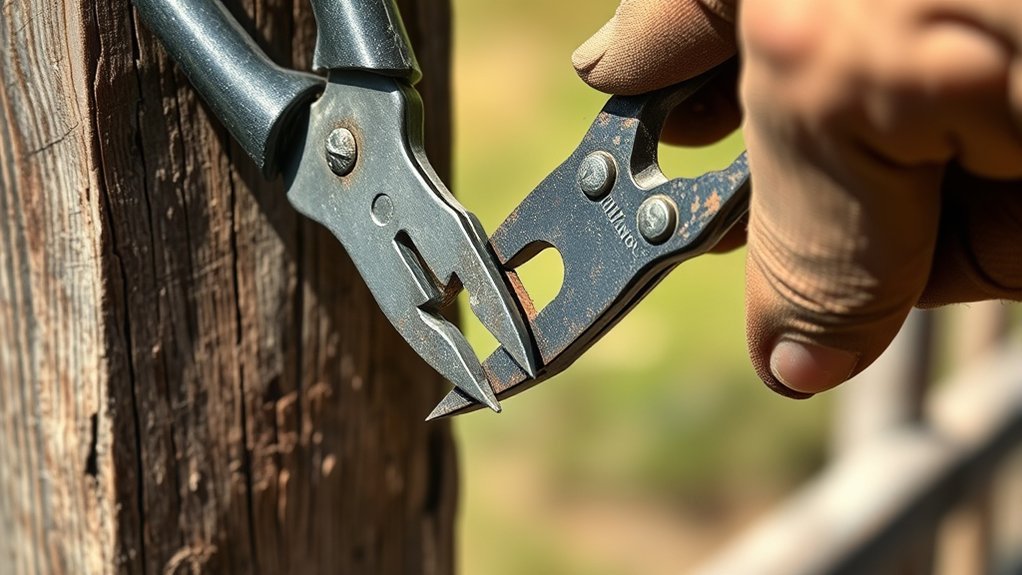
Use fencing pliers to efficiently remove and install staples without damaging the wire or fence posts. Mastering staple removal techniques guarantees you extract staples cleanly, preserving both the wood and wire integrity.
When removing, position the pliers’ claw under the staple’s crown, then lever it out steadily to avoid splintering. For installation, grip the staple with the pliers’ jaw, aligning it squarely on the post before driving it in.
Follow these staple installation tips for secure fastening: Place staples evenly spaced to distribute tension. Use the flat side of the pliers’ head to seat staples flush. Avoid overdriving staples, which can damage the wire or post.
These precise methods optimize fence durability and simplify maintenance tasks.
Use Fencing Pliers as a Hammer
Leverage the flat, heavy head of fencing pliers to drive staples and nails with controlled force, effectively replacing a traditional hammer in many fencing tasks. When using fencing pliers for hammering, position the flat head squarely on the nail or staple head and apply steady, controlled strikes.
This method guarantees precision and reduces material damage. Proper hammering techniques improve efficiency and safety during fencing applications.
| Task | Tool Position | Recommended Force |
|---|---|---|
| Driving staples | Flat head on staple | Moderate, steady strikes |
| Nailing wire clips | Flat head on clip | Firm, controlled taps |
| Adjusting posts | Handle end as lever | Gentle, precise taps |
Master these techniques to optimize your fencing pliers’ versatility in the field.
Maintain and Care for Your Fencing Pliers
To keep your fencing pliers in peak condition, clean them thoroughly after each use to remove dirt and debris that can cause rust. Store them in a dry, secure location to prevent moisture exposure and damage.
Following these maintenance steps will extend the tool’s lifespan and guarantee reliable performance.
Cleaning Tips
Anyone who relies on fencing pliers knows that regular cleaning is essential for maintaining their effectiveness and longevity. Proper cleaning techniques prevent dirt buildup and rust, ensuring smooth operation. Start by wiping your pliers with a clean cloth to remove surface debris.
Use a wire brush for stubborn dirt or rust spots, then apply a light machine oil to all metal parts to inhibit rust formation. Focus on pivot points and cutting edges to maintain peak function.
Key cleaning tips include:
Remove all visible dirt and debris after each use.
Use rust-preventative oil to protect metal surfaces.
Inspect and clean pivot joints thoroughly to avoid stiffness.
Proper Storage Methods
After thoroughly cleaning your fencing pliers to remove dirt and rust, proper storage plays a key role in preserving their condition and functionality. You should store your pliers in a dry environment to prevent moisture-related corrosion.
Utilize a dedicated tool rack or wall-mounted pegboard to guarantee efficient tool organization, keeping pliers accessible and separated from other tools to avoid damage. If you store your pliers in a toolbox, place them in a compartment with padding or a protective sleeve to minimize impact and abrasion.
Regularly inspect the storage area for humidity or debris that could compromise tool integrity. By implementing these proper storage methods, you extend the lifespan of your fencing pliers, maintain their precision, and ensure they’re ready for peak performance every time you need them.
Conclusion
Mastering fencing pliers puts the power of precision and strength right in your hands. Like a conductor guiding an orchestra, your firm grip and controlled movements guarantee every wire twist, cut, and staple removal hits the right note.
By following safe techniques and maintaining your tool, you’ll work efficiently and confidently. Remember, the right handling not only protects you but extends your pliers’ life—turning a simple tool into a reliable partner on every fencing job.
Proper use and care are essential. With fencing pliers, you ensure your work is both effective and long-lasting.