When you use hog ring pliers, precision and control are essential for a secure fastening. Hog ring pliers are designed to clamp hog rings tightly around materials, ensuring a strong and reliable join.
You’ll need to select the right hog rings, position your materials accurately, and apply consistent pressure to close the ring properly. Missteps can lead to weak joins or damage to your project.
Understanding these basics guarantees your work holds up under stress. However, mastering the technique involves more than just squeezing the handles. Taking the time to practice will improve your efficiency and the quality of your fastening.
What Are Hog Ring Pliers and How Do They Work
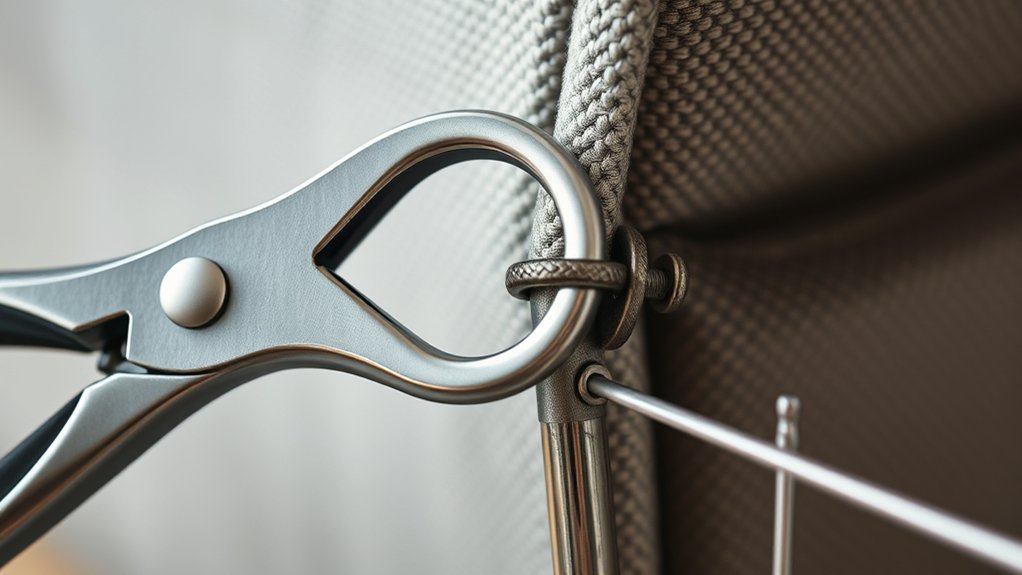
Hog ring pliers are specialized hand tools designed to fasten hog rings, metal clips shaped like a “C,” around objects for secure binding. Rooted in hog ring history, these tools originated in agricultural settings to secure fencing and animal husbandry tasks. Over time, their applications expanded into upholstery, automotive seat assembly, and wire mesh fastening.
You’ll find hog ring pliers equipped with curved jaws that hold and close the hog rings tightly when you squeeze the handles, ensuring a firm grip on materials. By applying consistent pressure, you can bend the metal rings around objects, creating durable connections. Understanding the mechanical function and historical context of hog rings helps you appreciate their broad utility across various hog ring applications.
Common Projects Using Hog Ring Pliers
You’ll find hog ring pliers essential for upholstery repair, where securing fabric tightly is vital. They also streamline fence installation by fastening wire quickly and securely.
Additionally, these pliers are key in automotive seat assembly, ensuring durable and precise attachments.
Upholstery Repair Techniques
Mastering upholstery repair techniques allows you to efficiently restore furniture by securing fabric, padding, and springs with hog ring pliers. When working with upholstery fabrics, you’ll first remove damaged sections, then reposition or replace padding and springs.
Use hog ring pliers to clamp hog rings tightly around frame components and fabric edges, ensuring stable tension and alignment. These repair tools provide strong, durable fastening that resists loosening over time.
Precise placement of hog rings is critical; avoid fabric bunching by spacing rings evenly and securing all layers firmly. Hog ring pliers streamline the repair process, making it easier to reassemble upholstered pieces without staples or adhesives.
Fence Installation Tips
Several common fence installation projects rely on hog ring pliers to secure wire mesh, fabric, or netting tightly to posts and frames. When using hog ring pliers, guarantee consistent spacing of rings to maintain tension and structural integrity.
Select fence materials compatible with hog rings. Galvanized wire mesh is ideal due to its corrosion resistance. Incorporate fence maintenance strategies such as regular inspections for loose rings and replacing damaged sections promptly to prolong fence life.
Use hog ring pliers to fasten fabric fences or privacy screens efficiently, reducing installation time and improving durability. Pay attention to the ring size and strength relative to your fence material selection to prevent premature failure.
Proper technique with hog ring pliers enhances fence stability and supports long-term performance in various environmental conditions.
Automotive Seat Assembly
Hog ring pliers don’t just secure fencing; they play an essential role in automotive seat assembly by fastening upholstery materials firmly to seat frames. When you replace a seat cover or perform foam replacement, you’ll rely on hog ring pliers to attach the fabric or vinyl tightly, ensuring a smooth, wrinkle-free finish.
First, position the seat cover over the foam and frame. Then, stretch the material taut and use hog ring pliers to clamp hog rings around the frame, securing the upholstery in place.
The tool’s design allows you to close rings quickly and precisely, maintaining tension without damaging materials. Proper use guarantees durability and a professional appearance, making hog ring pliers indispensable in automotive seat repair and assembly tasks.
Choosing the Right Hog Rings for Your Project
Choosing the right hog rings for your project depends on factors like material thickness, application type, and ring size. You’ll find several types of hog rings: standard, heavy-duty, stainless steel, and galvanized, each suited to specific tasks. For example, standard rings fit light upholstery, while heavy-duty rings secure thick materials or wire mesh.
Materials compatibility is critical; stainless steel rings resist corrosion in outdoor or marine environments, whereas galvanized rings offer moderate rust protection. Make certain the ring diameter matches your pliers and the materials’ thickness to guarantee a secure grip without damaging the fabric or frame.
Selecting hog rings with appropriate tensile strength and corrosion resistance will optimize durability and performance, preventing premature failure in your assembly. Always match the hog ring type to your project’s specific technical requirements.
Preparing Materials for Hog Ring Pliers Use
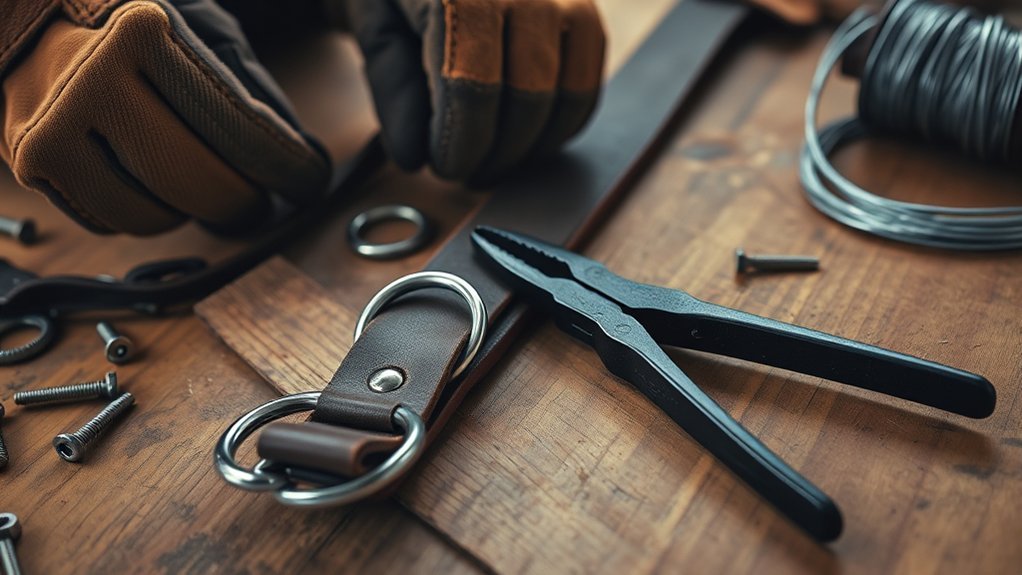
Before you start using hog ring pliers, prepare your materials by confirming they’re clean, properly aligned, and securely positioned. Proper material selection affects the durability and effectiveness of your work.
Use preparation techniques like trimming excess fabric and flattening edges to facilitate smoother clamping. Align materials evenly to avoid misfits or weak joints.
| Material Type | Preparation Technique | Key Consideration |
|---|---|---|
| Fabric | Trim edges, remove debris | Prevent snags, confirm fit |
| Wire mesh | Straighten, clean surface | Avoid gaps or misalignment |
| Foam padding | Flatten, align layers | Maintain consistent thickness |
Following these steps guarantees ideal hog ring application and long-lasting results.
How to Hold Hog Ring Pliers for Best Results
To achieve the best results, you need to maintain a firm yet controlled grip on the hog ring pliers. Position your hand so your fingers align with the handles, allowing smooth, precise movement without strain. This setup maximizes control and reduces the risk of slipping during use.
Proper Grip Techniques
Mastering three key grip techniques will greatly improve your control and precision when using hog ring pliers. Focus on proper handhold techniques and ideal finger positioning to guarantee consistent results.
- Grip the handles firmly but avoid excessive force that causes fatigue.
- Position your thumb on the upper handle for leverage and stability.
- Rest your index and middle fingers along the lower handle for guided control.
- Keep your wrist aligned with the tool’s axis to maximize force transmission.
- Maintain relaxed fingers to prevent unnecessary tension and improve responsiveness.
Hand Positioning Tips
Effective hand positioning directly impacts your accuracy and efficiency when using hog ring pliers. To optimize hand alignment, hold the pliers firmly but comfortably, ensuring your wrist remains neutral to reduce fatigue.
Position your index finger along the handle’s side to guide movement precisely, while your thumb applies controlled pressure opposite your fingers. Proper finger positioning involves wrapping your middle and ring fingers securely around the handle, stabilizing the tool during operation.
Avoid gripping too tightly, which can cause strain and reduce control. Maintain consistent hand alignment by keeping the pliers’ jaws perpendicular to the surface you’re working on, ensuring the hog ring seats correctly.
How to Clamp Hog Rings Step by Step
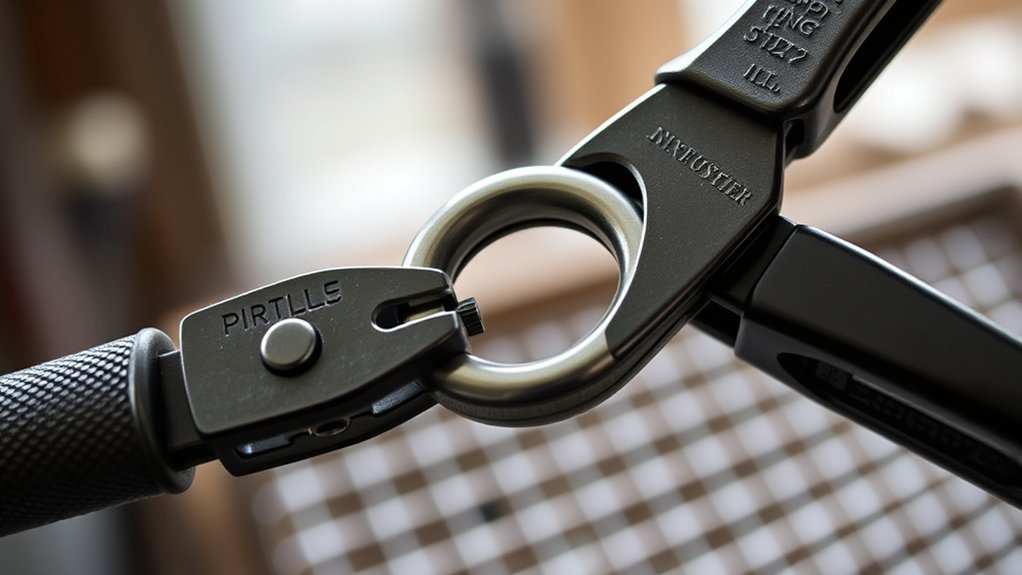
Although clamping hog rings requires some dexterity, following a systematic approach guarantees secure and consistent results. Begin by selecting the right hog ring size for your specific hog ring applications. Next, position the ring in the pliers’ jaws, confirming it’s centered.
Use proper hand positioning to maintain control during clamping. Apply steady pressure to close the ring fully around the material. Finally, inspect the clamp for tightness and uniformity.
Key clamping techniques include:
Aligning the ring precisely before squeezing
Maintaining consistent pressure throughout
Using the correct plier type for the ring size
Confirming the material is taut and correctly positioned
Checking for secure closure without deforming the ring
Mastering these steps will enhance your efficiency and confirm durable fastening.
Common Mistakes to Avoid With Hog Ring Pliers
When using hog ring pliers, avoid placing the rings incorrectly, as this compromises the strength of the clamp. Make certain you select the right size of pliers for your ring type to guarantee proper closure.
These common mistakes can lead to weak joints and tool damage.
Incorrect Ring Placement
If you place hog rings incorrectly, the connection will weaken, compromising the integrity of your work. Incorrect hog ring placement leads to gaps, misalignment, and reduced holding strength.
When troubleshooting hog rings, watch for these common issues:
- Rings not fully closed, causing slippage
- Misaligned rings that fail to grip materials evenly
- Overlapping rings that create weak points
- Rings positioned too far from the edge, reducing tension
- Applying rings at inconsistent angles, leading to uneven pressure
Always position the ring so it fully encircles both materials, and close it tightly with the pliers. Avoid forcing the ring at awkward angles, as this causes deformation and weak joints.
Proper placement guarantees durable, secure fastening, minimizing the need for rework during troubleshooting hog rings.
Using Wrong Pliers Size
Selecting the wrong size of hog ring pliers can compromise your fastening quality and increase the effort required. Using incorrect size pliers reduces your grip on the hog rings, leading to incomplete closures or ring deformation.
This not only weakens the fastening but also risks material damage. You’ll find it harder to apply consistent pressure, which impacts project efficiency and durability.
Always match the pliers size to the hog rings specified for your task. Using pliers that are too large or too small can cause misalignment, resulting in uneven tension and potential failure.
To avoid these issues, verify compatibility before starting and test your setup on scrap material. Proper sizing guarantees reliable, clean, and strong hog ring connections, ultimately improving your project outcomes.
How to Remove Hog Rings Without Damaging Materials
Removing hog rings without damaging materials requires careful technique and the right tools. To guarantee effective removal techniques while prioritizing material preservation, follow these steps:
Use needle-nose pliers to gently pry open the hog ring’s closure. Apply steady, controlled pressure to avoid tearing fabric or upholstery.
Gently pry open hog rings with needle-nose pliers, applying steady pressure to protect your fabric or upholstery.
Position a small flathead screwdriver beneath the ring for leverage if needed. Work slowly around the ring, gradually expanding its gap.
Avoid cutting tools unless absolutely necessary to prevent accidental damage.
How to Care for Your Hog Ring Pliers
Proper maintenance of your hog ring pliers extends their lifespan and guarantees consistent performance. Start by applying appropriate cleaning techniques after each use: wipe the jaws and pivot points with a dry cloth to remove debris, then use a mild solvent to eliminate stubborn residues.
Avoid water exposure to prevent rust. Regularly lubricate the pivot joint with light machine oil to secure smooth operation. Inspect for wear or damage and replace parts if necessary.
For storage solutions, keep your pliers in a dry, cool environment to avoid corrosion. Use a tool organizer or a protective case to prevent physical damage and misplacement.
Advanced Techniques for Faster Hog Ring Pliers Work
Mastering three key techniques can greatly speed up your use of hog ring pliers without sacrificing accuracy. For advanced applications, focusing on efficient handling and placement is essential. Employ these speed techniques to enhance your workflow:
Pre-load rings onto pliers to reduce downtime
Reducing downtime by pre-loading rings onto pliers boosts efficiency and keeps your workflow smooth.
Use a consistent wrist motion for rapid closures
Position the workpiece for ideal accessibility
Maintain steady pressure to avoid misfires
Organize materials within easy reach to streamline operations
Conclusion
Now that you’ve mastered using hog ring pliers, you hold the key to crafting strong, seamless connections. Like a skilled artisan shaping metal, your precise grip and steady squeeze transform loose materials into secure bonds.
Remember, choosing the right ring and aligning materials carefully guarantees your work stands the test of time. With practice, your hands become instruments of durability—fastening projects with efficiency and confidence every time.
By consistently applying these techniques, you will fully unlock the potential of hog ring pliers in all your fastening tasks.