Mixing Danish oil with tung oil is a great way to combine their individual benefits.
Danish oil offers a faster drying time, while tung oil provides a durable, waterproof finish.
Start with a 3:1 ratio of Danish oil to tung oil. Apply thin coats and allow proper curing between layers to prevent tackiness.
This blend enhances wood’s clarity and protection while balancing drying speed and hardness.
If you want to optimize the mix for your project’s needs, consider specific application techniques and ratios to achieve the best results.
Is It Safe to Mix Danish and Tung Oil?

When considering whether you can safely mix Danish oil with tung oil, it’s important to understand their chemical compositions and drying properties. Both oils cure through polymerization but differ in drying times and solvents used.
Safety concerns primarily arise from improper mixing ratios, which can affect drying efficiency and increase risks such as tackiness or incomplete curing. You should avoid arbitrary ratios; instead, test small batches to determine compatibility.
A common practice is to start with a 1:1 ratio and adjust based on drying behavior and finish quality. Confirm you’re working in a well-ventilated space and follow manufacturer guidelines to mitigate hazards.
Proper mixing ratios balance the oils’ characteristics, optimizing finish durability and minimizing safety risks associated with volatile organic compounds and flammability.
What’s in Danish Oil and Tung Oil?
You’ll find Danish oil typically contains a blend of tung oil or linseed oil, varnish, and mineral spirits, designed to penetrate and protect wood. Tung oil, on the other hand, is a natural drying oil extracted from the seeds of the tung tree, known for its water resistance and durability.
Understanding these compositions helps you compare their properties and how they interact when combined.
Danish Oil Ingredients
Understanding the composition of Danish oil and tung oil is essential before considering mixing them. Danish oil typically consists of a blend of drying oils, varnishes, and mineral spirits. The drying oils often include tung oil, linseed oil, or a combination, which penetrate wood fibers to provide protection and sheen.
The varnishes add a durable, protective layer, enhancing resistance to moisture and wear. Mineral spirits serve as a solvent, adjusting the viscosity for ease of application and proper drying time. This ingredient composition guarantees Danish oil offers both penetration and surface protection, making it distinct from pure tung oil.
Tung Oil Composition
Tung oil, derived from the seeds of the tung tree, is composed primarily of eleostearic acid, a drying oil known for its rapid polymerization when exposed to air. This unique fatty acid structure enables tung oil to form a hard, waterproof film, which is central to its tung oil benefits, including excellent water resistance and durability.
However, its composition also contributes to tung oil drawbacks, such as a longer curing time compared to synthetic finishes and potential yellowing over time. Unlike Danish oil, which is a blend of oils and varnishes, pure tung oil contains minimal additives, making it a natural option.
Understanding tung oil’s chemical makeup helps you appreciate its performance characteristics and informs your decision when mixing it with other oils like Danish oil.
Oil Properties Comparison
Comparing the properties of Danish oil and tung oil reveals distinct differences in their formulations and performance. Danish oil typically combines tung or linseed oil with varnish and mineral spirits, creating a blend that enhances oil absorption and provides a moderate drying speed. This mixture allows it to penetrate wood fibers effectively while forming a durable surface film.
Tung oil, by contrast, is a pure natural oil extracted from the tung tree, known for its superior oil absorption into wood and a slower drying speed due to its polymerizing properties. When you use tung oil, expect a more flexible, water-resistant finish but with longer curing times.
Understanding these differences helps you choose the right oil based on your project’s drying time requirements and the desired depth of oil absorption.
How Mixing Danish and Tung Oil Affects Drying Time
Although both Danish oil and tung oil are known for their protective finishes, mixing them can considerably alter the drying time of your wood treatment. The drying speed depends on the oil interaction at the molecular level.
Tung oil, rich in polyunsaturated fatty acids, polymerizes through oxidative curing, taking longer to dry. Danish oil, a blend often containing varnish and thinner, dries faster due to solvent evaporation and quicker curing agents.
When mixed, the drying speed is influenced by the ratio and compatibility of these components. The presence of Danish oil’s solvents can accelerate tung oil’s surface drying but may hinder full polymerization internally, resulting in a complex drying profile.
Understanding this oil interaction helps you optimize application timing and environmental conditions for efficient curing without compromising finish integrity.
Finish Characteristics of a Danish and Tung Oil Mix
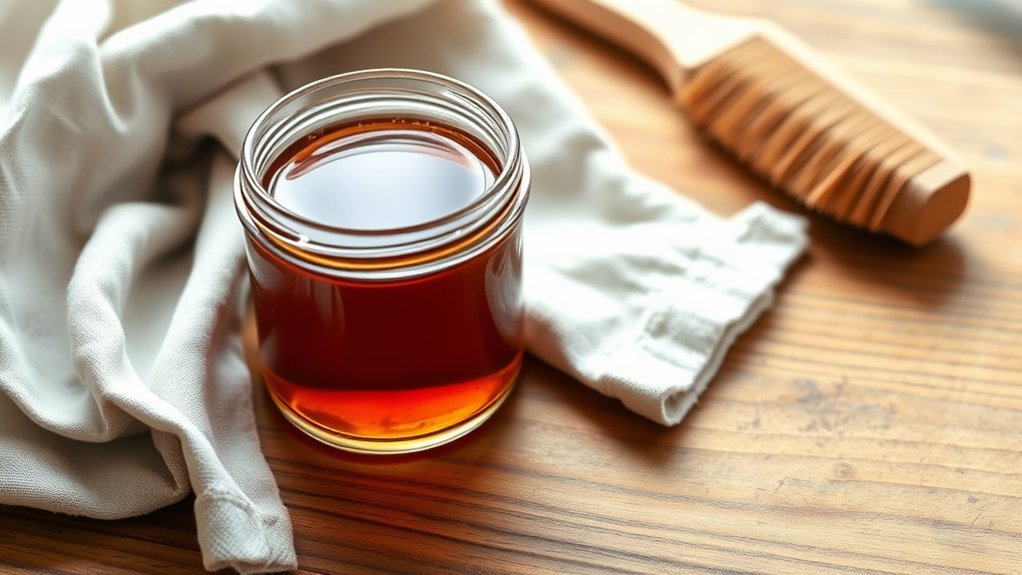
When you combine Danish oil with tung oil, the resulting finish balances durability and aesthetic appeal in a way that neither oil achieves alone. The finish durability increases due to tung oil’s superior polymerization, forming a resilient, water-resistant layer.
Simultaneously, Danish oil contributes to faster absorption and penetration, enhancing the oil blend aesthetics by imparting a warm, natural sheen with subtle depth. This synergy yields a smooth, satin finish that resists cracking and yellowing over time.
You’ll also notice improved clarity and richness in the wood grain, as the blend maintains tung oil’s hardness while softening its sometimes brittle texture. Overall, this combination optimizes protective qualities without sacrificing visual warmth, making it an ideal choice for furniture and hardwood surfaces requiring both strength and refined appearance.
How to Mix Danish and Tung Oil
To achieve the ideal balance between durability and appearance, start by mixing Danish oil and tung oil in a ratio of approximately 3:1, favoring Danish oil for faster drying and absorption. Make sure you use clean containers and stir thoroughly to maintain homogeneity.
Understanding oil compatibility is essential; both oils are penetrating finishes, so they blend well without separation. Adjusting mixing ratios allows you to tailor drying times and sheen. More tung oil enhances water resistance but slows drying.
Always test small batches first to confirm the blend meets your expectations. Store unused mixtures in airtight containers to prevent oxidation.
How to Apply a Danish and Tung Oil Blend
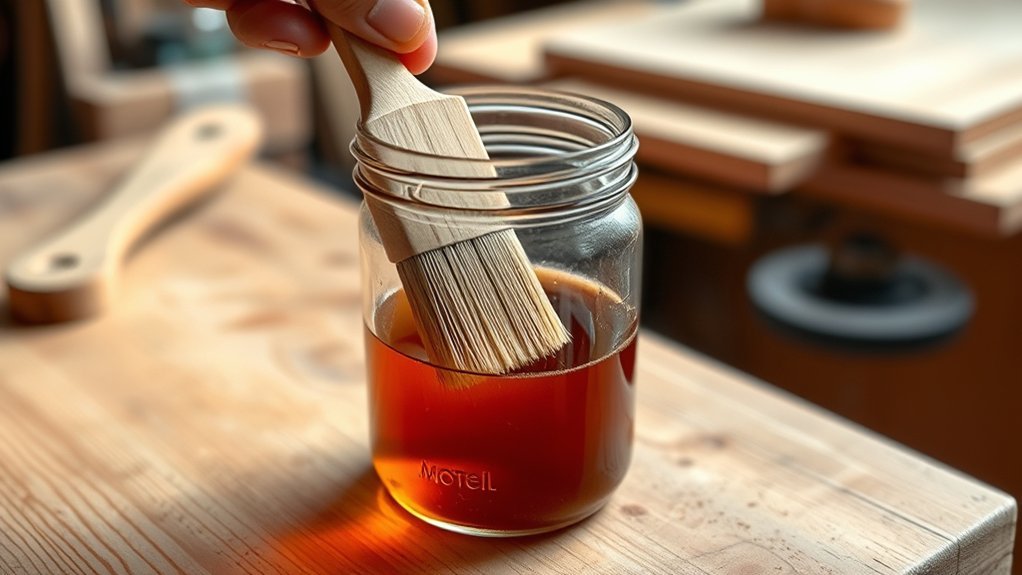
Before applying your Danish and tung oil blend, make certain the wood surface is clean, dry, and sanded to a fine grit for best absorption. Use a lint-free cloth or brush to apply the mixture evenly, working with the grain to avoid streaks.
Allow adequate drying time between coats, lightly sanding if necessary to guarantee a smooth, durable finish.
Preparing The Wood
Although preparing the wood might seem straightforward, achieving perfect absorption of a Danish and Tung oil blend requires meticulous surface preparation. Begin by selecting appropriate sanding techniques: start with medium-grit sandpaper (120-150 grit) to remove surface imperfections, then progress to fine-grit (220-320 grit) for a smooth finish. This guarantees the wood’s pores open evenly, promoting optimal oil penetration.
After sanding, clean the surface thoroughly to eliminate dust particles that could hinder absorption. Next, perform wood conditioning by applying a pre-stain conditioner or a light coat of the oil blend to test absorption uniformity. This step evens out varying porosity, preventing blotching.
Proper conditioning and sanding techniques together create a perfect substrate, maximizing the durability and aesthetic uniformity of your Danish and Tung oil finish.
Application Techniques
Since the wood is properly prepared, you’ll want to apply the Danish and Tung oil blend evenly using a lint-free cloth, brush, or foam applicator. Start by mixing your blend according to precise blending ratios, commonly 1:1 or 2:1 Danish to Tung oil, ensuring uniform consistency.
Apply thin, even coats, working along the grain to promote ideal absorption. After 15-20 minutes, wipe off excess oil to prevent sticky residue. Allow each coat to cure fully, typically 6-8 hours, before lightly sanding with fine-grit paper to achieve a smooth surface.
Repeat the process for 3-5 coats, adjusting blending ratios based on desired hardness and sheen. These application techniques guarantee a durable, water-resistant finish that highlights the wood’s natural beauty.
When to Choose a Mixed Oil Finish Over Using Them Separately
When you need a finish that balances the fast drying time and easy application of Danish oil with the deep penetration and durability of tung oil, mixing the two provides a tailored solution. You’ll find application benefits such as smoother spreading and reduced tackiness compared to pure tung oil, making the process more efficient.
Additionally, the mixture enhances finish durability by combining tung oil’s water resistance with Danish oil’s UV protection, resulting in a more robust surface. Choose a mixed oil finish when working on projects requiring both quick turnaround and long-lasting protection, such as furniture or flooring.
If you prioritize either rapid drying or maximum hardness alone, using the oils separately may be better, but mixing optimizes performance for balanced demands.
Frequently Asked Questions
Can I Use This Blend on Outdoor Furniture?
You can use this blend on outdoor furniture, but guarantee it offers strong outdoor durability and weather resistance. Tung oil enhances protection, while Danish oil adds finish; together they improve longevity against moisture and UV exposure when applied correctly.
How Long Does the Mixed Oil Last on Wood?
The oil longevity on wood typically ranges from 6 to 12 months, depending on exposure. Proper application enhances wood preservation, but you’ll need to reapply regularly to maintain protection against weathering and wear.
Does Mixing Oils Affect the Wood’s Color Over Time?
Think of your wood as a canvas; mixing oils can subtly shift its hue. While color stability generally remains intact, variations in oil composition might influence wood aging.
This can cause gradual changes in tone and finish over time.
Can I Mix Danish and Tung Oil With Other Wood Finishes?
You can mix Danish and tung oil with some finishes, but you must check oil compatibility carefully to avoid poor adhesion or curing issues.
Proper mixing enhances finish durability, but incompatible blends may compromise protection and appearance.
Is the Mixed Oil Safe for Cutting Boards and Kitchenware?
You’d need a whole ocean of research to confirm cutting board safety when mixing oils. Danish and tung oil compatibility varies; verify both are food-safe and fully cured, avoiding harmful additives to maintain proper cutting board safety and durability.
Conclusion
Mixing Danish and Tung oil can give you a balanced finish, combining durability with a rich, natural look. For example, a furniture maker blending these oils found the drying time improved while maintaining Tung oil’s water resistance and Danish oil’s ease of application.
Just remember to mix small batches and test on scrap wood first. This approach lets you tailor finishes precisely, making it ideal when you want both protection and aesthetic appeal in one step.
In conclusion, mixing Danish oil with Tung oil offers a practical way to enhance your wood finishing projects by leveraging the best properties of both oils.