When you use wire looping pliers, precision and control are essential to form clean, consistent loops in your wire. Wire looping pliers help you create professional-looking loops quickly and efficiently.
You’ll need to understand how to position the wire correctly within the jaws and apply the right tension to avoid kinks or uneven bends. Mastering these steps guarantees your loops serve their intended function, whether for jewelry, electronics, or craft projects.
But before you start, there are key techniques and common pitfalls you should be aware of. Following these guidelines will improve your results and make your work easier.
What Wire Looping Pliers Are and How to Use Them
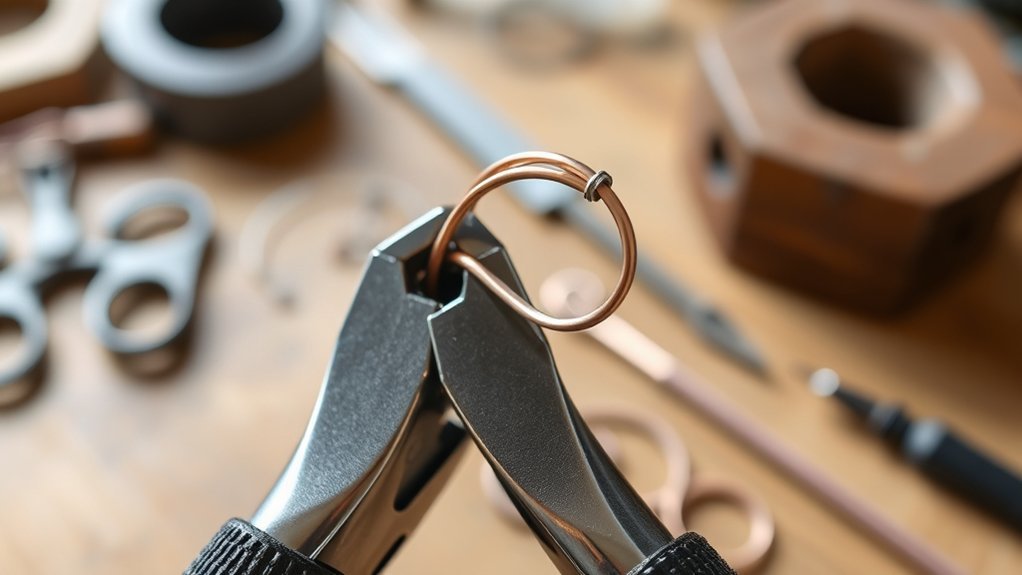
Wire looping pliers are specialized tools designed to create consistent, precise loops in wire, vital for jewelry making and electronics work. When you use these pliers, you apply specific wire looping techniques to bend wire uniformly, guaranteeing reliable connections or decorative elements.
The pliers typically feature a round nose for shaping loops and a flat side to hold the wire securely. To maximize efficiency and maintain accuracy, you must control wire tension and plier pressure carefully.
Additionally, pliers safety is essential; always wear protective eyewear to guard against wire ends snapping and guarantee a firm grip to prevent slippage. By mastering these aspects, you enhance your ability to produce neat loops while minimizing risks and material waste.
Step-by-Step Guide to Making Basic Wire Loops With Pliers
To create precise wire loops, you need to select the correct pliers with a rounded jaw that matches your wire gauge. Position the wire securely and use consistent pressure to form uniform loops without kinks or deformities.
Following these steps guarantees strong, professional-quality loops every time.
Choosing The Right Pliers
Selecting the right pliers greatly impacts the accuracy and ease of creating wire loops. You need to evaluate the types of pliers available: round-nose, chain-nose, and bent-nose. Each offers distinct advantages depending on loop size and wire thickness.
Round-nose pliers provide consistent circular loops, whereas chain-nose allow more control in tight spaces. Consider plier materials: stainless steel guarantees durability and corrosion resistance, while ergonomic handles reduce hand fatigue during repetitive use.
Avoid pliers with uneven jaws or poor grip, as they compromise loop uniformity and precision. By analyzing these factors, you can select pliers that maintain consistent loop shape and reduce wire damage, ultimately improving your wire looping efficiency and product quality.
Forming Consistent Wire Loops
Although mastering consistent loops demands practice, following a systematic approach guarantees precision and repeatability. Begin by selecting the appropriate wire type and diameter. Position the wire’s end in the pliers’ notch and apply steady pressure to bend it 90 degrees.
Rotate the pliers while maintaining tension to form a uniform loop. Adjust your looping techniques based on wire flexibility and thickness to avoid deformation.
| Challenge | Solution | Result |
|---|---|---|
| Uneven loops | Consistent angle | Symmetrical loops |
| Wire kinks | Proper tension | Smooth curves |
| Loop size varies | Controlled grip | Uniform loops |
Master these steps to achieve precise, repeatable loops suited for any wire type, enhancing your craftsmanship.
How to Hold and Position Wire Looping Pliers Correctly
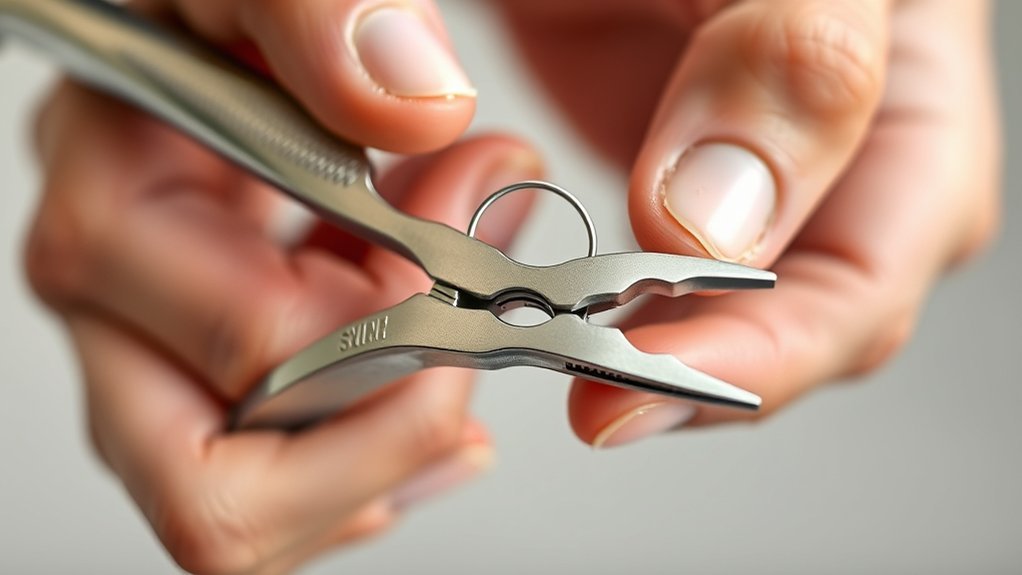
Mastering the grip on wire looping pliers involves positioning your fingers to maximize control and accuracy. To achieve the proper grip, rest the pliers’ handles comfortably in your palm, using your thumb and index finger to apply precise pressure near the pivot point. This arrangement guarantees minimal hand fatigue and enhances responsiveness.
Position the jaws at a preferable angle relative to your work surface, typically around 45 degrees, to facilitate smooth wire manipulation without slippage. Maintain wrist alignment to prevent strain and maintain consistent loop formation.
Avoid gripping too tightly, which reduces tactile feedback, or too loosely, which compromises stability. By consistently holding the pliers this way, you’ll improve loop uniformity and reduce rework caused by misaligned or uneven wire loops.
Choosing the Right Wire for Wire Looping Pliers Projects
Once you’ve established a reliable grip and positioning technique with your wire looping pliers, the next step involves choosing wire that complements your tool’s capabilities. Selecting the appropriate wire types is critical for project suitability, as the wire’s gauge and material affect loop formation and durability.
Softer metals like copper and aluminum are easier to manipulate, while harder wires like stainless steel require more force but offer greater strength.
| Wire Type | Gauge Range | Project Suitability |
|---|---|---|
| Copper | 18-24 | Jewelry, decorative loops |
| Aluminum | 16-22 | Lightweight frames, crafts |
| Stainless Steel | 20-26 | Durable loops, structural use |
Matching wire characteristics with your project guarantees consistent loops and superior performance with your looping pliers.
Techniques for Creating Consistent Wire Loops With Looping Pliers
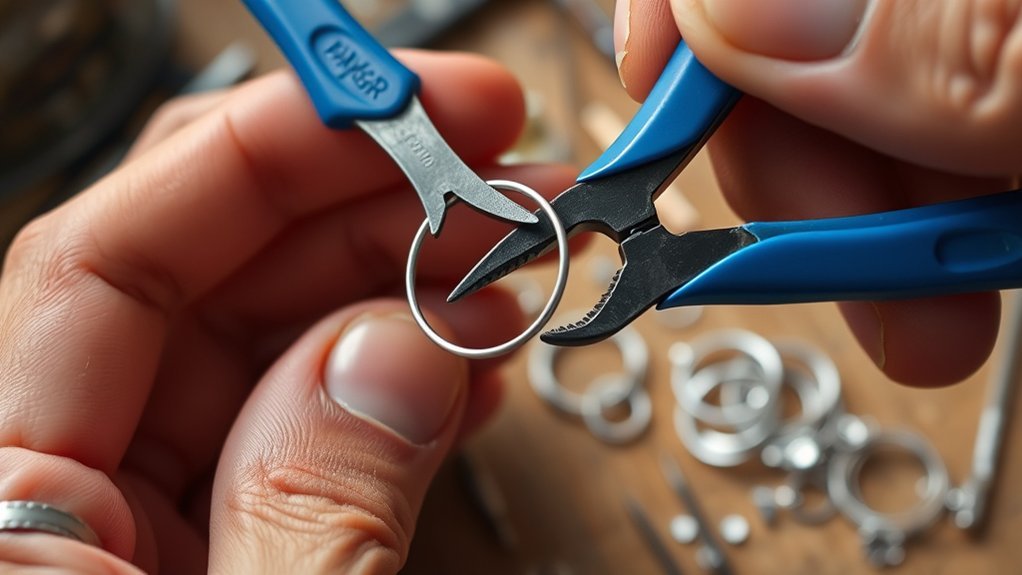
To create consistent wire loops, you need to select the proper wire gauge that matches your pliers’ jaw size for ideal control. Maintaining steady pressure during each loop guarantees uniformity and prevents wire deformation.
Finally, mastering loop size control by aligning the wire precisely with the pliers’ curved jaws will produce repeatable, accurate loops.
Choosing Proper Wire Gauge
Selecting the correct wire gauge is essential when creating consistent loops with looping pliers, as it directly affects the loop’s strength, size, and overall appearance. You need to match the wire gauge with your pliers’ jaw diameter to guarantee gauge compatibility; improper pairing can lead to weak loops or damage to the tool.
Thicker gauges provide greater wire strength but demand more force and can limit loop tightness, while thinner gauges allow finer loops but risk deformation. Always assess your project’s structural requirements and aesthetic goals before choosing a gauge.
Maintaining Consistent Pressure
Although mastering wire looping pliers requires practice, maintaining consistent pressure is essential for producing uniform loops that meet exact specifications. To achieve this, you need to develop precise pressure control throughout your looping techniques.
Start by gripping the pliers firmly but not excessively, allowing smooth, controlled movement. Apply steady force when bending the wire to avoid deforming or uneven loops.
Consistency in pressure prevents variations in loop tightness and shape, which is critical for functional and aesthetic standards. Monitor your hand’s muscle tension and adjust as needed to maintain uniformity.
Incorporate deliberate, repetitive motions to build muscle memory, enhancing your ability to sustain consistent pressure. Mastering this control directly improves loop quality and speeds up your workflow without sacrificing accuracy.
Mastering Loop Size Control
Achieving consistent loop size hinges on controlling the wire’s position relative to the pliers’ jaws throughout each bend. To master loop size control, you must align the wire precisely at the desired point on the jaws before bending.
Small shifts in wire placement cause variations in loop size, so maintain exact positioning for uniform results. Use the pliers’ calibrated markings, if available, to facilitate size adjustments during repetitive loops.
When adjusting loop size, slightly alter the wire’s entry point on the jaws rather than changing bending force, which can cause deformation. Consistency in hand pressure complements positional control but doesn’t replace it.
Using Wire Looping Pliers to Make Different Loop Sizes
Wire looping pliers offer precise control over loop size by allowing you to adjust the position of the wire within the jaw grooves. To create different loop sizes, first select the appropriate groove on the pliers’ jaws that corresponds to your desired diameter. Then, position the wire end accurately in that groove before rotating the pliers.
Employing refined loop size techniques involves steady hand movement and consistent pressure to maintain uniformity. Adjusting wire loops mid-process is possible by slightly repositioning the wire or re-clamping, but precision here is critical to avoid deformation.
Common Mistakes to Avoid When Looping Wire
Several common mistakes can compromise the quality and durability of your loops when using wire looping pliers. One frequent wire loop mistake is applying inconsistent pressure, which causes uneven loops prone to deformation.
Avoid bending the wire too sharply before looping, as this weakens its structural integrity. Another common wire error is misaligning the wire in the pliers’ jaws, resulting in skewed or off-center loops that affect assembly precision.
Additionally, using inappropriate wire gauge for your pliers can lead to inadequate looping or tool damage. Always verify the wire is clean and free of kinks before forming loops to prevent weak points.
How to Take Care of Your Wire Looping Pliers
Preventing common mistakes like misaligned jaws or using the wrong wire gauge starts with maintaining your wire looping pliers properly. Begin with regular cleaning techniques, such as wiping the jaws with a lint-free cloth and applying a small amount of lubricant to the pivot point. This reduces friction and prevents rust buildup.
Avoid using abrasive materials that can damage the precision surfaces. For storage solutions, keep your pliers in a dedicated compartment or a protective sleeve to prevent physical damage and contamination. Store them in a dry environment to inhibit corrosion.
Periodically inspect the alignment of the jaws and the tension of the pivot; adjust or service as needed to maintain peak performance. Proper care guarantees longevity and consistent accuracy in your wire looping tasks.
Creative Projects You Can Try Using Wire Looping Pliers
Mastering just a handful of fundamental techniques with looping pliers opens up a range of creative projects that combine precision and artistry. You can efficiently create consistent loops essential for assembling complex beaded jewelry, ensuring uniformity and structural integrity.
Additionally, looping pliers enable you to manipulate wire into precise curves and spirals, a critical skill when crafting detailed wire sculptures. By controlling loop size and shape, you enhance both aesthetic appeal and mechanical stability.
Incorporate various wire gauges and materials to expand your design possibilities. Experimenting with these projects will refine your technical skills and deepen your understanding of wire behavior under manipulation.
Ultimately, the versatility of wire looping pliers empowers you to transform simple wire into intricate, professional-quality creations.
Conclusion
Now that you’ve mastered the art of bending wire into perfect loops without turning it into a tangled mess, you’re practically a wire whisperer. Just remember, those looping pliers won’t work miracles if you treat them like magic wands—precision and steady pressure are your real tools.
So, put down the frustration, pick up your pliers, and create loops so consistent even your wire will salute you for not turning it into modern art. With wire looping pliers in hand, your crafting skills will reach new heights, making every loop count.