When Vision effortlessly lifts Thor’s hammer during the Avengers’ battle, it challenges what you might think about worthiness and power. Why can Vision lift Thor’s hammer? His synthetic nature combined with a Mind Stone-enhanced intellect suggests that moral integrity, not just physical strength, determines who can wield Mjolnir.
Understanding why Vision qualifies requires examining the enchantment’s criteria and how his unique blend of technology and ethics fits into that framework.
What Makes Thor’s Hammer Mjolnir So Special
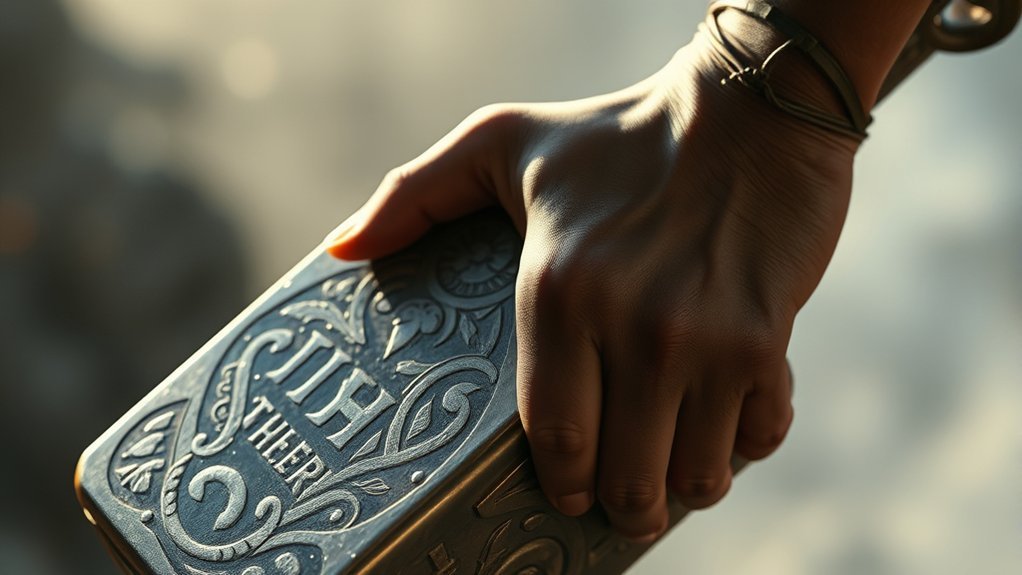
What exactly sets Thor’s hammer, Mjolnir, apart from any other weapon? Its uniqueness lies in the enchantment placed upon it by Odin, which restricts its use solely to those deemed worthy. This imbues Mjolnir with more than physical power; it becomes a symbol intertwined with moral judgment.
When you analyze mythic parallels, Mjolnir echoes legendary weapons like Excalibur, where worthiness governs possession. Additionally, the concept introduces cosmic irony: a weapon of immense strength demands not brute force but virtue.
This duality challenges conventional expectations of power, making Mjolnir not just a tool but a narrative device reflecting ethical dimensions within the cosmos. Understanding these elements clarifies why Mjolnir transcends typical weaponry and holds a unique place in both mythology and the Marvel Universe.
The Meaning of Worthiness in the Marvel Universe
You need to understand that worthiness in the Marvel Universe hinges on clear criteria, including moral integrity and the responsible use of power.
It’s not just about strength but also about honoring a legacy and accepting the responsibility that comes with it. These factors together define who can wield Mjolnir and why.
Defining Worthiness Criteria
How does the Marvel Universe determine who is worthy of wielding Thor’s hammer, Mjolnir? Worthiness hinges on a set of ethical and moral principles embedded in hammer ethics, emphasizing honor, bravery, and integrity.
When you approach Mjolnir, you must align with these criteria; any worthiness misalignment prevents you from lifting it. This alignment isn’t merely about strength but reflects a deeper congruence with the hammer’s intrinsic values.
The enchantment excludes those whose intentions or values conflict with this framework, ensuring only individuals embodying selflessness and noble purpose can wield Mjolnir.
Understanding these criteria objectively clarifies why some characters, despite physical power, fail to lift the hammer. The concept of worthiness is thus a selective filter based on ethical congruence rather than mere capability or desire.
Moral Integrity and Power
Examining the connection between moral integrity and power reveals the core of worthiness in the Marvel Universe. You quickly realize that possessing mundane strength alone doesn’t guarantee worthiness; instead, it hinges on an individual’s ethical framework.
The concept of contradictory ethics challenges you to consider that characters may face moral dilemmas where right and wrong blur, yet worthiness demands steadfast adherence to principles that transcend personal gain. Vision’s ability to lift Thor’s hammer exemplifies this: his synthetic nature doesn’t diminish his moral clarity.
You see that the hammer’s enchantment prioritizes consistent virtue over brute force. Thus, worthiness reflects a synthesis of moral integrity and power, not the latter in isolation. This nuanced relationship underscores why some with immense strength remain unworthy.
Legacy and Responsibility
What defines worthiness beyond individual actions often lies in the legacy one upholds and the responsibility one embraces. When you examine Thor’s hammer, Mjolnir, its enchantment demands more than strength; it requires a commitment to ethical transformation and the preservation of values.
By exploring aesthetics, Marvel visually conveys this legacy, where worthiness is symbolized through noble posture and integrity rather than mere physical power. You recognize that Vision’s ability to lift the hammer reflects not just his moral compass but also his acceptance of the responsibilities tied to his existence.
Worthiness, therefore, transcends momentary deeds; it embodies a sustained ethical evolution and accountability. This framework shifts your understanding from power alone to a holistic view of character shaped by legacy and duty in the Marvel Universe.
Mjolnir’s Magic and Who Can Lift It
You need to understand the enchantment that makes Mjolnir’s magic unique and the specific worthiness criteria that govern who can lift it. These rules aren’t just about strength but moral character and intent.
Vision meets these standards in a way that sets him apart from others.
Enchantment Behind Mjolnir
How does Mjolnir’s enchantment determine who can wield it? The hammer’s magic, forged by Odin, operates on a principle rooted in worthiness ethics. This enchantment assesses the moral character and intentions of the individual attempting to lift Mjolnir, integrating these values into the hammer dynamics.
The spell effectively locks Mjolnir’s physical mass to anyone deemed unworthy, regardless of their strength. You’ll notice that this enchantment transcends mere physical constraints; it’s a metaphysical barrier that aligns with ethical considerations.
The magic’s complexity ensures that only those embodying specific virtues can wield the hammer, making worthiness a key variable in the hammer’s interactive properties. This precise mechanism governs who can lift Mjolnir, linking ethics directly to the hammer’s operational dynamics.
Worthiness Criteria Explained
Why does Mjolnir respond exclusively to certain individuals? The hammer’s enchantment hinges on a strict worthiness criterion, filtering out anyone who emits irrelevant vibes or acts contrary to its core values. This isn’t a non sequitur rule; it’s a deliberate magical safeguard ensuring only those embodying specific virtues can wield it.
You need to understand that worthiness isn’t about strength alone but moral and ethical alignment.
Key worthiness factors include:
- Honor and integrity in actions
- Courage facing overwhelming odds
- Selflessness without personal gain
- Commitment to justice and protection
If you lack these qualities, Mjolnir remains immobile. This precise filtering mechanism maintains its sanctity, preventing misuse and preserving the hammer’s symbolic power.
Vision’s Unique Eligibility
What makes Vision uniquely qualified to lift Mjolnir lies in the intersection of his intrinsic qualities and the hammer’s enchantment criteria. Unlike traditional wielders, Vision combines synthetic intelligence with a moral compass aligned to the hammer’s worthiness standards.
This challenges common tech myths that suggest artificial beings lack the emotional or ethical depth required for such artifacts. Vision’s integration of logic and virtue adheres strictly to hammer etiquette, respecting the sacred nature of Mjolnir’s magic.
Who Else Has Lifted Mjolnir Besides Vision
Besides Vision, several characters have wielded Mjolnir, each demonstrating unique qualities that meet the hammer’s enchantment. Understanding these characters helps clarify the worthiness criteria beyond the vision synthezoid’s case. You’ll notice Mjolnir’s power responds to moral integrity, courage, and selflessness.
Consider these notable wielders:
- Thor: The original bearer, embodying strength and honor.
- Captain America (Steve Rogers): Recognized for unwavering virtue and leadership.
- Beta Ray Bill: An alien proving nobility and valor.
- Jane Foster: Demonstrated resilience and pure-hearted determination during adversity.
Each character’s ability to lift Mjolnir aligns with the enchantment’s demand for worthiness, emphasizing character traits rather than mere physical strength or origin. This framework helps you appreciate why Vision, despite being a synthezoid, qualifies under these standards.
Vision’s Origin: What Is a Synthezoid?
You need to understand that Vision is a synthezoid, a synthetic being created through advanced technology rather than natural biology. Unlike organic lifeforms, his design combines artificial intelligence with a synthetic body, granting him unique abilities.
These distinctions are key to explaining how Vision can wield Thor’s hammer.
Creation and Design
Several key elements contribute to Vision’s unique nature as a synthezoid, a synthetic humanoid engineered with both artificial intelligence and biological components. When you analyze his creation and design, you notice how tech ethics influenced the balance between machine precision and human-like qualities.
His development reflects careful integration of:
- Advanced artificial intelligence programming enabling learning and decision-making
- Synthetic tissues mimicking organic functions for seamless interaction
- Ethical safeguards preventing autonomous harm or misuse
- Quantum processing cores allowing rapid data analysis and adaptability
Synthetic Versus Organic
How do you distinguish between synthetic and organic life when examining Vision’s origin? Vision is a synthezoid, an artificial being created with synthetic components yet exhibiting traits often associated with organic life.
This distinction prompts a deeper inquiry into synthetic ethics: how do moral considerations apply to beings that merge mechanical construction with humanlike consciousness? Unlike traditional organic beings, Vision’s identity challenges the hammer philosophy, which links worthiness to inherent nature.
You must evaluate whether synthetic origin diminishes agency or moral value. Vision’s creation defies simple categorization; it requires you to consider the ethical and philosophical implications of synthetic life.
Understanding this boundary clarifies why Vision, despite being artificial, can engage with concepts typically reserved for organic entities, such as worthiness and moral responsibility.
Unique Abilities Explained
What sets Vision apart as a synthezoid lies in the complex integration of artificial intelligence, synthetic biological matter, and advanced technology. You need to understand that Vision is not just a robot but a being designed with synthetic ethics, allowing him to make moral decisions.
His unique abilities stem from this synthesis, bridging machine logic and human values.
- Advanced AI enables autonomous reasoning and adaptability.
- Synthetic biological components grant him durability and self-repair.
- The Mind Stone, embedded in his design, channels immense power linked to hammer symbolism.
- His synthetic ethics ensure worthy judgment, essential for wielding Mjolnir.
These elements collectively explain why Vision can lift Thor’s hammer, merging technology with mythic significance.
The Role of the Mind Stone in Vision’s Powers
Why does the Mind Stone play a pivotal role in Vision’s ability to lift Thor’s hammer? The Mind Stone fundamentally enhances Vision’s synthezoid power by integrating advanced cognitive functions and energy manipulation capabilities.
This gemstone not only augments his perception but also imparts a unique form of consciousness that intersects with ethical reasoning, often referred to as vision ethics. You can see how this ethical framework, embedded through the Mind Stone, guides Vision’s decisions and aligns him with worthiness criteria tied to Mjolnir.
Without the Mind Stone, Vision’s abilities would be limited to raw power, lacking the nuanced judgment required to wield Thor’s hammer. Consequently, the Mind Stone is essential, as it bridges Vision’s synthetic nature with the moral qualities necessary to access Mjolnir’s enchantment.
Why Vision’s Synthetic Nature Makes Him Worthy
Building on the Mind Stone’s integration of ethical judgment, Vision’s synthetic nature further shapes his eligibility to wield Thor’s hammer. Unlike humans, Vision operates without bias or emotional interference, aligning perfectly with Mjolnir’s worthiness criteria.
His construction bypasses the gloves protocol that restricts mortal interaction with the hammer, enabling direct contact without compromising hammer physics. Consider these points:
- Vision’s synthetic design inherently follows strict ethical programming.
- His lack of human flaws reduces the risk of misuse or selfish intent.
- The gloves protocol, designed to prevent contamination or accidental wielding, doesn’t apply to his non-biological form.
- Hammer physics depend on worthiness, not merely physical strength; Vision’s synthetic consciousness meets this standard.
Thus, Vision’s synthetic essence uniquely positions him as worthy, beyond conventional limits.
Why Vision’s Tech and Magic Matter for Lifting Mjolnir
How do Vision’s advanced technology and mystical elements combine to allow him to lift Mjolnir? Vision’s unique composition, melding synthetic technology with the Mind Stone’s inherent magic, creates a hybrid entity that transcends typical physical and metaphysical constraints.
His cybernetic nature provides a precise interface with the hammer’s enchantment, while the Mind Stone introduces a layer of arcane power that bypasses conventional worthiness rules. This fusion blurs the lines between science and sorcery, introducing moral ambiguity concerning what truly defines worthiness.
Additionally, Vision’s existence challenges temporal paradoxes; his creation from both Stark’s tech and magical forces situates him outside normal causality, allowing him to interact with Mjolnir in unprecedented ways. Understanding this interplay clarifies why Vision’s tech and magic are essential for wielding Thor’s hammer.
What Vision Lifting Mjolnir Reveals About Worthiness
What does Vision lifting Mjolnir tell us about the concept of worthiness? It challenges traditional views by introducing the hammer paradox: if a synthetic being can lift the hammer, what defines worthiness? Vision’s act forces you to reconsider worthiness beyond purely moral or spiritual terms.
Consider these points:
- Synthetic ethics play a role, as Vision’s programming aligns with virtuous principles.
- Worthiness may intertwine with intent and integrity rather than organic origin.
- The hammer paradox reveals a more nuanced threshold for lifting Mjolnir.
- Vision’s ability suggests worthiness can be inclusive of non-human entities embodying ethical conduct.
How Vision’s Ability Changes the Story of Thor’s Hammer
Vision lifting Mjolnir redefines the narrative surrounding the hammer by expanding its criteria beyond traditional human virtues. You realize that worthiness is no longer limited to moral qualities like honor or bravery but also includes the unique nature of beings like Vision, who combine synthetic intelligence with ethical reasoning.
This shift challenges prior assumptions and moves the discussion away from unrelated topics such as random speculation about brute strength or lineage. Instead, it focuses on the intrinsic qualities that define worthiness in a broader context.
Frequently Asked Questions
Can Other Avengers Lift Thor’s Hammer Besides Vision?
You can’t lift Thor’s hammer unless you’re worthy, reflecting dominant themes of honor and virtue. Few Avengers meet this standard, highlighting ethical implications about worthiness, power, and responsibility in their heroic roles and decisions.
Does Lifting Mjolnir Grant the Lifter Thor’s Powers?
You might think lifting Mjolnir grants Thor’s powers, but hammer lore and mythic ethics show it doesn’t fully transfer his abilities. Instead, extradimensionality empowers the wielder temporarily without granting true godlike strength or control.
How Often Has Mjolnir Been Lifted in the Marvel Movies?
You’ll find the hammer lifted only a few times in Marvel movies, each tied to the hammer lore and a worthiness test. These moments highlight character integrity and strength, making each lift a pivotal narrative event.
Is Vision’s Ability to Lift the Hammer Considered Permanent?
You won’t see Vision’s ability as permanent; it aligns with hammer mythology’s selective worthiness and Vision ethics’ unique consciousness. His lift reflects momentary harmony, not a lasting entitlement, balancing power with moral complexity in Marvel’s narrative.
Are There Real-World Myths Similar to Mjolnir’s Worthiness Enchantment?
Yes, you’ll find real-world myths featuring mythic symbolism tied to ethical worthiness, like King Arthur’s Excalibur, where only the virtuous can wield the sword. This highlights moral integrity as a key criterion for power and legitimacy.
Conclusion
You might think only gods or humans with brute strength could lift Mjolnir, but Vision’s synthetic nature challenges that notion. His blend of advanced technology and deep ethical virtue contrasts with traditional worthiness tied to physical power.
This juxtaposition reveals that lifting Thor’s hammer isn’t about muscle—it’s about moral integrity and responsibility. Vision’s ability reshapes the story, proving that true worthiness transcends origin and embraces the essence of honor and justice.
Ultimately, Vision can lift Thor’s hammer because worthiness is defined by character, not strength, highlighting the deeper meaning behind why Vision can lift Thor’s hammer.