You might not realize that electricity does interesting things to sand, a material often seen as inert and granular.
When exposed to electricity, sand’s silica structure, along with trace minerals and moisture, creates tiny electrical bottlenecks.
These bottlenecks generate localized heating and sparks.
Such electrical effects can even trigger the transformation of sand into glassy forms under controlled conditions.
Understanding these interactions reveals surprising details about sand’s behavior.
It also opens up potential uses beyond what you might expect.
Electricity’s Effect on Sand Molecules
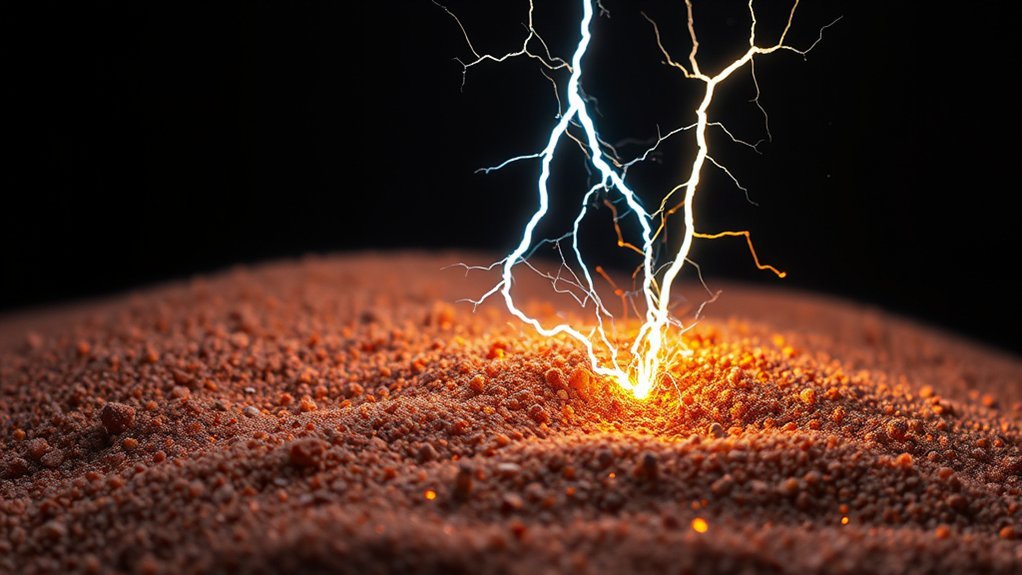
Although sand is primarily composed of silicon dioxide, its molecular structure responds uniquely when exposed to electricity. When you apply an electric current, the electric field influences the ionic bonds within the silicon dioxide lattice.
This interaction increases electricity induced friction at the molecular level, causing subtle shifts in the arrangement of ions. You’ll observe that this friction accelerates ionic weathering, breaking down the molecular structure more rapidly than natural processes.
As ions realign under electrical stress, the sand’s surface chemistry alters, making it more reactive. This molecular response is crucial for understanding how sand behaves under electrical influence, especially in industrial applications where electric fields are applied.
You should consider these effects when analyzing sand’s durability and transformation in electrically charged environments.
Why Electricity Makes Sand Spark and Heat Up
When you apply electricity to sand, its low electrical conductivity causes resistance that forces electrons to collide with particles. These collisions generate localized heat, raising the temperature rapidly.
As the energy builds, tiny sparks form where the current breaks through less conductive regions.
Electrical Conductivity of Sand
How does electricity cause sand to spark and heat up despite its granular, seemingly inert nature? The answer lies in sand chemistry and mineral conductivity. Sand primarily consists of silica (SiO₂), a poor conductor, but trace minerals like iron oxides can facilitate limited electrical flow.
When voltage is applied, electrons travel through conductive mineral pathways, causing localized sparks and heating due to resistance.
| Component | Conductivity Role |
|---|---|
| Silica (SiO₂) | Insulator |
| Iron Oxides | Moderate Conductor |
| Quartz Crystals | Low Conductor |
| Trace Minerals | Variable Conductivity |
| Moisture Content | Enhances Conductivity |
These mineral differences create conductive spots where electricity can jump gaps, sparking and heating the sand.
Heat Generation Mechanism
Why does sand spark and heat up under electrical current? It’s all about the intrinsic properties of sand formation and how energy transfer occurs within its structure. When electricity passes through sand, which is primarily silicon dioxide, it encounters resistance due to sand’s granular, non-uniform composition.
This resistance converts electrical energy into thermal energy, causing localized heating. Sparks occur when the electrical current jumps across gaps between sand particles.
Here’s the process in detail:
- Electrical current meets resistance within sand’s granular matrix.
- Energy transfer converts electrical energy into heat.
- Localized hot spots form due to uneven particle contact.
- Sparks emerge as current arcs across microscopic gaps in the sand.
This mechanism explains why sand heats and sparks under electrical influence.
How Electricity Transforms Sand Into Glassy Structures
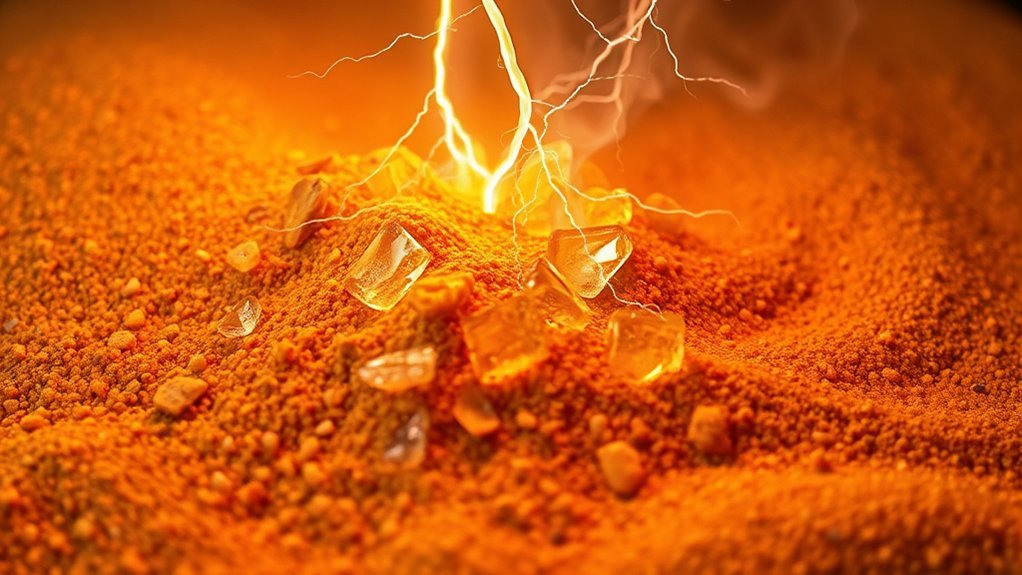
What happens to sand under an intense electrical current reveals a fascinating transformation at the molecular level. When you apply electricity, the energy rapidly heats the silica particles, disrupting their ordered crystalline lattice.
This interruption prevents traditional sand crystallization, instead causing the material to enter a molten state. As the current ceases and the temperature drops, the silica cools too quickly to reform its crystalline structure.
This rapid quenching leads to glass formation, a non-crystalline, amorphous solid. The resulting glassy structure exhibits distinct optical and mechanical properties compared to the original sand.
How Different Types of Sand React to Electricity
Different sand compositions respond uniquely when subjected to electrical currents due to variations in mineral content and particle size. Understanding these reactions requires analyzing sand formation and grain chemistry to anticipate conductivity and thermal response.
When you apply electricity to various sands, consider:
- Quartz-rich sands exhibit low conductivity but high thermal resistance, leading to localized melting.
- Feldspar-containing sands show moderate conductivity, facilitating partial sintering under current.
- Heavy mineral sands, rich in iron oxides, conduct electricity better, producing rapid heating and altered magnetic properties.
- Carbonaceous sands may ignite or decompose due to organic content, affecting electrical interaction.
Experiments Showing Electricity’s Impact on Sand
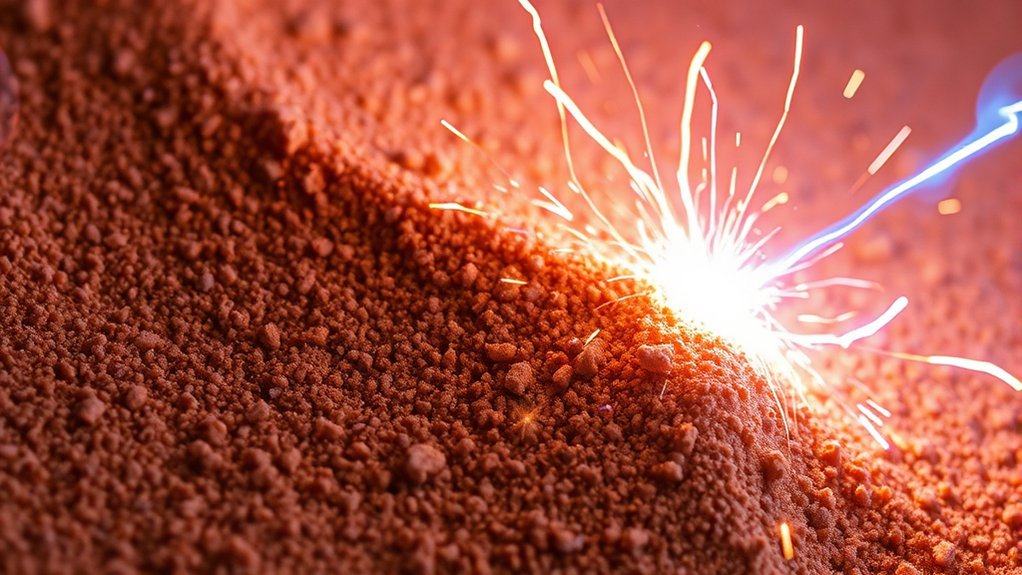
You’ll observe that when electricity passes through sand, its particles respond in measurable ways, such as shifting positions or changing temperature.
Experiments reveal how different current strengths and durations influence the sand’s conductivity and structural arrangement.
Electrical Effects On Sand
How exactly does electricity alter the physical properties of sand? When you apply a high-voltage electrical arc to sand, intense localized heat causes sand melting, transforming solid grains into molten glass-like structures. This process fundamentally changes sand’s texture and composition.
You can observe:
- Formation of fused glassy beads from melted silica particles.
- Rapid temperature spikes at the arc point, exceeding 1700°C.
- Structural rearrangement as crystalline sand converts to amorphous material.
- Generation of microfractures around the arc site due to thermal stress.
Sand Behavior Under Current
Building on the understanding of how high-voltage arcs transform sand’s structure, researchers have conducted controlled experiments to observe sand’s behavior under varying electrical currents.
You’ll notice that electrode design critically influences current pathways through the granular medium, affecting heating patterns and resultant morphological changes. For example, pointed electrodes concentrate current, creating narrow, deep pathways, while flat electrodes promote broader current distribution.
These variations alter melting zones and recrystallization in sand.
| Electrode Design | Current Pathway Effect |
|---|---|
| Pointed | Concentrated, narrow channels |
| Flat | Diffuse, widespread flow |
| Grid | Multiple parallel pathways |
Industrial Uses of Electricity-Treated Sand
Where does electricity-treated sand find its industrial value? When you apply electricity, microstructure shifts occur within sand grains, altering their mineralogical implications. This controlled transformation enhances sand’s properties for specific industrial applications. You’ll notice these uses:
- Glass Manufacturing – Improved purity and uniformity due to altered grain structures.
- Casting Molds – Enhanced refractoriness and thermal stability from mineralogical changes.
- Construction Materials – Increased bonding strength in concrete mixtures.
- Electronics – Tailored dielectric properties for semiconductor substrates.
Safety Tips for Electricity and Sand Experiments at Home
Why must you prioritize safety when experimenting with electricity and sand at home? Electricity can cause shocks or fires if mishandled, especially around conductive materials like wet sand.
Implementing strict safety precautions and proper equipment setup minimizes risks and ensures controlled results.
| Safety Aspect | Recommendation |
|---|---|
| Power Source | Use low-voltage, regulated supply |
| Protective Gear | Wear insulated gloves and goggles |
| Workspace | Keep area dry and clutter-free |
| Equipment Setup | Secure wires, avoid exposed connections |
| Supervision | Conduct experiments under adult watch |
Always verify your equipment setup before powering circuits. Avoid direct contact with energized parts and never leave experiments unattended.
Following these safety precautions protects you and your surroundings during electricity and sand experiments.
Future Possibilities for Changing Sand With Electricity
How can electricity revolutionize the way we manipulate sand in industrial and environmental applications? By harnessing controlled electric fields, you can induce sand metamorphosis similar to natural phenomena observed in electric storms. This approach opens pathways for innovative material synthesis and landscape engineering.
Controlled electric fields can transform sand, unlocking new possibilities in material synthesis and environmental design.
Consider these future possibilities:
- Precision glass manufacturing by electrically triggering localized melting and recrystallization of sand.
- Creating novel composite materials through electric field-driven alignment of sand particles.
- Environmental remediation by electrically stimulating sand to capture pollutants.
- Developing energy-efficient processes mimicking electric storm conditions to alter sand’s physical and chemical properties.
Frequently Asked Questions
Can Electricity Make Sand Explode?
Yes, you can make sand explode by creating an electric arc, which causes sand ignition. The intense heat from the arc rapidly vaporizes silica, producing a sudden expansion that results in an explosive reaction you can observe directly.
Does Electric Current Affect Sand Color Permanently?
You won’t see permanent sand color changes just from electric current alone, since sand’s electrical conductivity is low. However, high currents can heat sand, causing thermal effects that might alter color through mineral transformations.
Is It Safe to Touch Sand During a Lightning Storm?
You shouldn’t touch sand during a lightning storm because sand conductivity varies, potentially allowing current to pass through.
For lightning safety, avoid contact with any ground surface to reduce electric shock risk from nearby strikes or ground currents.
Can Electricity Purify Sand From Impurities?
You might think electricity’s a magical purification method for impurity removal in sand, but it’s not that simple. Electrical techniques can aid purification methods, yet they usually require precise control and aren’t standalone solutions for thorough impurity removal.
Does Wet Sand Conduct Electricity Better Than Dry Sand?
Yes, wet sand conducts electricity better than dry sand because water increases ion mobility, substantially enhancing conductivity. You’ll observe conductivity changes as moisture content rises, allowing electric current to pass more efficiently through the sand matrix.
Conclusion
You might find it fascinating that applying just a few thousand volts can instantly spark sand’s surface, generating temperatures above 1,700°C—hot enough to melt silica into glass. This shows how electricity doesn’t just heat sand; it fundamentally alters its molecular structure, enabling rapid glass formation.
Understanding these precise interactions helps you appreciate both the power and potential risks when experimenting with electricity and sand. It emphasizes the need for careful control in any practical or industrial application.
In conclusion, the effect of electricity on sand highlights its ability to transform the material at a molecular level, demonstrating the remarkable changes electricity can induce in sand.