You might think a belt sander is better than orbital sanders in every way, but the truth is, it depends on what you’re trying to achieve.
A belt sander excels at quickly removing large amounts of material on flat surfaces, yet it can be difficult to control and may damage edges.
On the other hand, an orbital sander offers smoother finishes and better precision but lacks the aggressive power of a belt sander.
Understanding these differences will help you choose the right tool for your project.
Which Sander Should You Use: Belt or Orbital?
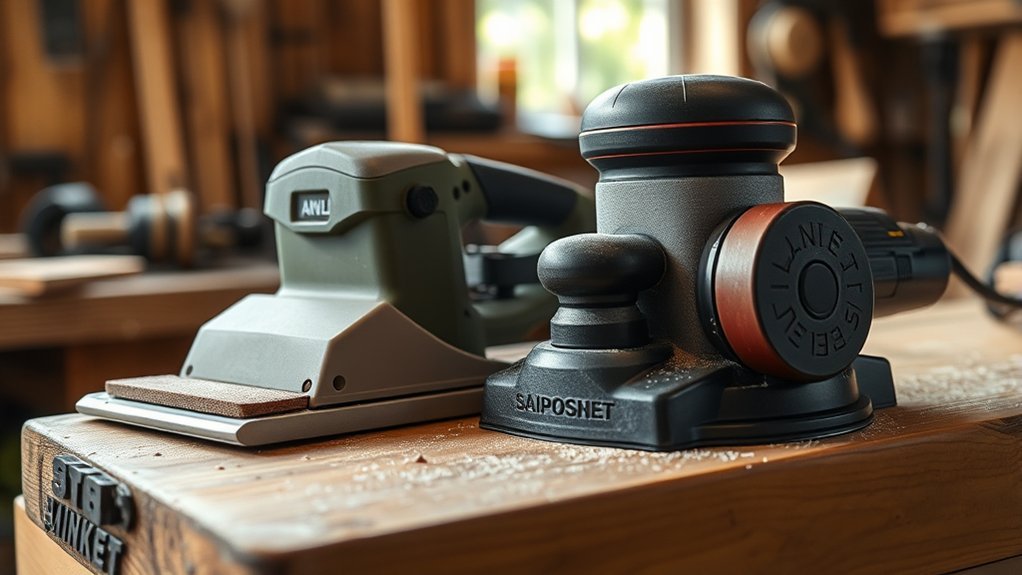
When deciding which sander to use, you’ll want to contemplate the specific demands of your project. Consider the contrast features between belt and orbital sanders: belt sanders deliver aggressive material removal with a continuous sanding belt, ideal for large, flat surfaces.
Orbital sanders, meanwhile, offer finer finishes through a circular, random motion that reduces visible scratches. Weight handling plays a pivotal role; belt sanders tend to be heavier and require more control to avoid gouging, while orbital sanders are lighter, making them easier for detailed or overhead work.
You should factor in surface type, desired finish, and your comfort managing the tool’s weight. Selecting the right sander hinges on balancing these contrast features and weight handling to optimize efficiency and finish quality.
How Belt and Orbital Sanders Work
Although belt and orbital sanders both smooth surfaces, they operate using distinct mechanisms that affect their performance and application. When you use a belt sander, you rely on a continuous loop of abrasive material moving rapidly in one direction, which demands regular belt maintenance to keep it aligned and effective.
Belt and orbital sanders smooth surfaces differently, with belt sanders needing regular maintenance for optimal performance.
In contrast, an orbital sander moves its pad in small, random orbits, reducing swirl marks and requiring precise orbital calibration for optimal results. Here’s what you need to know:
- Belt sanders apply aggressive, linear abrasion, great for fast material removal but need frequent belt adjustments.
- Orbital sanders use multi-directional motion, ideal for fine finishing and require careful calibration to avoid uneven sanding.
- Both tools depend on consistent maintenance routines to perform reliably and extend their lifespan.
When to Use Belt vs. Orbital Sanders
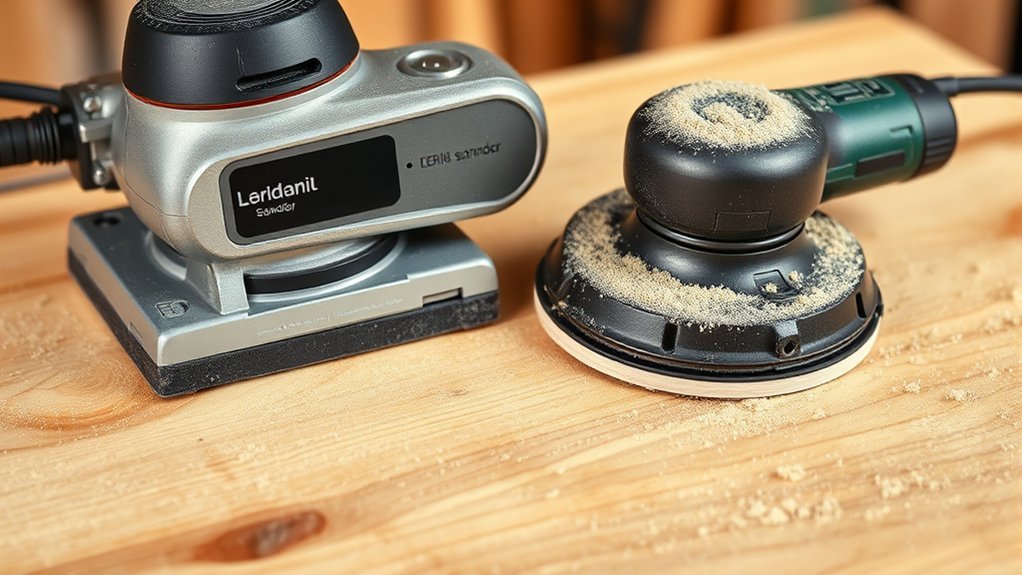
You’ll want to choose a belt sander for large, rough surfaces where aggressive material removal is needed, while an orbital sander suits smaller areas requiring finer finish quality.
Consider the project size carefully, as belt sanders cover more ground quickly but can be harder to control on detailed work. Understanding these differences ensures you pick the right tool for the surface type and finish you need.
Surface Type Suitability
Choosing the right sander depends largely on the type of surface you’re working with and the finish you want to achieve. A belt sander excels on tough, flat surfaces where you need rapid material removal or coarse finish. Conversely, an orbital sander is better suited for delicate surfaces or finishing tasks requiring smoothness without edge rounding.
Consider these factors:
- Hard, flat surfaces. Use a belt sander to quickly remove paint or smooth rough wood with minimal effort.
- Curved or intricate surfaces. An orbital sander prevents edge rounding and preserves contours.
- Softwoods or delicate veneers. Rely on an orbital sander to avoid gouges and maintain surface integrity.
Match your sander to the surface type to optimize efficiency and the quality of your finish.
Project Size Considerations
How do you decide which sander fits the scale of your project? For larger, more demanding tasks, a belt sander’s higher power draw and aggressive material removal make it ideal. It handles broad surfaces quickly, reducing labor time.
However, if you’re working on smaller or more detailed pieces, an orbital sander offers greater control and finesse without the risk of gouging. An edge case arises when you have a mid-sized project with tight corners; here, you might start with a belt sander for bulk removal, then switch to an orbital for refinement.
Finish Quality Differences
While project size and power guide your initial tool choice, the quality of the finish often determines which sander truly fits the task. A belt sander excels in rapid material removal but can leave a rougher surface, making it less ideal for fine finishing.
Conversely, orbital sanders provide smoother results due to their random orbit motion, minimizing swirl marks.
Consider these factors when deciding:
- Surface Smoothness: Use an orbital sander for final sanding to achieve a polished finish; belt sanders fit rough shaping.
- Edge Case Handling: Orbital sanders better navigate edges and contours without gouging, unlike belt sanders.
- Noise Levels: Belt sanders produce higher noise, which may affect your workspace environment during prolonged use.
Choose based on finish requirements, not just speed or power.
Speed and Power: Belt vs. Orbital Sanders
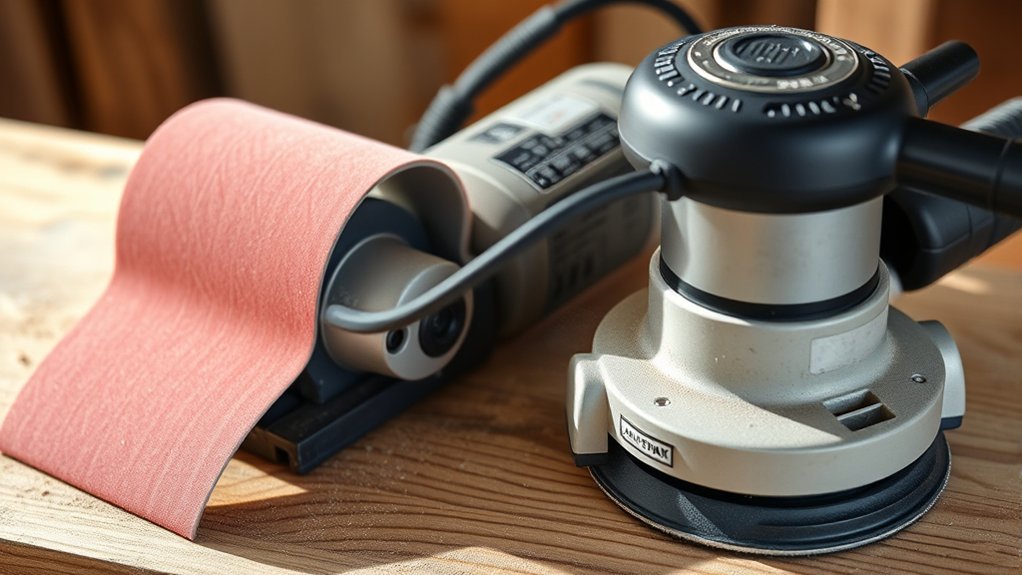
You’ll notice belt sanders pack more motor strength, delivering faster material removal compared to orbital sanders. While belt sanders operate at higher speeds, they also consume more power, which affects efficiency during extended use.
Understanding these differences helps you choose the right tool based on your project’s sanding speed and power requirements.
Motor Strength Comparison
What sets belt sanders and orbital sanders apart in motor performance is their fundamental design and intended application. When you compare motor strength, consider these technical points:
- Belt sanders typically feature more powerful motors, often exceeding 3 amps, which deliver consistent torque necessary for heavy-duty tasks. This enhances belt durability by reducing motor strain.
- Orbital sanders have smaller motors, usually around 2 amps, optimized for lighter work and smoother finishes. Their design minimizes orbital vibration, improving control and reducing operator fatigue.
- The continuous linear motion in belt sanders demands robust motor construction to maintain speed under load. Orbital sanders rely on oscillating motors that prioritize precision over raw power.
Understanding these distinctions helps you select the right tool for your project’s motor strength requirements without confusing sanding speed or finish quality.
Sanding Speed Differences
How fast your sander works depends largely on its design and intended use. Belt sanders operate with a continuous loop of abrasive material, delivering rapid material removal, especially on flat surfaces. This high sanding speed means you can tackle large areas quickly, but controlling edges requires careful gripmanship to avoid gouging.
Orbital sanders, meanwhile, move in small circular orbits, resulting in slower sanding but better finesse around edges. They generate less vibration and noise, which reduces user fatigue and improves precision.
When speed is your priority, a belt sander excels, but it demands steady control. If you prioritize detailed work with minimal vibration, an orbital sander’s slower speed is an advantage. Your choice hinges on balancing speed with control over edges and handling the associated vibration and noise levels.
Power Consumption Levels
When considering power consumption levels between belt and orbital sanders, it’s important to recognize how their speed and motor design impact energy use. Belt sanders typically draw more power due to their continuous, high-torque operation, while orbital sanders consume less because of their randomized orbital motion.
To optimize power and dust control, keep these factors in mind:
1. Motor Efficiency
Belt sanders use motors designed for sustained heavy use, which increases power consumption, whereas orbital sanders have motors optimized for intermittent, lighter work.
2. Speed Settings
Variable speed controls on both types allow you to adjust power draw, balancing performance and energy use.
3. Dust Collection
Effective dust collection systems reduce motor strain by preventing clogging, improving efficiency and prolonging tool life.
Understanding these elements helps you choose the right sander for your power and dust control needs.
Surface Smoothness: Belt vs. Orbital Sanders
Why does surface smoothness vary so much between belt and orbital sanders? It comes down to their abrasive action and how they handle edge wear and dust management. Belt sanders use a continuous loop of abrasive material, aggressively removing material but often leaving deeper scratches and uneven edges.
Orbital sanders move in a random orbit, minimizing edge wear and producing a finer finish with better dust extraction.
| Feature | Belt Sander | Orbital Sander |
|---|---|---|
| Abrasive Action | Linear, aggressive | Random orbit, gentle |
| Edge Wear | Higher, can cause gouging | Lower, smoother transitions |
| Dust Management | Bulkier dust collection, less efficient | Better dust extraction, cleaner workspace |
Choose based on the finish quality you need.
Which Sander Is Easier to Control: Belt or Orbital?
Controlling a sander effectively depends largely on its design and the force it requires during operation. When comparing belt control and orbital precision, consider these factors:
- Force and Stability: Belt sanders demand more downward pressure, which can challenge your grip and increase fatigue, making fine control trickier. Orbital sanders require less force, enhancing maneuverability.
- Motion Pattern: Belt sanders move linearly with aggressive abrasion, so maintaining a steady hand is essential to avoid gouges. Orbital sanders’ random orbital motion offers smoother control over delicate surfaces.
- Weight and Ergonomics: Belt sanders are generally heavier, impacting your ability to sustain precise movements. Orbital sanders’ lighter design supports better wrist control and accuracy.
Ultimately, orbital sanders provide easier control for detailed work, while belt sanders require more skill to manage their power and speed.
Cost and Maintenance: Belt vs. Orbital Sanders
How much you’ll spend and the effort needed to maintain your sander can considerably impact your overall project efficiency. In a cost comparison, belt sanders generally have a higher upfront price due to their powerful motors and durable belts. However, replacement belts are affordable and last longer if used correctly.
Orbital sanders, while cheaper initially, require frequent pad replacements and more regular cleaning to maintain performance, increasing maintenance frequency. Belt sanders demand routine checks for belt alignment and tension to avoid uneven sanding, while orbital sanders need consistent dust extraction system upkeep to prevent clogging.
Understanding these cost and maintenance factors helps you anticipate expenses and downtime, ensuring your sander stays reliable throughout your projects. You’ll find belt sanders require more technical upkeep but less frequent part replacement than orbitals.
Matching Your Project to the Right Sander
Choosing the right sander for your project depends on the material, surface area, and desired finish. You need to assess these factors carefully to optimize edge durability and ensure comfortable grip ergonomics during extended use. Here’s how to match your project:
Selecting the ideal sander hinges on material, surface size, and finish for durability and ergonomic comfort.
- Material Type: Use a belt sander for tough, hardwood surfaces needing rapid stock removal; orbital sanders suit softer woods or painted surfaces requiring a finer finish.
- Surface Area: For large flat areas, a belt sander offers speed and consistency. For intricate or curved surfaces, orbitals provide better control without gouging edges.
- Finish Quality: Choose orbital sanders when a smooth, swirl-free finish is critical. Belt sanders excel in initial rough sanding but can compromise edge integrity if overused.
Frequently Asked Questions
Can Belt or Orbital Sanders Be Used for Metal Surfaces?
You can use both belt and orbital sanders on metal surfaces, but you’ll need proper metal finish abrasives and reliable dust control to prevent clogging. This will guarantee smooth results without damaging your workpiece or surrounding environment.
Are There Safety Concerns Unique to Belt or Orbital Sanders?
You should always wear safety gear since belt sanders have a higher kickback risk due to their aggressive belt movement. Orbital sanders pose less risk but still require caution to avoid debris and dust inhalation during use.
What Types of Sandpaper Grit Work Best With Each Sander?
When you belt sand a rough wooden floor, start with 40-grit for fast material removal, then switch to 80-grit for smoothing.
Pair grit choices with strong dust extraction to keep your workspace clean and efficient.
Can These Sanders Be Used for Detailed Woodworking Projects?
You can use a belt sander for detailed woodworking, but its versatility suits rough shaping more. For fine, detailed work, an orbital sander excels, providing superior finish quality without gouging delicate surfaces.
How Do Noise Levels Compare Between Belt and Orbital Sanders?
When comparing noise levels, belt sanders roar like thunder, while orbital sanders hum softly. You’ll find better dust management in orbitals, making noise comparison and cleanup easier during detailed woodworking tasks.
Conclusion
You’ll want a belt sander when speed and aggressive material removal matter, especially on flat, hard surfaces. Use an orbital sander when precision, smoother finishes, and control around edges or curves are your priorities. You’ll appreciate the belt’s power but respect the orbital’s finesse.
For best results, combine both—start with the belt for bulk shaping, then switch to the orbital for fine finishing. Matching your tool to the task ensures efficiency, quality, and control.
In conclusion, understanding when a belt sander is better than orbital sanding can significantly improve your project outcomes. Choose wisely to get the best balance of power and precision.