If you’re wondering how to say hammer in Spanish, the word you’ll most often hear is martillo. It’s the standard term used across many Spanish-speaking countries, especially in everyday situations and when shopping for tools.
However, there are some regional variations and related terms you might want to know. Understanding these differences can help you communicate more clearly, whether you’re discussing simple repairs or more specialized tools.
What Is the Spanish Word for Hammer?
When you need to talk about a hammer in Spanish, the word you’ll use is “martillo.” This term is commonly understood across Spanish-speaking countries and refers specifically to the tool used for pounding nails or breaking objects.
If you’re navigating two word discussion ideas, like “hammer tools” or “tool types,” “martillo” fits perfectly as the precise term for hammer. Avoid mixing unrelated topics, such as discussing a hammer alongside unrelated words like “book” or “apple,” which can confuse your conversation or learning focus.
Sticking to clear, relevant vocabulary helps you build accurate language skills. Whether you’re learning Spanish for construction, DIY, or casual talk, knowing “martillo” ensures you communicate effectively and avoid misunderstandings.
Keep your discussions targeted to boost your confidence and fluency.
How to Pronounce “Hammer” in Spanish
Now that you know “martillo” is the Spanish word for hammer, you’ll want to pronounce it correctly to be understood. The hammer pronunciation in Spanish sounds like mar-TEE-yo, with the emphasis on the second syllable.
The double “ll” is pronounced like a soft “y” sound, similar to “yo” in English. To master this, listen carefully to native speakers and mimic their intonation.
Spanish listening tips include focusing on syllable stress and the subtle “ll” sound, which can vary by region but generally stays close to “y.” Practice by repeating the word slowly, then at normal speed.
Recording yourself and comparing it to native pronunciation can also help you adjust your accent for clarity. With consistent practice, your hammer pronunciation will improve quickly.
Using “Hammer” in Everyday Spanish
How often do you find yourself needing to talk about tools like a hammer in Spanish? Whether you’re discussing hammer usage with friends or browsing a hardware store, knowing the right terms helps.
When you go tool shopping, using clear vocabulary makes communication smoother and avoids confusion.
Here’s a quick reference for common hammer-related phrases:
| English Phrase | Spanish Translation |
|---|---|
| I need a hammer. | Necesito un martillo. |
| The hammer is heavy. | El martillo es pesado. |
| Where is the hammer? | ¿Dónde está el martillo? |
Spanish Phrases for Buying a Hammer
Where do you start if you need to buy a hammer in a Spanish-speaking store? Begin with basic hammer buying phrases like “¿Dónde puedo comprar un martillo?” (Where can I buy a hammer?) or “¿Tienen martillos aquí?” (Do you have hammers here?).
If you want a specific type, ask “¿Tienen martillos de carpintero?” (Do you have carpenter’s hammers?). You can also inquire about hammer related tools in Spanish, such as “clavos” (nails), “destornilladores” (screwdrivers), or “llaves inglesas” (wrenches).
Knowing these terms helps you navigate the store efficiently. Use phrases like “¿Cuánto cuesta este martillo?” (How much is this hammer?) to discuss price. These hammer buying phrases will make your shopping smoother and ensure you get exactly what you need in any Spanish-speaking hardware store.
Regional Variations of “Hammer” in Spanish-Speaking Countries
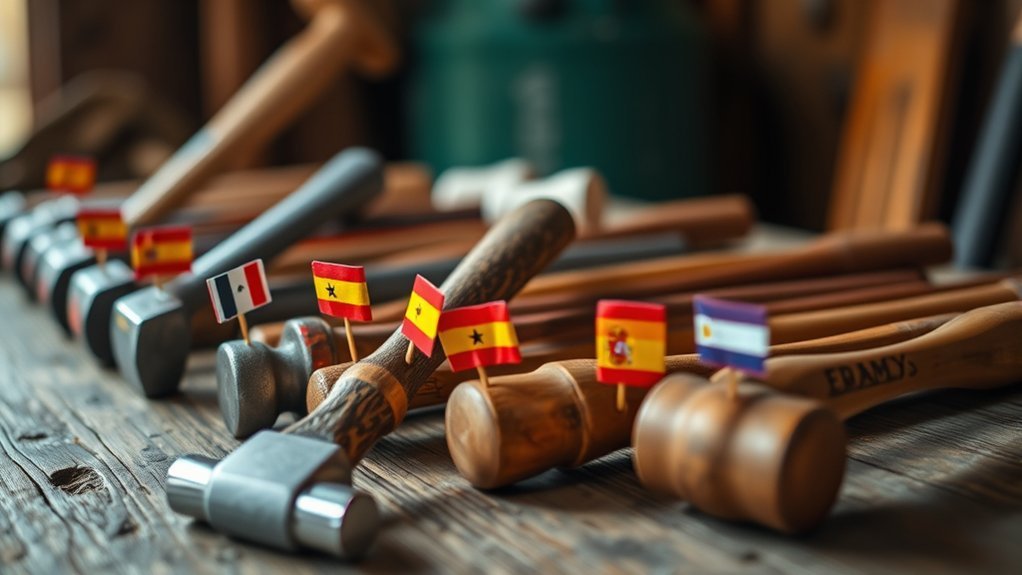
When you travel through different Spanish-speaking countries, you’ll notice that the word for “hammer” can vary regionally. Understanding these regional dialects helps you use the right tool acquisition phrases when shopping or asking for help.
Here are three common regional variations:
- Martillo – Widely used in Spain, Mexico, and much of Central America.
- Mazo – Common in parts of South America, like Argentina and Chile, often referring to larger hammers.
- Mazazo – Used colloquially in some Caribbean countries, sometimes meaning a heavy or blunt hammer.
Knowing these variations lets you communicate clearly and avoid confusion. When buying tools or discussing projects, adapting your language to local dialects shows respect and improves understanding.
Types of Hammers and Their Spanish Names
What kind of hammer do you need for your project? Different types of hammers serve various purposes, and knowing their Spanish names can help you communicate better.
Choosing the right hammer for your project is easier when you know their Spanish names.
For example, a claw hammer, called “martillo de uña,” is great for driving and removing nails. A sledgehammer, or “mazo,” delivers heavy blows for demolition. If you need precision, a ball-peen hammer, known as “martillo de bola,” works well for metalwork.
Each hammer shares basic hammer components: a handle (“mango”) and a head (“cabeza”). Some hammers have specialized heads for specific tasks, like the rubber mallet or “mazo de goma,” which prevents surface damage.
Understanding these types of hammers and their parts in Spanish ensures you pick the right tool and ask for it confidently.
Tools Related to the Hammer in Spanish
To work effectively with a hammer, you’ll often need related tools that complement its use. Understanding the tool taxonomy helps you grasp how these items work together, enhancing your hammer trivia knowledge.
Here are three essential tools related to the hammer in Spanish:
- Claw (uña) Often part of a claw hammer, used to remove nails.
- Nail (clavo) The small metal piece the hammer drives into surfaces.
- Chisel (cincel) Used alongside a hammer for cutting or shaping wood or stone.
Knowing these tools in Spanish not only broadens your vocabulary but also improves your practical understanding of how hammers fit into a larger toolkit. This foundation helps you communicate clearly about tools in Spanish-speaking contexts.
Common Mistakes When Saying “Hammer” in Spanish
You might mix up “hammer” with similar tools or use the wrong gender when speaking Spanish. It’s also common to overlook how different regions have unique words for the same tool.
Paying attention to these details will help you communicate clearly and avoid confusion.
Confusing Similar Tool Names
Why do so many learners confuse the words for hammer and other similar tools in Spanish? It often comes down to confusing tool names and pronunciation pitfalls. When you’re learning, it’s easy to mix up terms that sound alike or look similar in translation.
Here’s what trips you up the most:
- Martillo vs. Mazo Both mean “hammer,” but “martillo” is general, while “mazo” refers to a mallet or sledgehammer.
- Clavo vs. Cuña A “clavo” is a nail, not a tool, but beginners sometimes confuse it with wedge-shaped tools.
- Destornillador vs. Martillo “Destornillador” means screwdriver, which can be mistaken for a hammer due to similar usage contexts.
Understanding these distinctions helps you avoid common mistakes and speak more confidently.
Incorrect Gender Usage
Additionally, pronunciation pitfalls can make the word harder to recognize. Stress the second syllable: mar-TI-llo. Mispronouncing it can confuse listeners or make your speech less clear.
To avoid these errors, practice saying “el martillo” aloud, focusing on both the article and the pronunciation. This way, you’ll sound confident and accurate when referring to a hammer in Spanish.
Regional Vocabulary Differences
Mispronouncing “el martillo” isn’t the only challenge; different Spanish-speaking regions often use alternative words for “hammer.” If you’re not aware of these variations, you might confuse listeners or misunderstand others. To navigate regional slang and improve your hammer pronunciation, consider these common differences:
- In some parts of Mexico, people might say “mazo” instead of “martillo,” especially for larger hammers.
- In Argentina and Uruguay, “martillo” is standard, but “mango” can appear in slang contexts, though it usually means “handle.”
- In Spain, “martillo” is the norm, but be cautious—regional slang might vary, affecting hammer pronunciation.
Knowing these regional vocabulary differences ensures you communicate clearly and avoid common mistakes when saying “hammer” in Spanish.
Memory Tips to Learn “Hammer” in Spanish
How can you quickly remember the Spanish word for “hammer,” which is “martillo”? Use memory tips that link the word to familiar sounds or images. For example, break “martillo” into “mart” and “tillo.”
Picture a hammer striking a market stall (“mart”) to create a vivid mental image. This association helps cement the word in your mind.
For pronunciation tricks, note that “martillo” sounds like mar-TEE-yo. Emphasize the middle syllable “tee” and soften the “ll” into a “y” sound, as in “yo.”
Repeating this aloud while visualizing the image strengthens both recognition and pronunciation. By combining memory tips with pronunciation tricks, you’ll recall “martillo” faster and say it confidently when needed.
Frequently Asked Questions
What Is the Origin of the Spanish Word for Hammer?
You’ll find the origin of hammer in Spanish, “martillo,” traces back to Latin “martellus,” meaning a small hammer.
The etymology of martillo reflects this, linking it directly to ancient Roman tools and language roots.
Are There Idioms Involving “Hammer” in Spanish Literature?
Sure, Spanish speakers sprinkle sharp sayings with idioms with hammer, hitting home hard. You’ll find literary hammer usage emphasizing force or finality, like “dar en el clavo,” meaning to hit the nail on the head precisely.
How Do Children Learn the Word for Hammer in Spanish Schools?
You’ll see hammer pedagogy in action as teachers use hands-on activities and visuals for classroom acquisition.
Kids interact with real tools and vocabulary games, helping them naturally associate “martillo” with the hammer through engaging lessons.
Can “Hammer” Be Used Metaphorically in Spanish?
Yes, you can use “hammer” metaphorically in Spanish to emphasize force or impact, like a metaphorical hammer.
Just like a hammer in crafts drives nails, your words or actions can drive points home strongly.
What Are Popular Songs or Poems Featuring the Word Hammer in Spanish?
You’ll find “martillo,” the hammer in Spanish, featured in folk songs symbolizing strength.
Curiously, “martillo” derives from Latin “martellus.” Exploring lyrics like “El Martillo” reveals cultural depth tied to hammer origin in Spanish.
Conclusion
Now that you know “martillo” means hammer in Spanish, you can speak, shop, and work with confidence. You’ll pronounce it right, use it well, and recognize its variations. You’ll understand related tools, avoid common mistakes, and remember it easily.
Just as a hammer drives nails, your new word drives your Spanish forward. Keep practicing, keep learning, and keep building your skills—because every word, like every tool, shapes your success. Remember, “martillo” is your key to hammering down your Spanish skills.