Did you know that over 70% of sanding professionals prefer orbital sanders for finishing tasks due to their unique motion? An orbital sander does not simply spin like a typical drill. Instead, its pad moves in small, controlled orbits caused by an internal eccentric weight.
This subtle difference greatly impacts how the tool interacts with surfaces. It helps reduce heat buildup and minimizes swirl marks, resulting in a smoother finish. Understanding this motion can change how you approach smoothing your materials.
How an Orbital Sander Moves
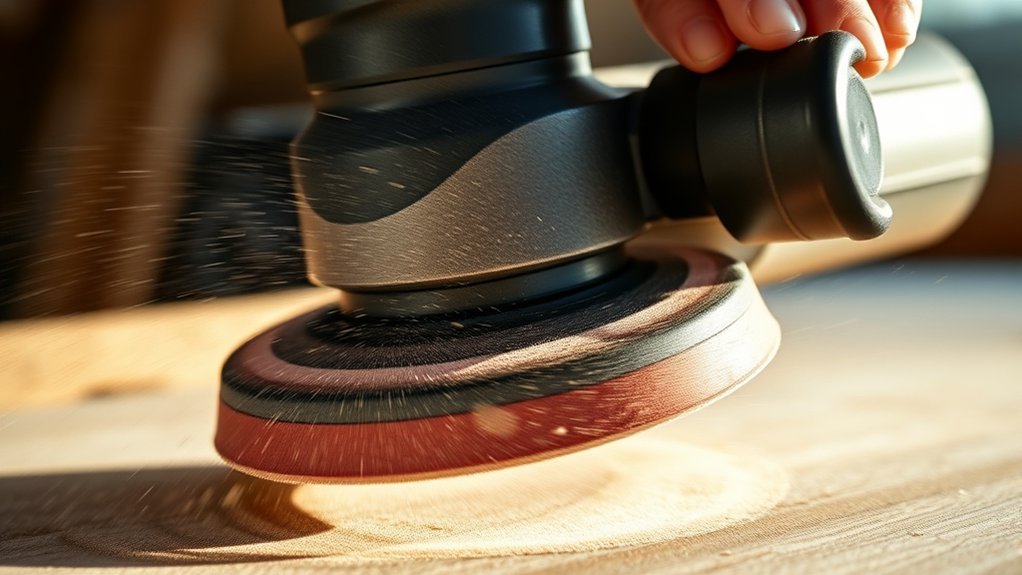
How exactly does an orbital sander move? When you operate one, the sanding pad follows a distinct orbital motion. This means the pad moves in small, rapid circles while simultaneously oscillating in a vibration pattern.
An orbital sander moves the pad in small, rapid circles while vibrating for smooth, swirl-free finishes.
The combination of these movements prevents the sander from leaving swirl marks on the surface. You’ll notice that the orbital motion is controlled by an eccentric weight attached to the motor shaft, which generates the characteristic vibration pattern.
This vibration pattern ensures consistent abrasion without aggressive spinning, enhancing surface smoothness. By understanding this motion, you can better appreciate how the tool balances efficient material removal with surface finish quality.
You’re essentially managing a complex interplay between controlled vibration and circular movements to achieve optimal sanding results.
Does an Orbital Sander Spin or Orbit?
When you use an orbital sander, does the sanding pad actually spin or just orbit? The answer lies in its distinct motion pattern. Unlike a traditional spinning sander that rotates the pad continuously around a fixed axis, an orbital sander’s pad moves in small circles or “orbits.”
This orbit vs spin distinction is crucial: the pad doesn’t rotate on its own axis but follows an elliptical or circular path. This motion pattern minimizes direct rotation, reducing the risk of visible swirl marks and uneven sanding.
Understanding this difference helps you select the right tool and technique for your project, ensuring efficient material removal without damaging the surface. So, an orbital sander orbits, it doesn’t spin, defining its unique sanding action.
Why Orbital Sanders Prevent Swirl Marks
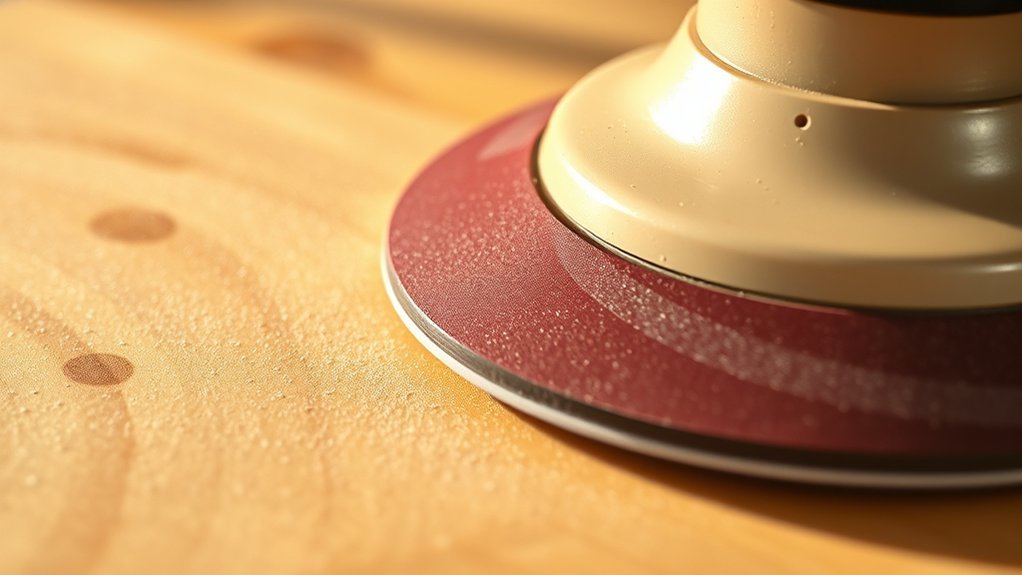
An orbital sander’s unique elliptical motion prevents swirl marks by distributing abrasive contact evenly across the surface. When you ask, “Does an orbital sander spin?” it’s important to understand that it doesn’t spin in a fixed circle but moves in small orbits. This motion is key to why orbital sanders prevent swirl marks. Here’s how:
- Randomized Abrasion: The elliptical path avoids repetitive patterns that cause visible swirls.
- Even Pressure Distribution: Contact is spread uniformly, reducing localized gouging.
- Reduced Heat Build-up: Less friction heat prevents surface burning and imperfections.
- Controlled Material Removal: The sander removes material gradually, minimizing surface distortion.
Orbital Sanders vs. Other Sander Types
Why choose an orbital sander over other types like belt or detail sanders? Unlike belt sanders that rely on continuous rotation and linear motion for aggressive material removal, the orbital sander utilizes a combination of rotation vs orbit, producing a random orbit behavior. This dual-action prevents repetitive sanding patterns, reducing visible swirl marks and yielding a finer sanding finish.
Detail sanders focus on tight corners but lack the broad, uniform coverage of an orbital sander. With its unique random orbit mechanism, the orbital sander balances speed and surface quality, making it ideal for both rough sanding and finishing.
When you prioritize a smooth, consistent finish without deep gouges, the orbital sander’s nuanced motion outperforms the straightforward spinning action of other sanders.
How to Use an Orbital Sander for a Smooth Finish
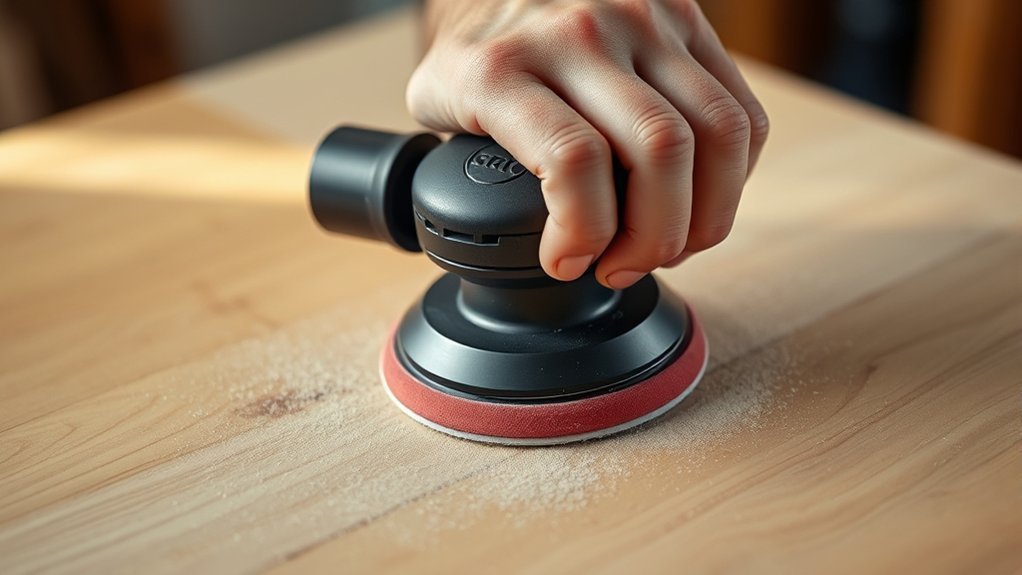
How do you achieve a smooth finish using an orbital sander? The key lies in proper surface prep and selecting the right grit for your sanding task. Follow these steps:
- Assess the surface condition to determine initial grit; coarse grits (60-80) remove material quickly, while finer grits (120-220) refine the finish. Understanding how to choose grit ensures efficiency.
- Clean and secure the workpiece to prevent movement during sanding.
- Start with a coarser grit to level imperfections, then gradually move to finer grits for smoothing.
- Maintain even pressure and keep the sander moving in overlapping, circular motions to avoid gouges and swirl marks.
Frequently Asked Questions
What Grit Sandpaper Is Best for an Orbital Sander?
You’ll want to choose grit compatibility carefully for your orbital sander: start with 80-120 grit for rough sanding, then move to 180-220 grit for finishing.
This ensures ideal material removal and smooth surface preparation.
Can an Orbital Sander Be Used on Metal Surfaces?
Sure, you can use an orbital sander on metal if you want sparks flying like a disco party. Just prioritize orbital sander safety and choose proper grit.
Metal sanding viability depends on technique and abrasive type.
How Do I Maintain and Clean My Orbital Sander?
You should perform regular orbital sander maintenance by cleaning dust from vents and pads using compressed air. Apply proper cleaning techniques like wiping with a damp cloth to prevent buildup and ensure optimal performance and longevity.
Are Orbital Sanders Safe for Beginners to Use?
Yes, orbital sanders are beginner friendly safety-wise due to their controlled, random orbital motion reducing gouging risks. You’ll also appreciate built-in dust management systems, which enhance visibility and minimize inhalation hazards during operation.
What Is the Average Lifespan of an Orbital Sander?
Imagine Sara refinishing furniture yearly; her orbital sander’s lifespan estimates reach 5-7 years with regular use. You’ll extend yours by following maintenance tips like cleaning dust ports and replacing worn pads promptly for peak performance.
Conclusion
Now that you know an orbital sander doesn’t spin but moves in tiny orbits, you can appreciate its precision. Studies show this orbiting action reduces swirl marks by up to 80% compared to rotary sanders. By evenly distributing abrasion and minimizing heat buildup, it delivers a smoother finish with less effort.
When you use an orbital sander correctly, you’ll get professional-level results without the visible patterns typical of spinning tools. Understanding that an orbital sander doesn’t spin helps you choose the right tool for a flawless finish every time.