You might recall the phrase “hard as a diamond,” but can you break a diamond with a hammer? Hardness doesn’t guarantee unbreakability.
When you strike a diamond with a hammer, its remarkable hardness resists scratches. Yet, its crystal structure makes it surprisingly brittle along certain planes.
Understanding this paradox calls for a closer look at how and why diamonds respond to force—something you’ll want to contemplate before assuming they’re indestructible.
Can You Really Break a Diamond With a Hammer?
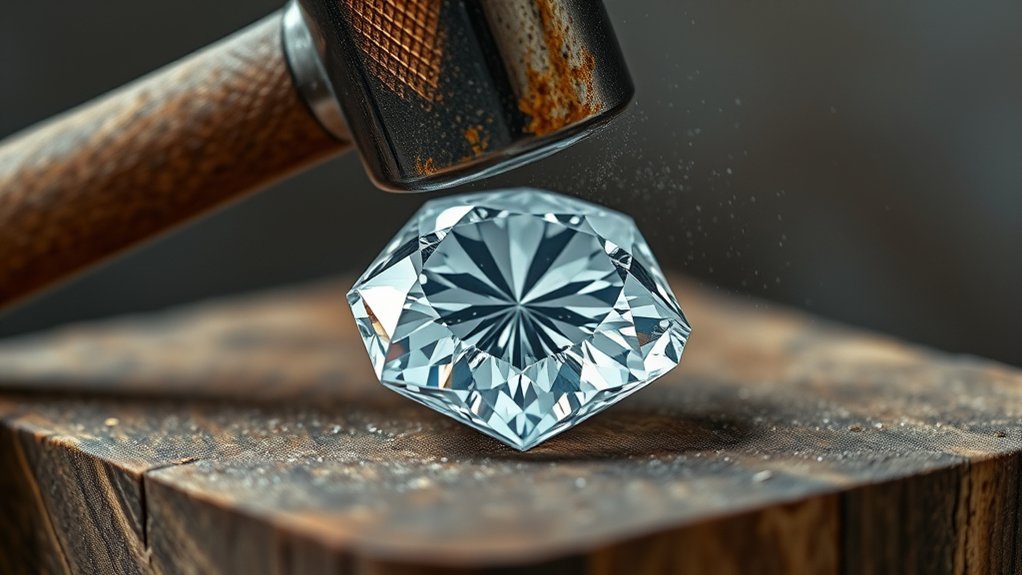
How resistant is a diamond when struck by a hammer? You might believe the fragile myth that diamonds are unbreakable, but the hammer reality tells a different story. Diamonds possess exceptional hardness, resisting surface scratches, but their crystal structure includes cleavage planes—natural weaknesses.
When you apply a sharp, forceful strike with a hammer along these planes, the diamond can fracture or split. This means that while diamonds resist abrasion, they are not impervious to mechanical shock.
If you hit a diamond without precision, it might withstand the blow, but a well-aimed strike exploiting cleavage directions can break it. So, the fragile myth of indestructibility contrasts with the hammer reality: diamonds can indeed be broken under specific conditions and impact forces.
What Does It Mean That Diamonds Are the Hardest Material?
Despite their vulnerability to targeted impacts, diamonds are renowned for their exceptional hardness. This property defines their resistance to surface scratches and abrasion. Hardness measures how well a material withstands deformation, not its ability to resist fracture.
When you consider fracture mechanics, diamonds can still break under specific environmental conditions that exploit their cleavage planes.
| Property | Description |
|---|---|
| Hardness | Resistance to scratching/abrasion |
| Fracture Toughness | Resistance to crack propagation |
| Cleavage Planes | Atomic planes where breakage occurs |
| Environment Conditions | Temperature, pressure affecting durability |
| Surface Integrity | Maintains smooth, scratch-free surface |
Understanding hardness helps you realize why diamonds resist scratches but aren’t impervious to breaking under focused force or adverse conditions.
Diamond Hardness vs. Toughness Explained
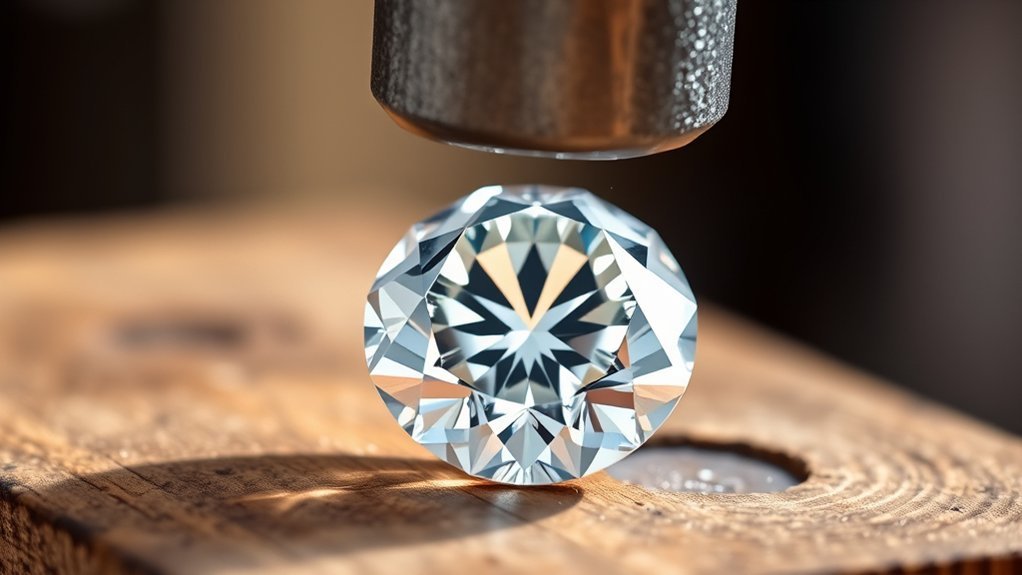
You might assume diamond’s hardness makes it unbreakable, but hardness and toughness measure different properties. Hardness gauges resistance to surface scratching, while toughness evaluates a material’s ability to absorb energy and resist fracture.
Understanding these distinctions helps explain why a diamond can be scratched only with another diamond yet still shatter under impact.
Hardness Definition And Measurement
Why does diamond stand out as the hardest known natural material? Hardness measures a material’s resistance to deformation, typically quantified by indentation tests. When you assess hardness, you’re evaluating how well a surface withstands scratching or penetration.
For diamonds, the Mohs scale rates them at the maximum hardness of 10, meaning no other natural material can scratch them. This example topic, hardness, differs from an unrelated concept like toughness, which involves resistance to fracture.
You measure hardness using instruments like the Knoop or Vickers hardness testers, which apply controlled force via diamond tips and assess indentations. Understanding hardness precisely helps you grasp why diamonds resist surface damage but doesn’t inform you about their behavior under impact or stress, which toughness would address.
Toughness And Impact Resistance
Hardness indicates a material’s surface resistance to scratching, but it doesn’t predict how the material behaves under sudden forces or impacts. When you consider toughness and impact resistance, diamond presents a unique case.
Despite being the hardest known natural material, diamond has relatively low toughness. This means it resists surface abrasion excellently but can fracture or cleave under sharp impacts.
In a toughness comparison with other materials, metals typically exhibit higher toughness and impact resistance due to their ability to deform plastically, absorbing energy before fracturing. Diamond’s atomic structure lacks this plasticity, making it brittle.
Why Diamond’s Crystal Structure Makes It Fragile
You need to understand that diamond’s atomic arrangement forms a rigid lattice with specific cleavage planes. These planes create natural weaknesses where the crystal can split under stress.
When you strike a diamond with a hammer, the force can exploit these cleavage planes, making the stone fragile despite its hardness.
Diamond Atomic Arrangement
How does the atomic arrangement of a diamond influence its susceptibility to breaking? Diamond’s atoms form a rigid, three-dimensional tetrahedral lattice, where each carbon atom bonds covalently to four others. This creates an incredibly strong network, but it’s also highly directional.
When you strike a diamond, the force concentrates along specific atomic planes, making the lattice vulnerable. Unlike a two word discussion ideas or unrelated topic, this precise bonding pattern determines how stress distributes within the crystal. If enough energy surpasses the bond strength along these planes, the lattice fractures.
Cleavage Planes Impact
Why does a diamond, known for its hardness, still fracture under certain impacts? Hardness misconceptions often confuse hardness with impact resistance. Diamond’s crystal structure features specific cleavage planes, planes of atomic weakness where bonds break more easily. When you strike a diamond along these planes, it can cleave, despite its overall hardness.
| Property | Explanation |
|---|---|
| Hardness | Resistance to scratching |
| Impact Resistance | Ability to absorb force without fracturing |
| Cleavage Planes | Directions with weaker atomic bonds |
| Fracture Behavior | Crack propagation along cleavage planes |
Understanding these distinctions clarifies why diamonds, though extremely hard, aren’t impervious to chipping or breaking under sharp, targeted impacts.
How Diamonds React When Struck By a Hammer
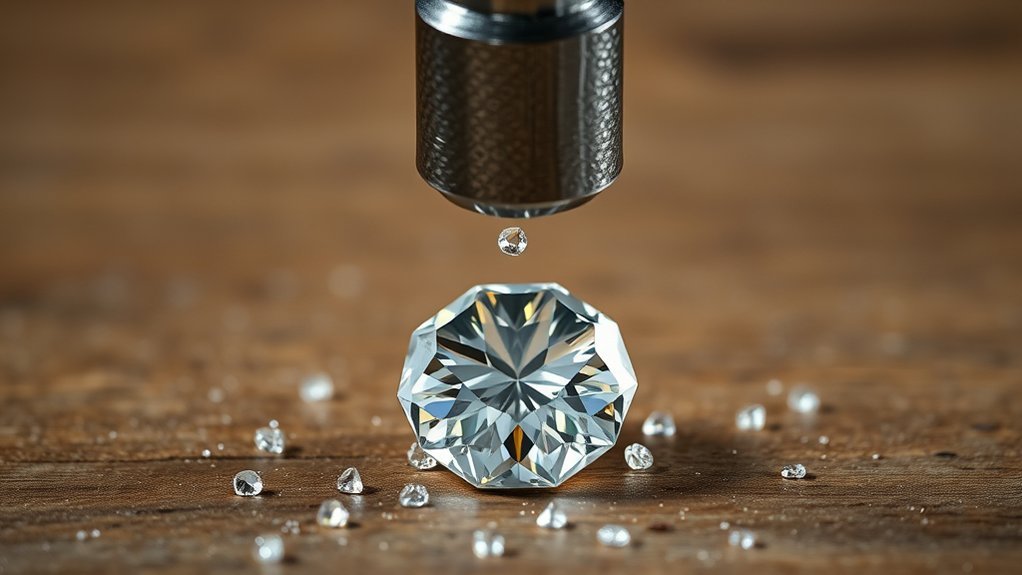
What happens to a diamond when it’s struck by a hammer depends on the force and angle of impact. You’ll find that diamonds, despite their hardness, have cleavage planes that can cause them to fracture sharply under targeted blows.
The reaction varies based on whether the diamond is natural or lab grown; lab grown diamonds often exhibit subtle differences in internal structure, influencing their fracture patterns. When applying cutting methods, professionals exploit these planes to split diamonds precisely.
If you strike a diamond at an angle aligned with its cleavage plane, it’s more likely to cleave or shatter. Conversely, impacts at other angles may only cause surface chipping or minor damage. Understanding these variables helps you predict how a diamond will respond to mechanical stress like hammer strikes.
Real-Life Examples of Diamonds Breaking Under Impact
You’ve likely heard about famous diamonds shattering under unexpected impacts, proving their vulnerability despite extreme hardness. These incidents reveal how specific impact forces can exceed a diamond’s structural limits, causing fractures.
Let’s examine key cases to understand the mechanics behind diamond breakage.
Famous Diamond Breakage Incidents
How often do diamonds actually break under impact? Contrary to dangerous myths and everyday myths, diamonds do fracture, but incidents are rare and usually involve extreme conditions.
For example, the famous Koh-i-Noor diamond reportedly cracked during a recutting process, illustrating how internal flaws and improper handling can lead to breakage. Similarly, the Hope Diamond showed minor fractures after a significant impact, highlighting that even flawless-cut stones harbor vulnerabilities.
These well-documented cases demonstrate that diamonds are not invincible; their crystalline lattice structure, while exceptionally hard, is anisotropic and can cleave along specific planes. So when you consider diamond breakage, remember these incidents underscore the critical role of impact angle and force, rather than supporting the myth that diamonds shatter easily like glass.
Impact Forces On Diamonds
While diamonds exhibit remarkable hardness, their ability to resist impact depends heavily on the direction and magnitude of the force applied. When subjected to high impact forces aligned with specific crystallographic planes, known as diamond cleavage planes, the crystal lattice can split sharply.
In real-life scenarios, strong blows from tools like hammers can exploit these cleavage planes, causing the diamond to fracture or cleave. For example, gem cutters intentionally apply precise impact forces along cleavage directions to split rough diamonds.
Conversely, random or off-axis impacts may cause surface chipping or internal cracks rather than complete breakage. Understanding how impact forces interact with diamond cleavage helps explain why, despite their hardness, diamonds can break under targeted mechanical stress. You must consider both force magnitude and orientation to assess diamond durability accurately.
Do Synthetic Diamonds Break More Easily Than Natural Ones?
Do synthetic diamonds exhibit different breakage characteristics compared to natural ones? The answer lies in their atomic structure, which is virtually identical. Claims suggesting synthetic diamonds break more easily are based on irrelevant theory or fictional myths rather than empirical evidence.
Both types share a hardness of 10 on the Mohs scale and similar cleavage planes.
When assessing breakage resistance, consider these factors:
- Crystal purity and internal stresses
- Presence of inclusions or microfractures
- Growth method (HPHT vs. CVD) and resulting structural defects
- External impact angle and force magnitude
Ultimately, synthetic diamonds do not inherently break more easily than natural ones. Their fracture susceptibility depends primarily on internal flaws and external conditions, not their origin.
Tools That Can Cut or Break Diamonds: And How They Work
Which tools possess the capability to cut or break diamonds, and what mechanisms enable their effectiveness? Diamond cutting primarily employs diamond-tipped saws and lasers. Diamond saws exploit the hardness of diamond by using a blade embedded with tiny diamond particles, inducing controlled fractures along cleavage planes.
Lasers utilize concentrated energy, creating tiny vibrations at a molecular level that disrupt the crystal lattice, enabling precise cuts without physical contact. Mechanical tools like hammers can break diamonds only when applied with force aligned to these cleavage planes, exploiting inherent structural weaknesses.
Understanding market ethics is crucial here; improper or careless cutting damages value and misrepresents quality. You must handle these tools with precision and respect for the diamond’s internal structure to maintain integrity and ethical standards in the gemstone market.
How Jewelers Protect Diamonds in Jewelry Settings
How exactly do jewelers guarantee that diamonds remain secure and undamaged once set into jewelry? They must counteract the risk posed by fragile facets and the potential for brittle disorientation under stress. To achieve this, they employ carefully designed techniques:
- Use protective settings like bezel or halo to shield vulnerable edges.
- Apply precise pressure when securing prongs, avoiding stress concentrations.
- Position diamonds to minimize impact on brittle disorientation planes.
- Select metal types with appropriate hardness to absorb shocks without transferring force to the stone.
How to Handle Diamonds to Avoid Damage
Jewelers employ specific techniques to protect diamonds once set, but damage can also occur during handling before setting. You must handle diamonds with precision, avoiding impacts or sharp blows that exploit cleavage planes.
Always use clean, soft tools and avoid gripping diamonds with excessive force. Store diamonds separately to prevent abrasion. When transporting, secure them in padded containers to minimize vibrations and shocks.
Stay focused on diamond-specific protocols; introducing unrelated topics like general gemstone care dilutes your attention and risks mishandling. In two word discussion ideas, emphasize “impact resistance” and “cleavage vulnerability” to highlight key handling concerns.
Frequently Asked Questions
How Are Diamonds Formed Deep Within the Earth?
You’ll understand diamonds form through deep origin mantle processes, where intense heat and pressure convert carbon into crystalline structures.
This transformation occurs over millions of years, deep within Earth’s mantle before volcanic eruptions bring them closer to surface.
What Are the Different Types of Diamonds?
You’ll find natural diamonds formed geologically, while synthetic diamonds are created via diamond synthesis methods like HPHT or CVD.
Understanding synthetic vs natural distinctions is crucial for assessing authenticity, quality, and application suitability in various industries.
How Does Diamond Grading Affect Its Value?
Over 80% of diamonds lose value from poor grading. You’ll see diamond grading directly impacts value by evaluating clarity, cut, and color.
These factors are shaped by deep formation, mining history, diamond types, and industrial uses influencing market demand.
Can Diamonds Be Used for Industrial Purposes?
Yes, diamonds can be used for industrial purposes due to their exceptional hardness and thermal conductivity.
You’ll find them in cutting, grinding, drilling tools, and abrasives, enhancing efficiency and precision in manufacturing and construction applications.
What Is the History of Diamond Mining?
You’ll uncover diamond mining’s unrelated history rooted in speculative mining methods, evolving from chance discoveries to precise geological techniques.
Analytical advancements transformed rough searches into targeted excavations, enhancing yield and shaping modern extraction’s scientific rigor and efficiency.
Conclusion
You might imagine a diamond shattering like glass under a hammer’s strike, but the reality is more complex. While diamonds resist scratches due to their hardness, their brittleness and cleavage planes mean a well-placed, precise blow can indeed break them.
However, random hammer strikes usually cause only minor damage. Understanding this delicate balance between hardness and fragility helps you appreciate why breaking a diamond requires skill, not just brute force.
In conclusion, breaking a diamond with a hammer is possible, but it demands precision rather than sheer strength.