You might recall Heraclitus’ assertion that you never step into the same river twice—similarly, a handful of sand embodies constant flux within seeming permanence. This handful of sand reveals the delicate balance between change and stability.
Each grain slips through your fingers, illustrating entropy’s quiet persistence and the limits of control. This simple gesture prompts reflection on how time, memory, and identity transform.
What deeper insights emerge when we consider sand beyond mere particles? A handful of sand invites us to explore the transient nature of existence and the subtle shifts that shape our lives.
The Symbolism of a Handful of Sand in Life
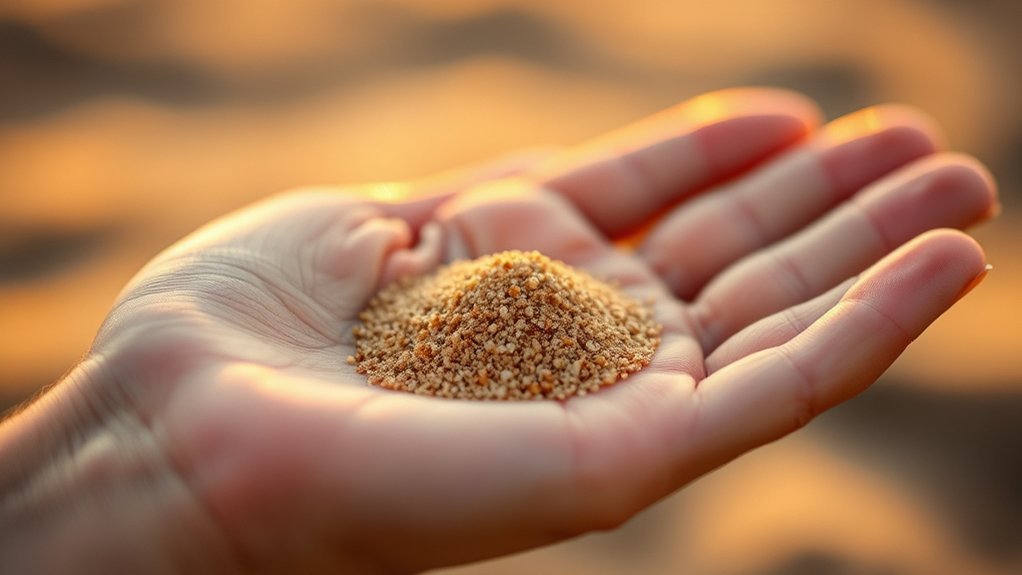
A handful of sand often symbolizes the transient nature of time and control in life. When you grasp sand, it slips through your fingers despite your efforts, illustrating how control is inherently limited. This physical reality shapes your change perception, revealing how moments and experiences resist permanent capture.
Additionally, the grains’ continuous motion parallels memory erosion, where details fade or distort over time, undermining your grasp on past events. You recognize that just as sand’s fine particles scatter, memories fragment and dissipate, emphasizing impermanence within cognition.
This symbolism prompts a reevaluation of how you process time and experience, highlighting the fragile boundaries between retention and loss. Ultimately, understanding this metaphor sharpens your awareness of life’s fleeting nature and the limits of control you possess.
How Sand Represents Change and Impermanence
Recognizing how sand slips through your fingers despite your effort naturally leads to understanding its role in symbolizing change and impermanence. Sand’s granular nature exemplifies transience and resilience simultaneously, reflecting how individual grains endure yet constantly shift.
Sand slipping through fingers reveals its essence: enduring yet ever-changing, embodying both transience and resilience.
You observe entropy in the disordered flow of sand particles, symbolizing inevitable decay and transformation. Yet, renewal emerges as sand reorganizes into new formations.
Consider these points:
- Sand’s constant movement illustrates the fluidity of existence and the impermanence of structures.
- The interaction of grains demonstrates resilience through adaptability amid continuous change.
- Sand exemplifies entropy driving decay, but also the cyclical renewal inherent in natural systems.
Cultural Interpretations of the Handful of Sand
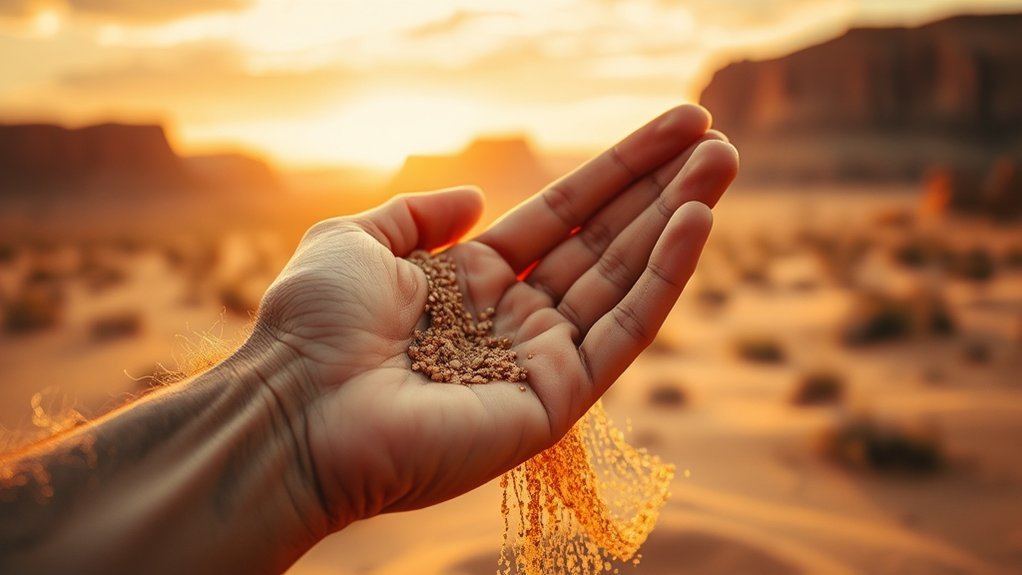
How do different cultures interpret the symbolism of a handful of sand? You’ll find that cultural rituals often employ sand to signify transition, endurance, or spirituality.
In many desert societies, a handful of sand represents the intimate connection between humans and the harsh environment, emphasizing survival and resilience. Desert symbolism also extends to notions of time’s passage and the fragility of life, where sand grains function as discrete units marking existence.
When you analyze rituals from Indigenous Australian ceremonies to Middle Eastern traditions, sand’s granular quality embodies both unity and fragmentation, illustrating collective memory and individual experience.
How Literature Uses Sand to Reflect Time and Memory
When authors incorporate sand into their narratives, they often leverage its granular nature to symbolize the passage of time and the persistence of memory. You’ll notice that sand’s physical properties enable a nuanced exploration of time, memory, and perception decay.
Specifically, sand embodies:
1. Time’s Fragmentation
Each grain represents discrete moments, emphasizing time’s segmented flow rather than continuity.
2. Memory’s Impermanence
Like shifting sand, memories alter with selective retention and erosion.
3. Perception Decay
The gradual loss of detail in sand parallels how human perception of past events fades or distorts.
What Sand Teaches Us About Letting Go
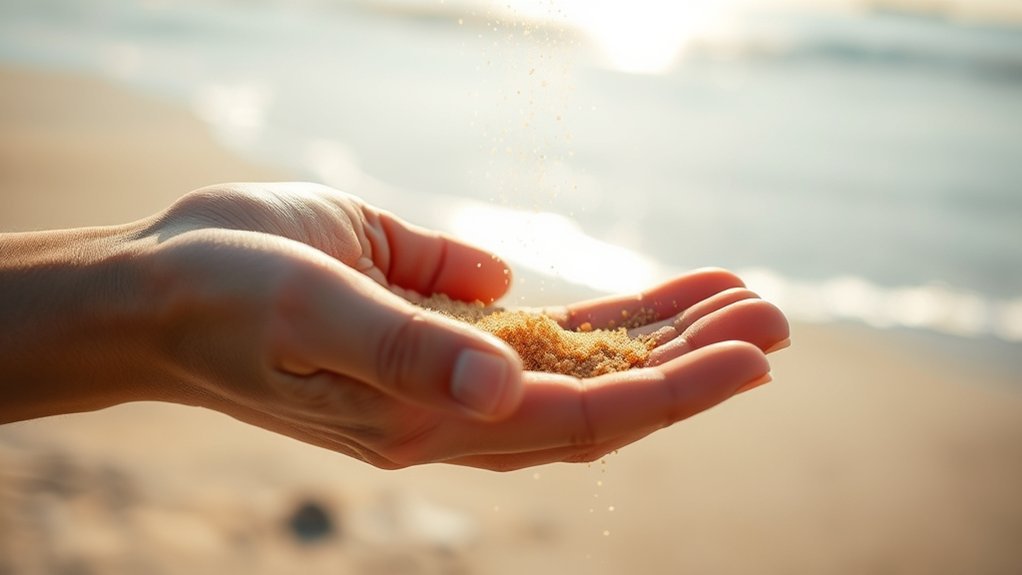
The shifting nature of sand not only mirrors memory’s impermanence but also offers insight into the process of letting go. When you grasp a handful of sand, you recognize its transient cohesion. Individual grains slip through your fingers despite your effort to hold on.
This physical reality aligns with letting go ideas, emphasizing acceptance of change rather than resistance. Sand’s constant movement illustrates impermanence reflections, reminding you that attachment to fixed states is futile.
By observing sand, you learn to release control, embracing flux as natural. This analytical perspective aids in understanding emotional detachment and cognitive flexibility, essential in psychological resilience.
Ultimately, sand teaches you that letting go is an active process grounded in acknowledging impermanence, facilitating adaptive responses rather than clinging to static experiences.
Frequently Asked Questions
Where Can I Find a Handful of Sand Sculpture?
You can find sand sculptures at specialized galleries and coastal locations known for sand art.
Major sand sculpture events, like the World Sand Sculpting Championship, also showcase intricate works. Check event schedules and gallery listings for precise locations.
How Is Sand Physically Composed and Formed?
You’ll find sand’s composition mainly quartz, with grains formed by rock weathering. Mineral variability affects grain size and shape, influencing aesthetics versus durability.
Selecting sand depends on balancing visual appeal and structural strength for your project.
What Are the Environmental Impacts of Sand Mining?
When you see the disappearing beaches of Mumbai, you realize sand mining consequences include habitat destruction and groundwater depletion. These environmental impacts disrupt ecosystems and increase erosion, forcing you to reconsider unsustainable extraction methods affecting biodiversity and local communities.
Can Sand Be Used in Modern Technology?
You can use sand in modern technology, especially in electronics and construction. Its sand applications extend to nanotechnology implications, where silica nanoparticles enhance device efficiency, demonstrating sand’s essential role in advancing innovative technological solutions.
How Do Different Beaches’ Sands Vary in Color?
You’ll find that sand color variation softly whispers tales of mineral composition, where quartz, feldspar, or volcanic fragments gently shape each beach’s unique palette. These subtle differences reveal precise geological histories beneath your feet.
Conclusion
As you hold a handful of sand, feel each grain slip through your fingers—an unyielding reminder of time’s relentless flow and your limited grasp on permanence. This granular cascade mirrors memory’s fade and reshaping, urging you to embrace change with cognitive flexibility.
In releasing your tight hold, you cultivate resilience, witnessing renewal within fragmentation. Sand’s silent lesson compels you to accept impermanence, transforming loss into insightful adaptation rather than futile control.
Ultimately, the handful of sand teaches us that true strength lies in letting go, allowing life’s shifts to guide growth and understanding.