You might assume Thor’s hammer, Mjölnir, has a fixed weight like any physical object, but its mass defies simple measurement. Rooted in mythology and adapted through comics and film, its heft shifts with worthiness and enchantment, challenging conventional physics.
To understand Mjölnir’s true weight, you need to analyze mythic descriptions, fictional portrayals, and theoretical models—each offering a different perspective on what it means for a hammer to be “heavy.” This complexity makes the question of how much Thor’s hammer weighs a fascinating topic beyond mere numbers.
What Norse Mythology Says About Mjölnir’s Weight
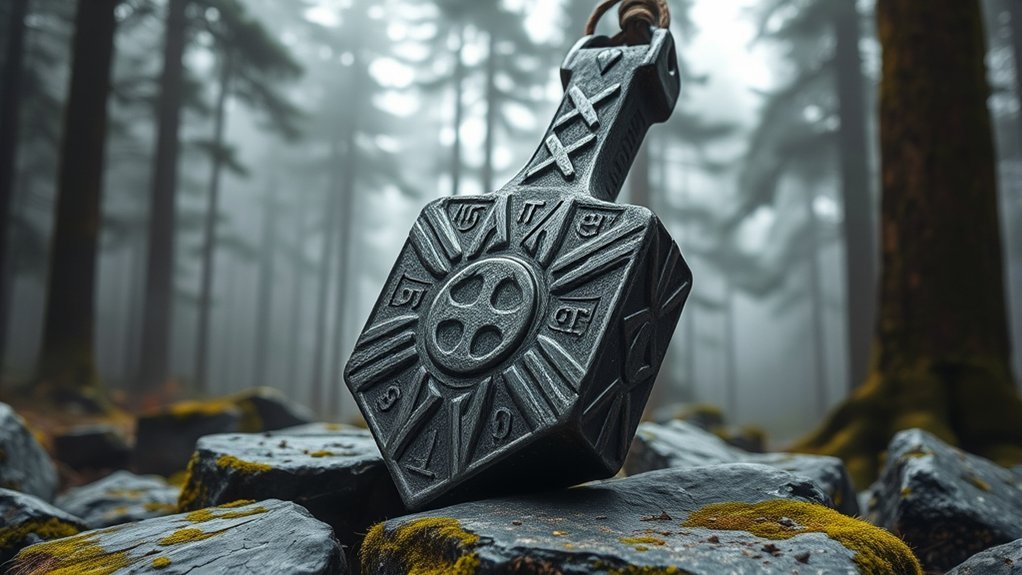
How heavy is Mjölnir according to Norse mythology? The original texts don’t specify an exact weight; instead, the hammer’s significance lies in its mythic symbolism as a divine weapon forged by dwarven smiths.
You’ll find that Mjölnir’s power is rooted more in its magical properties, such as always returning to Thor’s hand, than in physical mass. This absence of detail contrasts with modern interpretations, where weight is often a focal point.
When analyzing mythic symbolism, you understand that Mjölnir represents strength, protection, and consecration, not a measurable object. You should also note that comic inconsistencies often arise from attempts to quantify the hammer’s weight, deviating from its original portrayal as a symbol rather than a literal, weighted tool.
How Comics and Movies Portray Mjölnir’s Weight
Why does the weight of Mjölnir vary so much across comics and movies? The answer lies in mythic physics and narrative symbolism. Creators adjust Mjölnir’s weight to serve plot needs, emphasizing worthiness over raw mass.
This flexibility challenges real-world physics but enhances storytelling impact.
| Medium | Portrayal of Weight | Purpose |
|---|---|---|
| Marvel Comics | Extremely heavy | Symbolizes worthiness and power |
| MCU Films | Variably heavy | Enhances dramatic effect |
| Animated Series | Light to medium | Allows dynamic action scenes |
| Video Games | Adjustable | Balances gameplay mechanics |
| Graphic Novels | Consistent heavy | Reflects mythic authenticity |
You’ll notice mythic physics bend to narrative symbolism, showing Mjölnir’s weight as a storytelling tool rather than a fixed physical attribute.
Estimating Mjölnir’s Weight From Its Description
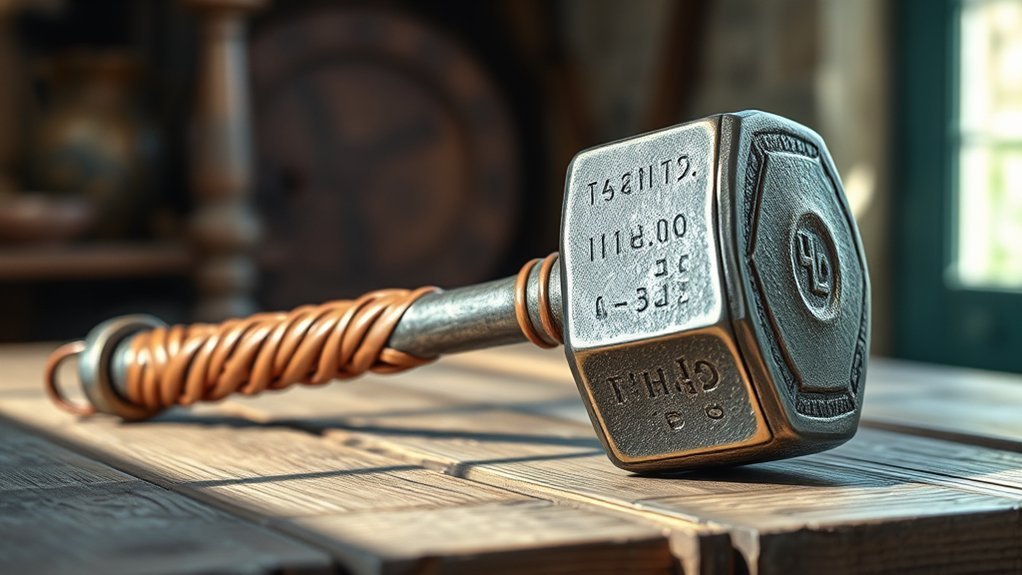
You’ll start by analyzing Mjölnir’s material composition to understand its density and mass. Next, you’ll examine its size and dimensions to calculate a baseline weight.
Finally, you’ll consider mythological clues that hint at its extraordinary heaviness beyond physical measurements.
Material Composition Analysis
Understanding Mjölnir’s material composition is essential to accurately estimating its weight. You must consider the mythic balance embedded in its forging, which suggests a blend of super-dense metals and divine elements.
Traditional metals alone can’t explain the hammer’s extraordinary heft; enchantment influence plays a critical role by altering physical properties at a molecular level. Analyzing Norse descriptions, you find references to uru or a similar mythical alloy, combining durability and exceptional density.
This alloy likely surpasses tungsten or steel in weight-to-volume ratio. The enchantments may reduce or increase its effective mass, complicating direct measurement.
Therefore, your analysis requires integrating metallurgical principles with magical theory, acknowledging that the hammer’s mass is not purely physical but also a product of its mythic and magical synthesis.
Size And Dimensions
Building on the analysis of Mjölnir’s material composition, estimating its weight requires a detailed examination of its size and dimensions as described in Norse mythology and related sources. Descriptions portray Mjölnir as a compact hammer, roughly the size of a one-handed war hammer, with a short handle, an unusual design reflecting mythic symbolism rather than practical weaponry.
This compactness introduces a weight paradox: despite its small size, Mjölnir is said to possess immense heaviness and destructive power. To resolve this, you must consider volumetric estimates based on comparative artifacts while acknowledging mythic exaggeration. The compact dimensions suggest a volume far less than typical war hammers, implying that its weight stems from material density and mythic attributes rather than sheer size alone, highlighting the tension between physical description and symbolic meaning.
Mythological Weight Clues
How can we infer Mjölnir’s weight from the mythological descriptions that emphasize its extraordinary heaviness despite its small size? You need to analyze the mythic symbolism embedded in the texts, where the hammer’s weight represents divine balance rather than physical mass alone.
The hammer’s compact form juxtaposed with its immense force suggests a metaphysical heaviness, an attribute symbolizing unyielding power and cosmic order. You’ll find that mythological sources highlight the hammer’s resistance to being lifted by anyone but Thor, implying an effective weight beyond material metrics.
How Magic Affects Mjölnir’s Weight and Wieldability
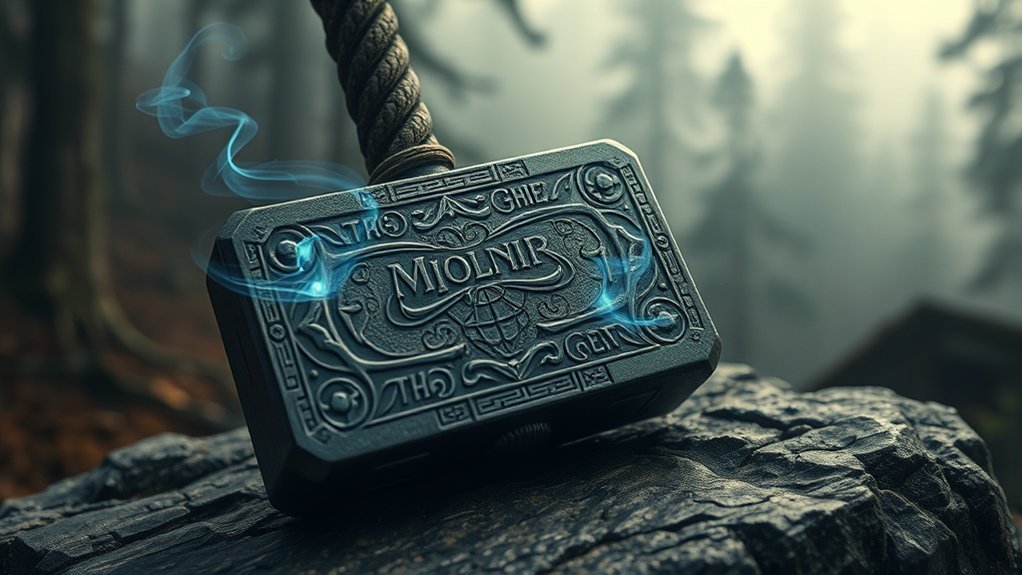
You’ll find that Mjölnir’s enchantments alter its effective weight by restricting who can wield it, rather than changing its physical mass. Magic sets specific limits on handling, enabling only those deemed worthy to lift or swing the hammer.
Understanding these spell effects clarifies how Mjölnir’s weight interacts with its magical constraints.
Enchantment and Weight Dynamics
Why does Mjölnir’s weight defy conventional measurement? The answer lies in its enchantment, which transcends physical mass and challenges standard physics. In mythology myths, Mjölnir’s weight is not fixed; instead, it dynamically adjusts based on who attempts to wield it.
This variability stems from a complex interplay of enchantment ethics, ensuring only the worthy can lift the hammer. The enchantment manipulates gravitational and inertial forces, creating a pseudo-weight that varies contextually.
Consider these factors:
- The hammer’s mass remains constant physically but is perceived differently through magical influence.
- Enchantment ethics impose thresholds for wieldability, effectively modulating weight.
- Magic alters Mjölnir’s interaction with physical laws, disrupting conventional weight assessments.
You must analyze Mjölnir’s weight as a hybrid of physical and metaphysical properties.
Wielding Limits by Magic
The enchantment on Mjölnir doesn’t just alter its perceived weight; it establishes strict parameters for who can physically wield the hammer. According to enchantment physics, the hammer’s mass is dynamically modulated based on the wielder’s worthiness, a concept rooted in mythic physics principles.
This selective weight modulation means that, regardless of your physical strength, you cannot lift Mjölnir unless you meet the enchantment’s criteria. The magic essentially overrides conventional mass properties, creating an adaptive resistance force that scales with the wielder’s moral and existential status.
As a result, Mjölnir’s wieldability isn’t governed by raw physicality but by an intricate interplay of magical constraints, making it a unique artifact where mythic physics dictates the boundary between immovability and maneuverability.
Spell Influence on Handling
Magic profoundly alters how Mjölnir responds to physical interaction by dynamically adjusting its effective weight and balance. When you attempt to lift or wield the hammer, enchantment physics come into play, selectively modulating gravitational forces and inertial mass.
This mechanism resolves mythic paradoxes, such as how the hammer can be both immensely heavy and effortlessly wielded by the worthy. The spell’s influence ensures that Mjölnir’s handling isn’t fixed but context-dependent, responding to the wielder’s worthiness and intent.
Key aspects include:
- Variable mass effect: The hammer’s weight shifts based on enchantment criteria.
- Dynamic balance control: The hammer self-adjusts to optimize wieldability.
- Selective interaction: Only those meeting specific magical conditions can manipulate its inertia.
Understanding these factors clarifies Mjölnir’s unique physical behavior under magical influence.
Comparing Mjölnir’s Weight to Real-World Hammers
When you compare Mjölnir’s weight to real-world hammers, the differences quickly become clear. Typical construction hammers weigh between 16 to 20 ounces, optimized for hammer ergonomics to minimize user fatigue and maximize impact efficiency.
In contrast, mythology correctness suggests Mjölnir is extraordinarily heavy, often described as impossible for anyone but Thor to lift. This significant disparity challenges practical design principles, as no conventional hammer would weigh hundreds of pounds without compromising usability. The mythic weight serves symbolic and narrative functions rather than ergonomic practicality.
Consequently, while real hammers are engineered for balance and repetitive use, Mjölnir’s conceptual weight defies physical norms, underscoring its supernatural nature rather than adherence to real-world hammer ergonomics or functional weight standards.
Scientific Theories Explaining How Thor Lifts Mjölnir
How exactly does Thor manage to lift Mjölnir despite its legendary weight? Scientific theories analyze this through the lens of mythic symbolism and hammer mechanics. Instead of focusing solely on brute strength, these theories propose mechanisms that align with Thor’s unique attributes and the hammer’s enchanted nature.
Consider these perspectives:
- Electromagnetic fields: Mjölnir could generate intense magnetic forces, requiring specific counterforces only Thor can overcome.
- Quantum binding: The hammer’s atoms might be bound by quantum forces that respond exclusively to Thor’s biofield.
- Gravitational manipulation: Mjölnir may locally alter gravitational pull, making it effectively weightless only to Thor.
These hypotheses integrate mythic symbolism with precise hammer mechanics, framing Thor’s ability as a fusion of physical laws and narrative enchantment.
What Fans Calculate About Mjölnir’s Weight
Exactly what weight do fans estimate for Mjölnir based on its depiction and mythological context? By analyzing visual portrayals and Norse texts, enthusiasts often calculate Mjölnir’s weight to range between 40 to 80 kilograms.
This estimate factors in the hammer’s solid, dense appearance and the symbolic emphasis on its immense heft. You’ll find calculations grounded in the mythology accuracy, considering the constraints of a human-like figure wielding it.
Fans also use comparisons with real-world metals and hammer sizes to refine these numbers. While these estimates vary, they consistently reflect the hammer’s intended portrayal as an object of extraordinary weight and power.
This analytical approach helps you appreciate how weight symbolism integrates with the hammer’s mythical narrative without contradicting physical plausibility.
How Mjölnir’s Weight Symbolizes Power and Strength
Why does Mjölnir’s weight carry such profound significance beyond its physical mass? You recognize that its heft operates as a critical element in mythic symbolism, representing not just a physical burden but an embodiment of divine authority and strength. The hammer’s weight acts as a power metaphor, implying that only the worthy can wield such immense force.
Consider these points:
The weight of Mjölnir embodies power, strength, and the profound responsibility of wielding divine authority.
- The impenetrable weight symbolizes unchallengeable power, reinforcing Thor’s role as a protector.
- Its resistance serves as a metaphor for moral and spiritual strength, not just brute force.
- The mythic symbolism of weight conveys responsibility alongside power, emphasizing equilibrium.
Why Mjölnir’s True Weight Might Be Impossible to Measure
The symbolic weight of Mjölnir extends beyond conventional measurement, challenging any attempt to quantify it with standard tools or methods. You must consider that its true weight intertwines with mythology balance, where physical properties are subordinate to narrative significance.
Enchantment physics complicates the matter further; Mjölnir’s mass isn’t fixed but dynamically adjusted by mystical forces, making empirical weight measurement ineffective. When you try to measure it, you confront a paradox: the hammer’s weight depends on the wielder’s worthiness and situational context, factors outside physical laws.
Thus, traditional scales or sensors fail to capture Mjölnir’s essence. Instead, its weight operates as a conceptual metric within Norse mythology’s framework, symbolizing power and balance rather than a static physical attribute you can assess.
Frequently Asked Questions
Who Forged Thor’s Hammer Mjölnir?
You’ll find the mjölnir origin traces to the dwarven brothers Sindri and Brokkr, who expertly executed the hammer forging using advanced techniques. This ensured mjölnir’s unmatched power and durability in Norse mythology’s weaponry.
What Materials Is Mjölnir Made From?
You’ll find Mjölnir forged from uru metal, a mythical iron alloy rooted in dwarven lore and iron myths. This rare material grants exceptional strength and enchantment, making the hammer uniquely powerful and virtually indestructible.
Can Anyone Lift Mjölnir Besides Thor?
No, can anyone lift Mjölnir besides Thor? Only those deemed worthy can. The hammer weight is irrelevant; enchantments restrict lifting, making worthiness the sole criterion rather than physical strength or mass.
What Are Mjölnir’s Special Powers?
You’ll find Mjölnir’s special powers include energy manipulation, weather control, and dimensional travel, grounded in hammer physics. Its lore grants worthiness-based lifting, enabling you to harness Thor’s strength and unleash devastating, precise thunderous strikes.
How Does Mjölnir Return to Thor’s Hand?
Mjölnir returns to your hand through mythic ethics, overriding hammer physics by obeying your will. Its enchantment enables instantaneous recall, defying physical laws while symbolizing responsibility and worthiness tied to Thor’s character and moral code.
Conclusion
You see, Mjölnir’s weight isn’t just about mass—it’s a dynamic interplay of enchantment, worthiness, and mythic symbolism. While you might calculate it around 40–80 kilograms, its true heft defies scientific scales, much like trying to weigh a legend with a smartphone scale.
Ultimately, its weight measures responsibility and power, not pounds or kilos. Understanding this helps you appreciate why Mjölnir remains a timeless symbol beyond mere physical limits. This perspective is key when considering how much does Thor’s hammer weigh.