If you’re looking to add some subtle sophistication to your arm training, hammer curls might be just what you need. Hammer curls work primarily by targeting muscles that often get overlooked, like the brachialis and brachioradialis. These muscles play a key role in arm thickness and forearm strength.
Understanding how these muscles work together can change your approach to building balanced, functional arms. So let’s explore what sets hammer curls apart from traditional bicep exercises.
What Muscles Do Hammer Curls Target?
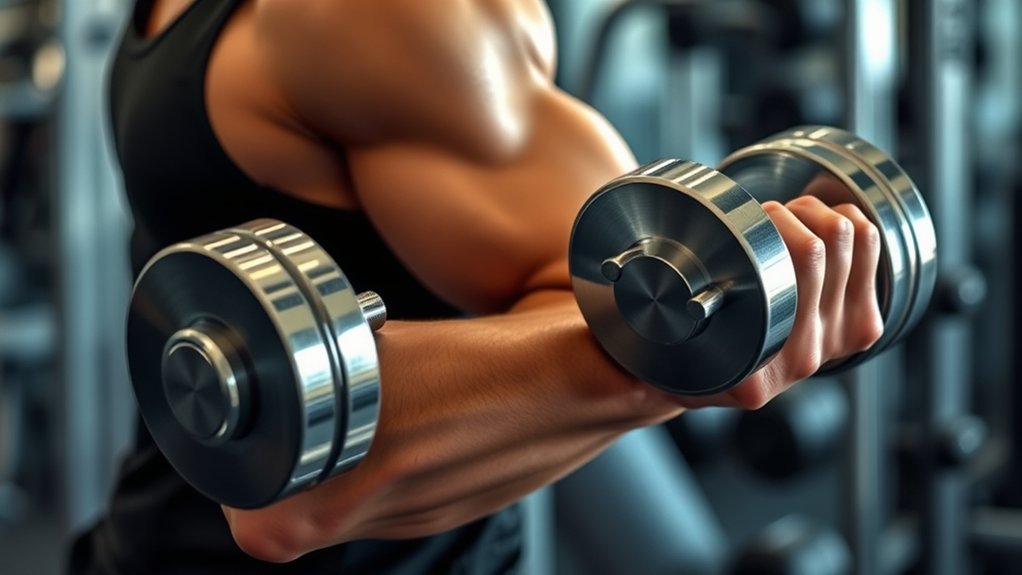
Hammer curls primarily target the brachialis, a key muscle that lies beneath your biceps. When you use an alternative grip, like the neutral grip in hammer curls, you engage this muscle more effectively than traditional curls. This action helps increase your arm’s overall size and strength.
Additionally, hammer curls involve the brachioradialis, a muscle running along your forearm that contributes to elbow flexion. The alternative grip also places less strain on your wrist fascia, reducing discomfort and injury risk.
How Do Hammer Curls Differ From Traditional Bicep Curls?
You’ll notice hammer curls use a neutral grip, holding the dumbbells like a hammer, while traditional bicep curls use a supinated grip with palms facing up. This difference in grip shifts the focus onto different muscles, activating the brachialis and brachioradialis more during hammer curls.
Understanding these variations helps you target your arms more effectively and build balanced strength.
Grip Position Differences
How exactly does grip position change the muscles you target during curls? When you switch to hammer curls, your grip positioning shifts from the traditional supinated (palms-up) hold to a neutral (thumbs-up) grip. This subtle change significantly boosts forearm engagement, activating muscles like the brachioradialis more intensely than traditional bicep curls.
By keeping your wrists aligned with your forearms, hammer curls reduce strain while promoting balanced strength development. This grip positioning not only targets your biceps differently but also helps improve your grip strength, making it functional for daily activities and other lifts.
Muscle Activation Variations
Shifting your grip to a neutral position not only changes which muscles engage but also alters how they work during each curl. Hammer curls emphasize the brachialis and brachioradialis more than traditional bicep curls, which target the biceps brachii predominantly.
This difference comes down to grip mechanics. The neutral grip in hammer curls recruits forearm muscles alongside the upper arm, enhancing overall arm development. Additionally, curl tempo plays a crucial role: controlling the speed during both the lifting and lowering phases maximizes muscle tension and growth.
Why the Brachialis and Brachioradialis Matter for Arm Size
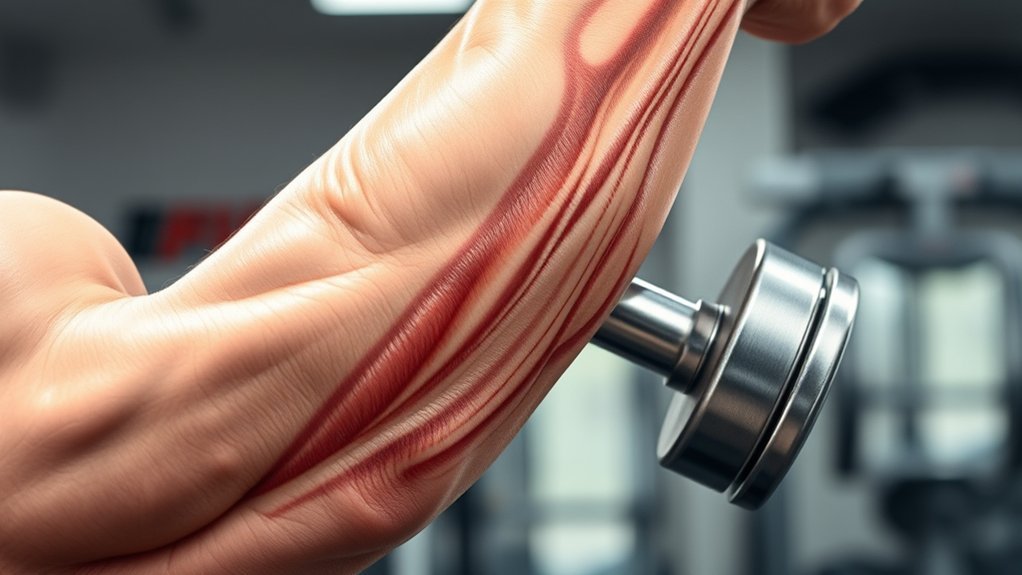
You might not realize it, but the brachialis muscle plays a key role in boosting your arm’s overall thickness. Alongside it, the brachioradialis helps improve strength and shape, especially in the forearm.
Understanding how these muscles work together can transform the way your arms look and perform.
Brachialis Muscle Function
Understanding the brachialis muscle’s function is key to releasing greater arm size and strength. This muscle lies beneath your biceps, and when you target it effectively, you add significant thickness to your upper arm.
Hammer curl dynamics play a crucial role here, as they emphasize the brachialis more than traditional curls. By maintaining a neutral grip during hammer curls, you shift the load from the biceps to the brachialis, promoting balanced arm development.
Focusing on brachialis emphasis not only boosts muscle size but also improves elbow flexion strength, enhancing overall arm performance. Incorporating hammer curls into your routine ensures you’re not neglecting this powerful muscle, helping you build bigger, stronger arms with a well-rounded, functional look.
Brachioradialis Role Explained
Just as the brachialis plays a significant role in adding thickness to your upper arm, the brachioradialis also contributes to both size and functional strength. Understanding the brachioradialis role is key to maximizing your arm development.
This muscle sits on the outer part of your forearm and acts as a powerful elbow flexor, especially when your palms face each other, like in hammer curls. Its unique function enhances forearm engagement, improving grip strength and overall arm stability.
When you target the brachioradialis, you’re not just building muscle size. You’re boosting the arm’s ability to perform everyday tasks with power and control. Focusing on this muscle ensures balanced arm strength and helps prevent imbalances that can limit progress or increase injury risk.
Impact on Arm Thickness
How much does targeting the brachialis and brachioradialis really affect your arm thickness? Quite a bit, actually. These muscles lie beneath and alongside the biceps, pushing your arm outward as they grow.
By focusing on them through hammer curls, you improve grip mechanics, which enhances your overall lifting performance. Strengthening these muscles not only boosts arm size but also promotes forearm symmetry, giving your arms a balanced, powerful look.
Ignoring the brachialis and brachioradialis means missing out on that critical thickness many lifters strive for. So, if you want fuller, thicker arms that stand out, incorporating exercises that emphasize these muscles is key. Don’t just chase biceps size. Embrace the impact of these often-overlooked muscles to maximize arm growth.
Grip Strength and Forearm Benefits of Hammer Curls
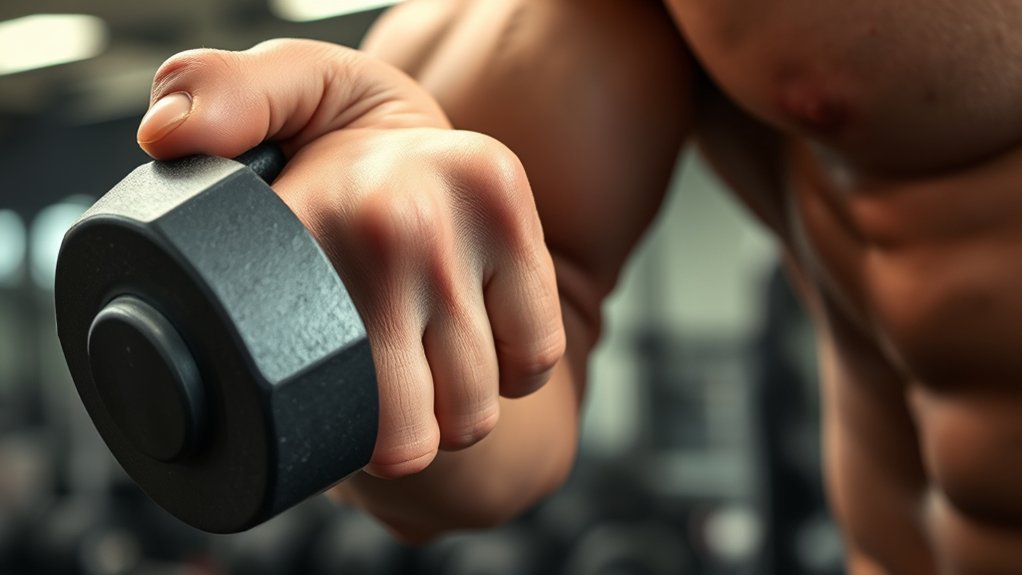
Why focus on grip strength when doing hammer curls? Because improving your grip endurance and forearm hypertrophy directly boosts your overall arm functionality. Hammer curls target muscles in your forearm more than traditional curls, making your grip stronger and more resilient.
Here’s how hammer curls benefit your grip and forearms:
- Enhanced Grip Endurance: Holding the dumbbell with a neutral grip challenges your forearm muscles, increasing stamina.
- Forearm Hypertrophy: The unique motion activates the brachioradialis, promoting muscle growth along your forearm.
- Improved Daily Performance: Stronger forearms translate to better control during activities like lifting, climbing, or even typing.
Incorporating hammer curls into your routine builds a powerful grip and well-developed forearms, supporting both athletic performance and everyday tasks.
How Hammer Curls Help Build Balanced Arm Muscles
Hammer curls target both your biceps and brachialis muscles, helping you build stronger, more balanced arms. This exercise also enhances forearm muscle symmetry, which improves overall arm definition.
Targeting Biceps and Brachialis
Ever wondered which muscles you’re really working when you perform hammer curls? Hammer curls are excellent for targeting biceps and brachialis, two key muscles that shape your upper arm. Unlike traditional curls, hammer curls use a neutral grip position, which leads to different muscle activation variations.
Here’s how hammer curls help you build balanced arm muscles:
- Targeting Biceps: The neutral grip keeps the biceps engaged but shifts some focus away from the peak, promoting overall arm strength.
- Emphasizing Brachialis: This deeper muscle lies beneath the biceps and gets more activation during hammer curls, helping widen your upper arm.
- Grip Position Differences: The unique grip reduces strain on wrists while maximizing muscle engagement, making your workout more efficient.
Incorporate hammer curls to develop balanced, stronger arms.
Enhancing Forearm Muscle Symmetry
Although many exercises focus primarily on the upper arm, incorporating hammer curls into your routine plays an essential role in enhancing forearm muscle symmetry. The distinct grip used in hammer curls, holding the dumbbells with a neutral, palms-facing-in position, targets both the brachioradialis and other forearm muscles evenly.
This balanced activation encourages balanced muscle development, preventing one side from overpowering the other. By regularly performing hammer curls, you ensure your forearms grow proportionally, improving forearm symmetry and overall arm aesthetics.
This not only enhances your physical appearance but also strengthens your grip and functional strength. So, if you want well-rounded, balanced arms, don’t overlook hammer curls. They’re a simple yet effective way to build forearm symmetry and boost your upper body performance.
Proper Form Tips for Hammer Curls
How can you maximize the benefits of hammer curls while minimizing injury risk? Mastering proper form is key. When you focus on technique and safety tips, you ensure effective muscle engagement and protect your joints.
Follow these three essential tips for proper form:
- Maintain a neutral grip: Keep your palms facing each other throughout the movement to target the brachialis and forearms effectively.
- Control your motion: Lift and lower the weights slowly to avoid momentum, which reduces injury risk and boosts muscle activation.
- Keep your elbows close: Prevent your elbows from drifting forward or outward to maintain tension on the right muscles and support joint stability.
Stick to these safety tips and proper form to get the most from your hammer curls every time.
Common Hammer Curl Mistakes to Avoid
Why do some hammer curl routines fail to deliver results or cause discomfort? Often, it’s due to poor hammer curl form and common grip mistakes. You might be swinging your arms or using momentum instead of controlled movements, which reduces effectiveness and risks injury.
Another frequent error is gripping the dumbbells too tightly or incorrectly, putting unnecessary strain on your wrists and forearms. To maximize gains, maintain a neutral wrist position and keep your elbows close to your body throughout the movement.
Avoid leaning back or jerking the weights up. Focus on slow, steady reps. By correcting these mistakes, you’ll engage the right muscles effectively and prevent discomfort, making your hammer curl workouts more productive and safe.
Hammer Curl Variations to Target Different Muscles
Where should you focus your effort to maximize hammer curl benefits? It’s all about variations that challenge your muscles in new ways while maintaining the hammer grip and neutral stance.
Here are three effective hammer curl variations to target different muscles:
- Cross-Body Hammer Curl: By curling the dumbbell across your body, you emphasize the brachialis muscle more, enhancing arm thickness.
- Incline Hammer Curl: Perform curls on an incline bench to increase the stretch and engage the long head of the biceps and brachialis.
- Seated Hammer Curl: Sitting down stabilizes your body, reducing momentum and forcing your forearms and biceps to work harder.
Incorporate these variations to fully activate your arms and build balanced strength with every set.
Combining Hammer Curls With Other Arm Exercises
Wondering how to maximize your arm workout? Combining hammer curls with other arm exercises boosts muscle balance and growth. Focus on maintaining strict hammer curl form to fully engage your brachialis and brachioradialis.
Pair hammer curls with traditional bicep curls to target both the brachialis and biceps brachii effectively. Incorporate tricep exercises like dips or extensions to ensure comprehensive arm development.
Varying forearm grip positions between neutral (hammer curls), supinated (standard curls), and pronated (reverse curls) challenges your muscles differently, enhancing strength and size. This strategic mix prevents plateaus and keeps your routine fresh.
When and How Often to Include Hammer Curls in Your Workouts
How often you include hammer curls in your workouts depends on your overall training goals and recovery ability. To get the most from hammer curls, consider these guidelines:
- For muscle growth: Perform hammer curls 2-3 times a week using moderate rep schemes (8-12 reps) with a controlled hammer curl cadence to maximize tension.
- For strength: Focus on heavier weights with lower reps (4-6) twice a week, maintaining a steady hammer curl cadence to ensure form and control.
- For endurance: Use lighter weights with higher reps (15-20), performing hammer curls 1-2 times weekly, emphasizing a consistent cadence to build stamina.
Adjust frequency based on how your arms recover, and always prioritize quality reps over quantity to avoid injury and promote progress.
Frequently Asked Questions
Can Hammer Curls Help Reduce Elbow Pain?
Yes, hammer curls can help reduce elbow pain by improving elbow mechanics and strengthening surrounding muscles. They support joint stability, which decreases strain and discomfort, helping you move pain-free and stay motivated in your fitness journey.
Do Hammer Curls Improve Sports Performance?
You might be surprised how hammer curls boost your sports performance! They strengthen your forearms and grip, giving you better control and power in many activities.
Add them to your routine and watch your game improve!
Are Hammer Curls Safe for Beginners With Wrist Issues?
Hammer curls safety depends on your wrist condition. You can try wrist-friendly variations like using neutral grip dumbbells or lighter weights.
Focus on controlled movements, and if pain occurs, stop and consult a professional for personalized advice.
Can Hammer Curls Be Done Without Weights?
You can do hammer curls without weights by using resistance bands or household items. This boosts your grip strength and HD awareness, helping you stay motivated and precise while improving muscle control and endurance effectively.
How Long Does It Take to See Results From Hammer Curls?
Think of hammer curls like planting seeds. You’ll start seeing growth in about 4 to 6 weeks.
Consistent hammer curls build muscle, but if you feel elbow pain, adjust form to prevent setbacks and keep progressing.
Conclusion
Incorporating hammer curls into your routine isn’t just about adding size—it’s about crafting well-rounded, resilient arms that perform day to day with ease. By focusing on those often-overlooked muscles, you’re giving your arms the subtle edge they need to stand out and stay strong.
Keep your form in check, mix up your grips, and watch your progress unfold. Small adjustments can make a big difference in targeting the right areas.
Remember, consistent effort with smart choices builds arms you’ll be proud to show off. Understanding what do hammer curls work will help you maximize your training and achieve balanced arm development.