When you scoop up a handful of sand, you might wonder how many grains of sand are actually in your grasp. The number varies significantly based on factors like grain size, moisture, and how tightly the sand is packed. Understanding these variables requires examining sand’s composition, texture, and volume.
All of these factors influence the final count. Before you estimate, consider how subtle differences in these elements can dramatically change the outcome.
What Determines the Size of a Grain of Sand
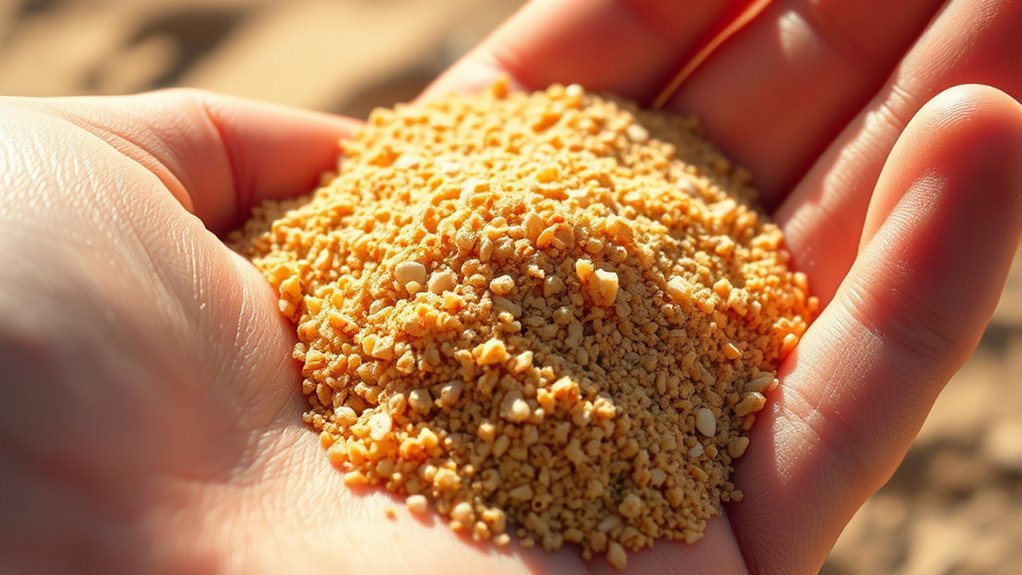
How exactly do you determine the size of a grain of sand? You begin by measuring its diameter, typically in millimeters, using calibrated tools like sieves or laser diffraction analyzers.
Determining grain size starts with measuring diameter using precise tools like sieves or laser diffraction analyzers.
Grain size depends on factors such as the mineral’s hardness, weathering intensity, and erosion history. Unlike subtopic unrelated factors such as color variations, size is tightly linked to physical breakdown processes.
You can’t rely on two word discussion ideas like “grain color” or “rock type” alone to assess size; instead, focus on mechanical and chemical weathering forces. Additionally, depositional environment influences size sorting, as high-energy settings yield coarser grains.
Precise grain size determination demands controlled sampling and standardized measurement protocols to avoid errors, enabling accurate quantification critical for sedimentological analysis.
How Sand Composition Influences Grain Size and Quantity
You’ll find that the mineral composition directly impacts grain size, as harder minerals tend to fracture into smaller particles. Grain shape also varies with mineralogy, influencing how tightly grains pack together in a handful.
Additionally, the presence of organic material can alter both the size distribution and total grain count by creating irregular aggregates.
Mineral Types Affect Size
Several factors determine the size and quantity of sand grains in a handful, with mineral composition playing an essential role. Different minerals exhibit varying hardness, density, and cleavage properties, directly influencing grain fragmentation and size distribution.
For instance, quartz grains tend to be more uniform and resistant to weathering, resulting in smaller, consistent particles, while feldspar breaks down into coarser fragments. When you perform a gentle calibration of grain size against mineral types, you’ll notice predictable patterns emerging, aiding precise quantification.
Additionally, a planetary comparison reveals that sand on Mars, rich in basaltic minerals, generally has coarser grains than terrestrial quartz sands, affecting grain count per volume. Understanding mineral-specific grain size helps you accurately estimate the number of grains in any given handful of sand.
Grain Shape Variations
Why do sand grains exhibit such diverse shapes, and how does this variation impact their size and quantity in a handful? Grain shape results from geological processes like weathering and transport, producing forms from angular to well-rounded.
Angular grains occupy more volume due to irregular edges, reducing total grain count per handful compared to rounded grains of similar mass. This variability challenges counting methods that assume uniform grain geometry, requiring adjustments or imaging techniques to accurately estimate grain numbers.
When analyzing a handful, you must consider that elongated or platy grains pack less efficiently than equant grains, affecting both size distribution and packing density. Understanding grain shape’s influence enables more precise quantification of sand grains, enhancing the reliability of volumetric or mass-based counting methods you apply in sediment analysis.
Organic Material Influence
How does the presence of organic material alter the size and quantity of sand grains in a handful? Organic material impacts grain formation by introducing variable particle cohesion and altering sediment composition.
When organic debris mixes with mineral grains, it can bind smaller particles together, effectively increasing individual grain size. This aggregation reduces the total grain count for a given volume.
Additionally, organic material often decomposes into fine particles that fill interstitial spaces, influencing packing density. You’ll notice that sand with higher organic content tends to have fewer, larger grains per handful compared to purely mineral sands.
Understanding this interplay helps you accurately estimate grain quantities, as organic matter changes both physical grain dimensions and spatial distribution, directly affecting grain size and the overall grain count in your sample.
Why Shape and Texture Matter for Counting Grains of Sand
What factors influence the accuracy of estimating the number of sand grains in your hand? Primarily, shape and texture significantly impact counting methods. When you assess sand grains, consider these technical factors:
- Grain shape: Angular grains pack less densely than rounded ones, altering volume-to-count ratios.
- Surface texture: Rough textures increase contact points, affecting how grains settle and cluster.
- Intergranular voids: Irregular shapes create variable void spaces, complicating volume estimations.
- Aggregation tendencies: Textured grains may stick together, leading to undercounting if you rely on simple separation techniques.
Understanding these elements sharpens your counting methods, ensuring more accurate grain estimates by accounting for physical and tactile variances in sand samples.
How to Estimate Sand Grains Using Volume and Density
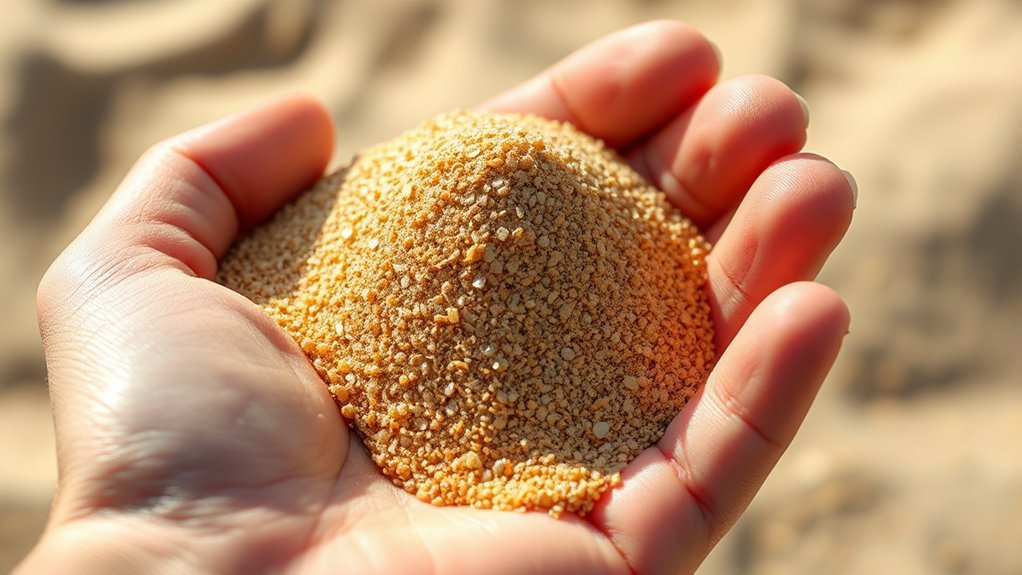
When estimating the number of sand grains in your hand, you’ll rely heavily on measuring volume and calculating density. First, determine the total volume of the sand you’re holding by using displacement methods or geometric approximation.
Next, calculate the average grain volume by analyzing representative orbiting grains through microscopy or imaging techniques, accounting for irregular shapes. With grain density known, typically around 2.65 g/cm³ for quartz, you can convert mass measurements to volume.
Dividing the total sand volume by the average grain volume yields an estimate of grain count. This approach assumes uniform grain density and minimal void spaces. By focusing on precise volume measurements and grain density, you can achieve a reliable estimate of sand grains, balancing the variability introduced by orbiting grains within the sample.
How Moisture and Compaction Affect Sand Grain Estimates
Why do moisture and compaction considerably influence your sand grain estimates? Moisture effects alter the sand’s bulk density by filling voids between grains, causing them to adhere and reducing free volume. Compaction implications further change grain arrangement, increasing density and decreasing interstitial spaces. These factors directly impact your calculation accuracy.
Consider these points:
- Moisture increases effective volume, misleading volume-based grain counts.
- Water films cause grains to clump, decreasing individual grain count per volume.
- Compaction reduces porosity, increasing grain count density per unit volume.
- Variable moisture and compaction require calibration of both volume and density parameters.
You must account for these moisture effects and compaction implications to refine your sand grain number estimates accurately.
How Grain Size Varies by Location
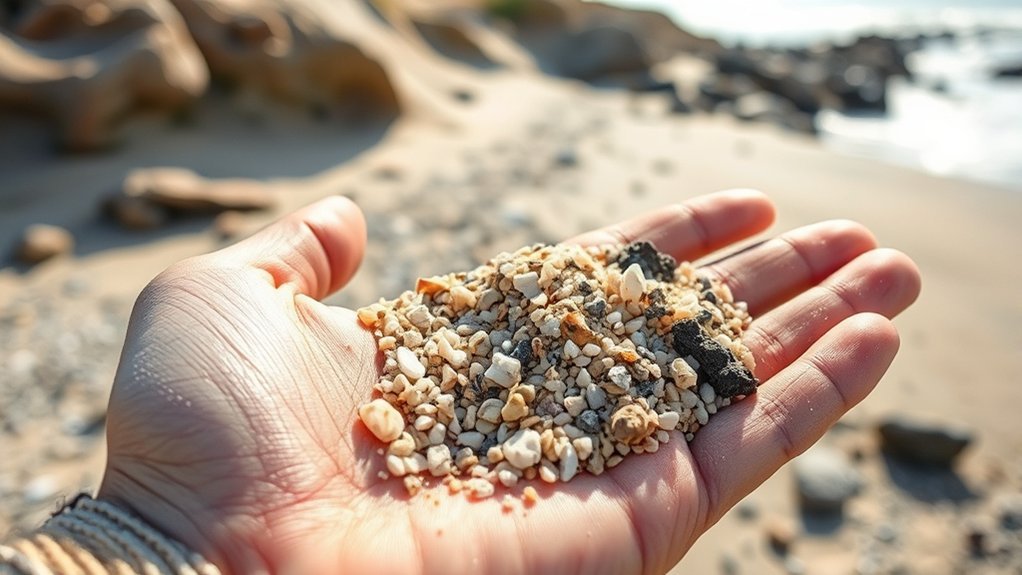
You’ll notice that grain size differs substantially depending on the environment. Coastal sands tend to be finer and more rounded, while desert grains are coarser and angular.
Riverbed and tropical beach sands each have distinct textures and compositions that influence their average grain size.
Coastal vs. Desert Grains
How does grain size differ between coastal and desert environments? When you analyze sand grains from coastal windward zones versus desert dunes, distinct patterns emerge due to varying transport and depositional mechanisms. Consider these factors:
- Coastal windward sands tend to be finer and more rounded due to constant wave action and salt weathering.
- Desert dunes feature coarser, more angular grains shaped primarily by wind abrasion and saltation.
- Sorting is typically better in coastal sands because water selectively deposits grains of similar size.
- Desert sands exhibit wider size distributions as wind energy fluctuates, transporting diverse grain sizes.
Understanding these differences helps you predict grain size distribution in each environment accurately, revealing how physical forces shape sediment characteristics dynamically.
Riverbed Sand Characteristics
While coastal and desert sands reveal distinct grain size patterns shaped by wave and wind dynamics, riverbed sands present another complex set of characteristics influenced by water flow variations and sediment sources. You’ll notice that sand deposition here depends heavily on flow velocity; faster currents transport larger grains, while slower waters deposit finer particles.
Grain isolation occurs as sediments separate based on size and density, leading to stratified layers along the riverbed. This segregation means you’ll typically find coarser sand near the source or in turbulent zones, while finer grains accumulate downstream or in calmer pools.
Understanding these patterns helps you predict sediment distribution and grain size variability, essential for analyzing riverbed composition and its ecological or engineering implications.
Tropical Beach Variations
Where exactly do grain sizes vary most on tropical beaches? Understanding this requires analyzing grains physics and local factors influencing sediment distribution. You’ll notice significant variation due to:
- Wave Energy: Stronger waves sort grains by size, leaving coarser sand nearshore and finer particles further out.
- Coral Reef Proximity: Beaches adjacent to reefs often have biogenic sand with larger, angular grains.
- Sediment Source: Volcanic islands yield darker, denser grains compared to quartz-dominant continental sands.
- Human Impact: Coastal modifications alter natural sorting, disrupting typical size gradients.
While beach folklore suggests sand color or feel indicates grain size, only precise measurement reveals true variations. By examining these factors, you can predict how tropical beach grain size changes spatially, reflecting dynamic environmental and geological processes.
How Scientists Count Sand Grains
Why do scientists need exact counts of sand grains, and how do they achieve such precision? Accurate grain counting allows researchers to analyze sediment composition, transport processes, and environmental changes.
You start by collecting a representative sample of tiny nuggets, individual sand grains, from the site. Then, you use high-resolution microscopy combined with image analysis software to identify and count each grain automatically.
This method minimizes human error, ensuring precise quantification even when grains differ in size or shape. Advanced techniques like laser diffraction and automated particle counters help refine size distribution data, providing a comprehensive grain profile.
How Many Grains of Sand Fit in an Average Handful?
A typical handful of dry sand contains roughly one hundred thousand to two hundred thousand individual grains, depending on factors like grain size and hand volume. When you estimate how many grains fit in your hand, consider these technical aspects:
- Grain Size Variation: Smaller grains increase count; larger grains reduce it.
- Hand Volume: Larger hands naturally hold more sand.
- Packing Density: How tightly grains settle affects total count.
- Moisture Content: Wet sand clumps, lowering grain count per handful.
You might find discussion ideas about unrelated topics tempting, but focusing strictly on these variables sharpens your understanding. This approach ensures precision without drifting into irrelevant areas, making your grasp of sand grain quantities more analytical and exact.
Surprising Facts About the Total Grains of Sand on Earth
How many grains of sand cover the Earth’s surface might surprise you: estimates suggest there are roughly 7.5 x 10^18 grains, or seven quintillion five hundred quadrillion. This staggering number results from countless tiny crystals and glassy fragments, primarily quartz, formed through geological processes like erosion and volcanic activity.
These particles vary in size but consistently fall within the sand grain classification, typically between 0.0625 mm and 2 mm. When you consider the vast deserts, beaches, and seabeds, the accumulation of these microscopic fragments becomes immense.
The uniformity in grain composition, dominated by silicon dioxide, highlights the recurring natural mechanisms shaping Earth’s surface. Understanding this scale helps you appreciate the vastness hidden within what seems like simple sand, revealing complex planetary dynamics at a granular level.
Frequently Asked Questions
Can Sand Grains Harm Human Health if Inhaled?
Yes, sand inhalation harms your lungs, especially because smaller grain size effects allow fine particles to penetrate deep.
Chronic exposure can cause respiratory issues like silicosis, so you should avoid inhaling airborne sand grains whenever possible.
What Tools Are Used to Magnify Sand Grains?
You’ll find microscopes and scanning electron microscopes essential for magnification techniques, achieving up to 100,000x magnification. These tools comply with grain measurement standards, allowing precise analysis of sand’s intricate surface and size distribution.
How Does Sand Impact Marine Ecosystems?
You’ll find sand impacts marine ecosystems by influencing grain scale dispersion, which affects nutrient distribution and habitat structure.
This micro-scale arrangement regulates species interactions, sediment stability, and overall ecosystem functionality essential for marine biodiversity.
Are Synthetic Sand Grains Used in Industry?
Yes, synthetic sand serves specific sectors, supplying standardized, stable industrial grains. You’ll find these fabricated fragments facilitating filtration, fabrication, and fracking, forming fundamental functions in manufacturing.
This two-word discussion idea: “engineered granules.”
Can Sand Grains Be Used in Art or Jewelry?
You can definitely use sand grains in art and jewelry; their unique grain textures enhance visual appeal, offering diverse jewelry design options. Analyzing grain size and composition helps you achieve precise artistic effects and structural durability.
Conclusion
When you scoop up a handful of sand, you’re holding roughly 100,000 to 200,000 individual grains—each shaped and sized by complex geological factors. This staggering number highlights how even a small volume contains immense detail and variability. Understanding moisture, composition, and packing helps refine your estimate.
So next time you grasp sand, remember: beneath your fingertips lies a microscopic world, packed densely with countless tiny particles shaped by nature’s precise forces. The incredible number of grains in a handful of sand reveals just how intricate and fascinating this natural material truly is.