When you pick up wire cutter pliers, you’re holding a tool that’s fundamentally a simple machine combining levers and wedges.
Wire cutter pliers use these basic mechanical principles to efficiently cut through metal wires. You apply force through the handles, which the tool amplifies to slice through materials with ease.
Understanding how this mechanical advantage works can clarify why these pliers outperform many other cutting tools.
But what exactly makes wire cutter pliers a specialized type of lever? The handles act as levers, increasing the force you apply.
Meanwhile, the cutting edges function as wedges, concentrating that force into a small area to cut through wires cleanly and efficiently.
This combination of lever and wedge is what defines wire cutter pliers as a simple yet powerful machine.
What Simple Machine Are Wire Cutter Pliers?
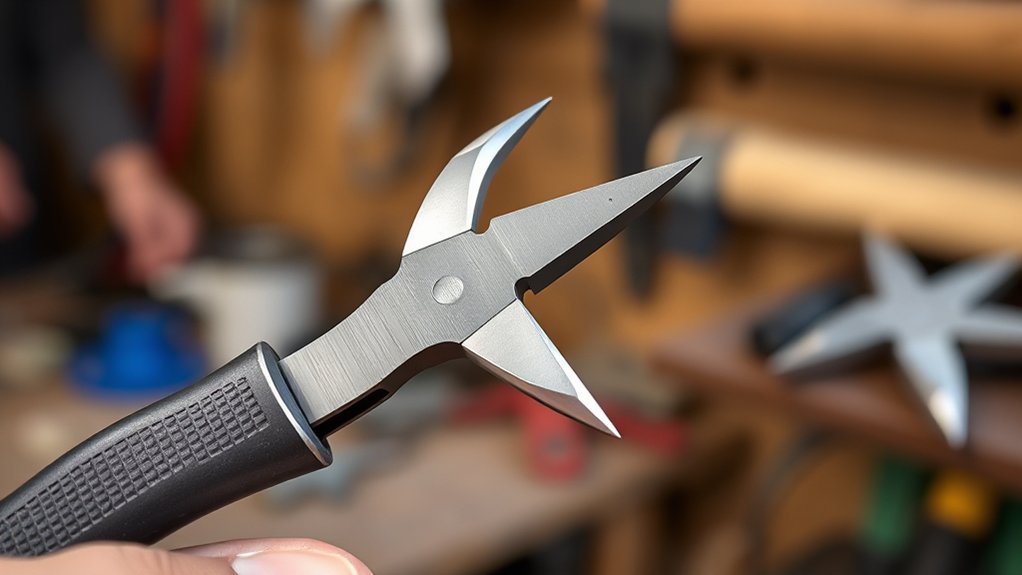
Although wire cutter pliers might seem like a complex tool, they primarily function as a combination of simple machines, specifically levers and wedges. In their mechanical design, the handles act as levers, amplifying the force you apply.
The cutting edges serve as wedges, concentrating this force onto a narrow area to sever wires with cutting precision. This integration of simple machines enhances efficiency, permitting you to cut through materials that would otherwise require significant effort.
The wedge-shaped blades focus stress on the wire, initiating a clean cut, while the lever mechanism guarantees you don’t have to exert excessive force. Understanding this mechanical design clarifies how wire cutter pliers optimize force and precision, making them indispensable for tasks demanding accuracy and strength without complex mechanisms.
How Wire Cutter Pliers Use Leverage to Cut Wires
You apply force on the handles, which act as levers to amplify that input at the cutting edges. This force amplification reduces the effort needed to sever wires efficiently.
Understanding the mechanics and factors affecting cutting efficiency helps you optimize tool performance.
Lever Mechanics Explained
Because wire cutter pliers rely on lever mechanics, they multiply the force you apply to the handles, enabling efficient cutting of wires. These pliers function primarily as a class 1 lever, where the fulcrum sits between the input force (your hand) and the output force (cutting jaws).
This arrangement aligns with fundamental mechanical principles, allowing the tool to convert small hand movements into significant cutting power. Understanding lever types is essential; the positioning of the fulcrum relative to the load and effort determines force amplification.
In wire cutter pliers, the short distance between the fulcrum and the cutting edge concentrates force, maximizing efficiency. By applying these lever mechanics, the pliers reduce the physical effort required, ensuring precise, clean cuts without excessive strain on your hands.
Force Amplification Process
When you apply force to the handles of wire cutter pliers, the tool’s lever system amplifies this input, transforming it into a much greater cutting force at the jaws. This force amplification hinges on the mechanical design, specifically the relative lengths of the lever arms.
The longer handles allow you to exert a smaller input force, which is then efficiently transmitted through the pivot point. The force distribution is optimized so that a concentrated, high-magnitude force acts precisely at the cutting edge.
Cutting Efficiency Factors
Efficiency in wire cutting relies heavily on the precise application of leverage within the pliers’ design. When you use wire cutter pliers, their mechanical advantage allows you to apply greater force at the cutting edges than your hand alone could generate.
The cutting angles of the jaws are engineered to optimize shearing action, reducing the effort required to sever wires. Material hardness also plays a critical role; harder wires demand more force, influencing the leverage needed.
Key factors affecting cutting efficiency include:
- Optimized cutting angles for clean, minimal-resistance cuts
- Lever arm length enhancing force amplification
- Jaw material and hardness compatibility with wire type
- Precision alignment preventing energy loss during cutting
Understanding these factors helps you maximize the pliers’ performance, ensuring clean cuts with minimal exertion.
What Role Does the Fulcrum Play in Wire Cutter Pliers?
You rely on the fulcrum’s position to maximize the mechanical advantage when cutting wires with pliers. By placing the fulcrum closer to the cutting jaws, you increase the force applied with less effort.
Understanding this relationship helps you optimize the tool’s efficiency and precision.
Fulcrum Position Importance
Because the fulcrum acts as the pivot point in wire cutter pliers, its position directly influences the tool’s cutting force and control. You must recognize that ideal fulcrum placement enhances fulcrum stability and lever alignment, critical for precise operation.
When the fulcrum is positioned correctly:
- It maintains consistent lever alignment, ensuring efficient force transmission.
- It provides fulcrum stability, preventing unwanted lateral movement during cutting.
- It balances the handles’ mechanical interaction, reducing operator fatigue.
- It maximizes the spatial relationship between handles and jaws for maximum control.
Fulcrum’s Mechanical Advantage
Three key mechanical principles define the fulcrum’s role in wire cutter pliers: leverage, force multiplication, and pivot dynamics. The fulcrum placement directly influences how effectively you can convert your hand’s input force into cutting power.
By positioning the fulcrum closer to the cutting jaws, the design maximizes mechanical advantage, enabling you to exert greater force with less effort. This optimized fulcrum placement enhances mechanical efficiency by reducing energy loss through friction and unnecessary movement.
Additionally, the pivot dynamics governed by the fulcrum guarantee smooth, controlled motion, improving precision during cutting. Understanding these factors helps you appreciate how the fulcrum acts as the critical axis that balances force and motion, ultimately determining the effectiveness and ease of wire cutting with your pliers.
Why Wire Cutter Pliers Are First-Class Levers
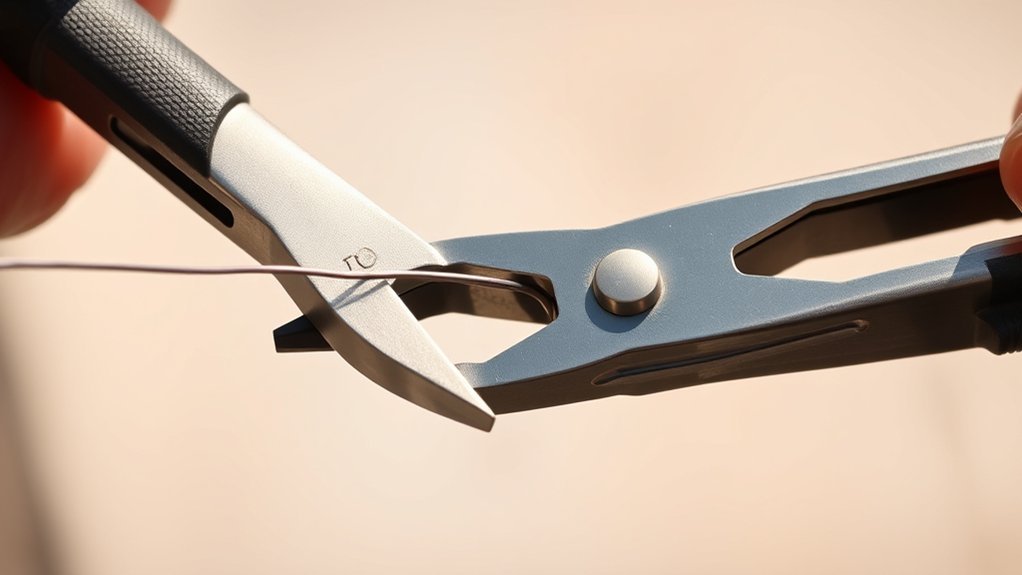
Although wire cutter pliers may seem simple, their design exemplifies the mechanics of a first-class lever. You’ll find the fulcrum positioned between the effort (your hand applying force) and the load (the wire being cut).
This setup aligns with the classic characteristics of lever types, specifically the first-class lever, where the fulcrum sits centrally. When you squeeze the handles, the force is efficiently transmitted, allowing you to cut wire with less effort.
Key points include:
- Fulcrum located between effort and load
- Handles act as effort arms
- Cutting jaws bear the load
- Mechanical advantage achieved by handle length versus jaw length
Understanding this lever classification helps you appreciate the mechanical efficiency engineered into wire cutter pliers.
How the Cutting Edges on Wire Cutter Pliers Work Like Blades
When you apply force to the handles of wire cutter pliers, the cutting edges function like finely honed blades, concentrating pressure on a small surface area to sever the wire efficiently. This cutting precision results from the blade design, which features sharp, angled edges that meet at a narrow point.
The geometry of these blades maximizes stress concentration, allowing you to cut through various wire gauges with minimal effort. As you close the handles, the blades shear the wire by applying compressive and tensile forces simultaneously, ensuring a clean cut without deformation.
The precise alignment of the cutting edges is critical; any misalignment reduces cutting efficiency and can damage the wire or the tool. Consequently, the blade design is fundamental in delivering reliable, accurate cuts every time.
How Handle Length Affects Force in Wire Cutter Pliers
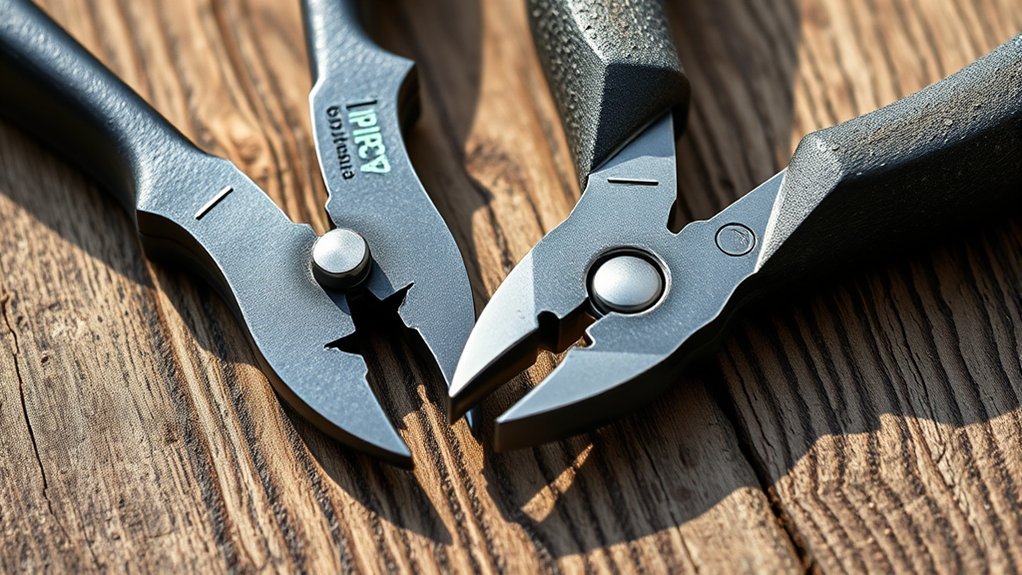
Because handle length directly influences leverage, it plays an essential role in the force you apply with wire cutter pliers. When you maximize handle length, you enhance the force transmission from your hand to the cutting edges, impacting cutting precision and overall efficiency.
Handle length boosts leverage, increasing cutting force and improving precision with wire cutter pliers.
Consider these factors for handle enhancement:
- Longer handles increase leverage, reducing your effort for cutting tougher wires.
- Shorter handles offer greater control, improving precision in delicate cuts.
- Excessively long handles may reduce maneuverability and accuracy.
- Balanced handle length ensures effective force without sacrificing cutting precision.
How Mechanical Advantage Makes Cutting Easier With Wire Cutter Pliers
You use the lever mechanism in wire cutter pliers to convert your hand force into a much greater cutting force at the jaws. This force multiplication reduces the effort needed to sever wires efficiently.
Understanding this mechanical advantage helps you optimize cutting tasks with minimal strain.
Lever Mechanism Explained
Although wire cutter pliers may seem straightforward, their lever mechanism plays a crucial role in amplifying your applied force. This design optimizes cutting precision and reduces hand fatigue, thanks to its ergonomic design. When you apply pressure on the handles, the lever system multiplies that force at the cutting jaws, enabling cleaner cuts with less effort.
Key aspects of the lever mechanism include:
- Fulcrum placement that maximizes mechanical advantage
- Handle length optimized to balance force and control
- Pivot point engineered for minimal friction and smooth operation
- Jaw geometry designed to concentrate force efficiently
Understanding these elements helps you appreciate how the lever mechanism enhances performance, making wire cutter pliers an indispensable tool for precise, efficient cutting tasks.
Force Multiplication Benefits
When you apply force to wire cutter pliers, the mechanical advantage created by their lever design greatly reduces the effort needed to sever materials. This force enhancement occurs because the pliers convert a small input force at the handles into a considerably larger output force at the cutting jaws through mechanical leverage.
The fulcrum’s position relative to the handles and jaws maximizes this leverage, enabling you to cut wires with much less exertion than direct hand pressure would require. By optimizing the ratio between the input arm and output arm lengths, wire cutter pliers amplify your input force efficiently.
This precise force multiplication mechanism guarantees consistent cutting performance, minimizes user fatigue, and increases the tool’s effectiveness for various wire gauges and materials.
Efficiency In Cutting Tasks
Building on the force multiplication benefits, wire cutter pliers enhance cutting efficiency by applying increased mechanical advantage precisely where it’s needed. This mechanical advantage reduces the effort required to sever wires while improving cutting precision.
When you use wire cutter pliers, their ergonomic design minimizes hand fatigue, allowing for sustained accuracy and control. Key factors contributing to efficiency include:
- Optimized lever arm length amplifies input force effectively.
- Sharp cutting edges concentrate force on a minimal area, enhancing precision.
- Ergonomic handles distribute pressure evenly, reducing strain.
- Pivot placement maximizes mechanical advantage at the jaws for cleaner cuts.
How Wire Cutter Pliers Compare With Other Cutting Tools
While various cutting tools serve specific functions, wire cutter pliers excel in precision and efficiency when handling electrical wires and small metal components. Compared to general-purpose scissors or utility knives, wire cutter pliers offer superior cutting performance due to their sharp, hardened blades designed to slice through metal cleanly without deforming the material.
Their ergonomic handles provide excellent leverage, reducing user fatigue during repetitive tasks. Additionally, tool durability is enhanced by heat-treated steel construction, which maintains blade sharpness over prolonged use and resists wear better than softer cutting tools.
However, for larger or tougher materials, you might need specialized cutters. Overall, if your work requires consistent precision and reliable tool longevity in cutting small metal parts, wire cutter pliers outperform many alternatives in both efficiency and durability.
What Materials Can Wire Cutter Pliers Cut?
Wire cutter pliers deliver precise cuts on a variety of materials due to their hardened steel blades and ergonomic leverage. You can rely on them to efficiently slice through different wire types without compromising the tool’s integrity or the wire’s structure.
These pliers excel with:
- Copper wire and aluminum wire, which are softer and require sharp, clean cuts.
- Steel wire and hard wire, necessitating robust blades and firm grip to avoid deformation.
- Insulated wire and multi strand wire, where precision prevents damage to the insulation or strands.
- Braided wire and soft wire, demanding controlled pressure for a clean severance.
Understanding these material compatibilities guarantees you select a wire cutter plier tailored to your specific cutting needs, maintaining both efficiency and safety.
Choosing Wire Cutter Pliers: Key Mechanical Tips to Consider
Selecting the right pair of cutter pliers involves evaluating several mechanical factors to affirm peak performance and durability. First, assess cutting precision by examining blade sharpness and alignment; misaligned jaws reduce cutting efficiency and cause material deformation.
Next, consider the mechanical advantage. Pliers with longer handles provide greater force with less effort, essential for tougher materials. The tool’s construction material impacts longevity; high-carbon steel or alloy blades offer superior hardness and edge retention.
Don’t overlook ergonomic design. Handles coated with non-slip, cushioned grips reduce hand fatigue during repetitive tasks, improving control and safety. Finally, verify joint quality; a riveted or box joint ensures smooth operation and stability.
Conclusion
Remember, “a tool is only as good as the hand that wields it.” Wire cutter pliers combine the mechanical advantages of a first-class lever and wedge, maximizing force with minimal effort.
By understanding how the fulcrum and cutting edges work together, you can choose the right pliers for precise, efficient cuts on various materials.
Mastering their mechanics guarantees you get the most control and power, making your tasks safer and more effective every time. Ultimately, knowing that wire cutter pliers are a type of simple machine helps you appreciate their design and functionality even more.