Danish oil protects wood by penetrating its fibers to strengthen and enhance the natural grain while providing moderate moisture resistance.
It forms a partial barrier that helps reduce water absorption, making it a popular choice for improving wood durability.
This finish offers decent wear protection but typically requires multiple coats and regular reapplication, especially in high-traffic or outdoor environments, to maintain its effectiveness.
Unlike thicker finishes, Danish oil does not fully seal the wood or shield it from deep scratches and prolonged exposure to water.
If you want to understand its limitations and learn the best application methods, there is more detailed information available ahead.
What Is Danish Oil and How Does It Work on Wood?
Danish oil is a penetrating wood finish composed of a blend of oils and varnishes designed to enhance and protect wood surfaces. When you apply it, the Danish oil ingredients, typically tung oil, linseed oil, and a varnish, soak into the wood fibers, creating a durable, water-resistant layer within the wood rather than just sitting on the surface.
This penetration strengthens the wood internally while the varnish component hardens to form a protective film. The Danish oil benefits include enhancing the natural grain and color of the wood, providing a low-luster finish, and increasing resistance to wear and staining.
How Does Danish Oil Protect Wood From Moisture and Water?
When you apply Danish oil, it penetrates the wood fibers and forms a moisture barrier that limits water absorption. This barrier reduces swelling and warping by preventing moisture from entering the wood’s cellular structure.
Understanding this water resistance mechanism helps you maintain wood’s durability and appearance over time.
Moisture Barrier Formation
Although wood is naturally porous and prone to absorbing moisture, applying Danish oil creates a protective barrier by penetrating deeply into the fibers and polymerizing within the wood structure. This process reduces moisture absorption by filling microscopic voids and reinforcing cell walls, which limits the wood’s ability to swell or warp.
The barrier effectiveness depends on proper application. Multiple coats guarantee thorough saturation and polymer formation. Unlike surface coatings, Danish oil integrates with the wood, enhancing dimensional stability without creating a thick film.
However, while it greatly diminishes moisture uptake, it does not fully block moisture transmission. Understanding this moisture barrier formation helps you optimize protection, balancing natural wood aesthetics with improved durability against environmental humidity and incidental moisture exposure.
Water Resistance Mechanism
Because moisture is one of the primary factors that degrade wood over time, understanding how Danish oil enhances water resistance is essential for effective wood preservation. Danish oil penetrates the wood fibers, reducing water absorption by filling microscopic pores.
This limits moisture ingress while allowing moisture evaporation from within the wood, maintaining dimensional stability. The oil’s polymerizing properties create a semi-permeable layer that balances protection and breathability.
| Mechanism | Effect on Wood |
|---|---|
| Penetration | Reduces water absorption |
| Polymerization | Forms semi-permeable barrier |
| Moisture evaporation | Allows internal moisture release |
How Durable Is Danish Oil Against Scratches and Wear?
While Danish oil penetrates wood to enhance its natural beauty, its durability against scratches and wear depends largely on the number of coats applied and the wood’s usage conditions. The finish offers moderate scratch resistance but isn’t as hard as varnishes or polyurethane.
Wear resistance improves with multiple coats, especially when adequately cured. You should consider the following factors:
Applying multiple coats and allowing proper curing significantly enhances wear resistance of Danish oil finishes
- Single coats provide minimal protection; multiple layers increase durability.
- High-traffic surfaces experience faster wear, requiring more frequent reapplication.
- Danish oil’s flexibility allows it to absorb minor impacts without cracking.
- It doesn’t form a thick surface film, so it’s less resistant to deep scratches.
For ideal protection, apply at least three coats and maintain the finish regularly to maximize both scratch resistance and wear resistance.
Danish Oil vs. Other Wood Finishes: How They Compare
When comparing Danish oil to other wood finishes, you’ll notice distinct differences in durability, with some finishes offering stronger resistance to wear and scratches. The application process also varies considerably, affecting drying times and ease of use.
Additionally, the final appearance ranges from natural matte to glossy, influencing the overall aesthetic of your project.
Durability Comparison
Although Danish oil offers a natural finish that enhances wood grain, its durability differs markedly from other common wood finishes like polyurethane, varnish, and lacquer. When evaluating durability factors and long term performance, you’ll find Danish oil provides moderate protection against moisture and wear but lacks the hardness and chemical resistance of synthetic finishes.
Consider these points when comparing durability:
- Polyurethane: Superior abrasion and moisture resistance, ideal for high-traffic surfaces.
- Varnish: Excellent UV protection, maintaining finish integrity outdoors.
- Lacquer: Quick drying with a hard, durable surface, but less moisture resistant.
- Danish Oil: Penetrates wood for a natural look but requires more frequent reapplication.
Understanding these differences helps you choose the best finish for your wood’s intended use and longevity.
Application Process Differences
Because Danish oil soaks deeply into wood fibers rather than forming a surface layer, its application process differs considerably from finishes like polyurethane, varnish, or lacquer. When you use Danish oil, surface preparation primarily involves thorough sanding to open the wood pores, ensuring ideal absorption.
Application techniques include wiping or brushing on thin coats, allowing the oil to penetrate before wiping off excess to avoid sticky residues. Unlike film-forming finishes, Danish oil requires multiple applications for sufficient buildup, each needing adequate drying time.
In contrast, finishes such as polyurethane demand more meticulous surface prep, including cleaning and sometimes priming, followed by careful brushing or spraying to build a protective film. Understanding these differences helps you select the appropriate technique to achieve the desired protection and longevity for your wood project.
Finish Appearance Variations
While Danish oil penetrates wood to enhance its natural grain with a subtle, satin sheen, other finishes like polyurethane or varnish create a more pronounced surface layer that can range from matte to high gloss. When you choose Danish oil, you get a finish sheen that gently deepens color enhancement without masking wood texture.
In contrast, film-forming finishes provide stronger protection but often at the cost of obscuring some natural wood characteristics.
Consider these finish appearance variations:
- Danish oil offers a warm, natural glow with moderate color enhancement
- Polyurethane yields a durable, glossy surface that highlights color vibrancy
- Varnish provides customizable sheen levels, from matte to high gloss
- Shellac imparts a rich, amber tone with high gloss but less durability
Understanding these differences helps you select the finish that balances aesthetics and protection.
Limitations of Danish Oil’s Protection
Even though Danish oil enhances wood’s appearance and offers some moisture resistance, it doesn’t provide thorough protection against all environmental factors. You should know that Danish oil has limited UV protection, which means prolonged exposure to sunlight can cause wood to fade or degrade over time.
It’s also important to understand that Danish oil is not waterproof. While it repels some moisture, it doesn’t create a fully sealed barrier, so water can eventually penetrate the wood, leading to swelling, warping, or mildew.
If you’re relying solely on Danish oil for outdoor use or high-moisture environments, you might find the protection insufficient. For extensive defense against UV rays and water damage, additional treatments or finishes designed for durability and sealing are necessary to maintain the wood’s integrity long-term.
How to Apply Danish Oil for the Best Protective Results?
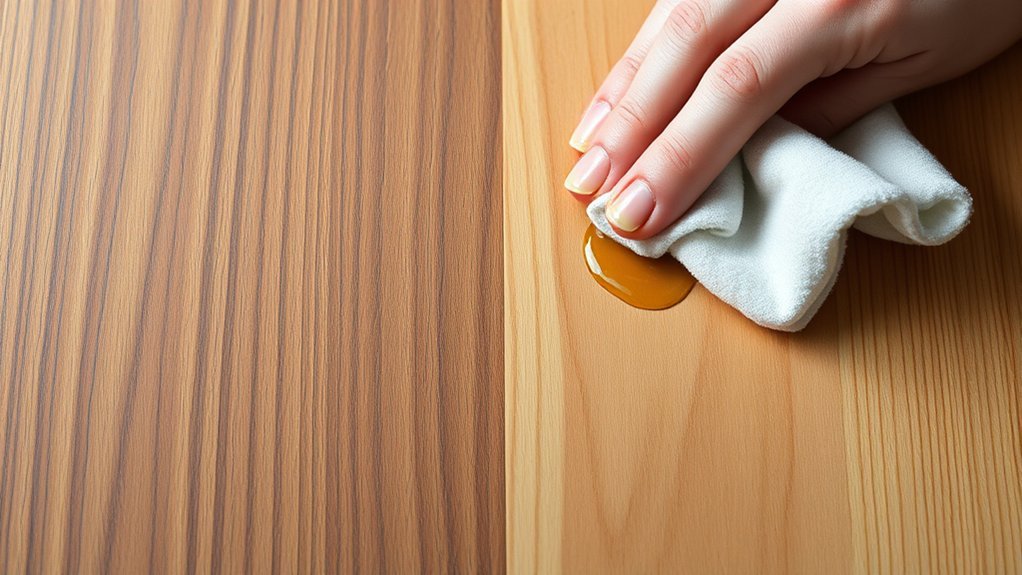
To maximize the protective benefits of Danish oil, proper application technique is key. First, confirm the wood surface is clean and dry for ideal penetration. Use a lint-free cloth or brush to apply the oil evenly, avoiding pooling.
Allow sufficient drying times between coats, typically 6-8 hours, to enable proper curing and durability. Lightly sand between coats with fine-grit sandpaper to enhance adhesion.
Key application techniques include:
- Apply a generous first coat to saturate the wood fibers
- Wipe off excess oil after 15 minutes to prevent tackiness
- Maintain consistent drying times for each layer
- Use multiple thin coats rather than one thick coat for better protection
Following these precise steps confirms Danish oil forms a resilient, water-resistant barrier on wood surfaces.
How Often Should You Reapply Danish Oil for Ongoing Protection?
How frequently should you reapply Danish oil to maintain ideal wood protection? The reapplication frequency largely depends on the wood’s exposure to environmental factors such as moisture, sunlight, and wear.
Typically, you should plan a maintenance schedule that includes reapplying Danish oil every 6 to 12 months for indoor furniture, and every 3 to 6 months for outdoor or high-traffic surfaces.
Regular inspection for signs of dryness, fading, or water absorption will guide your timing more precisely.
Adhering to a consistent maintenance schedule guarantees the oil continues to penetrate and protect the wood fibers effectively, preventing damage and prolonging the wood’s lifespan.
Tips to Maximize Danish Oil’s Protection
Where should you start to get the most out of Danish oil’s protective qualities? First, focus on proper surface preparation; verify the wood is clean and sanded smoothly. This step maximizes Danish oil benefits by allowing deeper penetration.
Next, master application techniques. Apply thin, even coats with a lint-free cloth or brush, allowing each layer to cure fully before adding the next. Avoid pooling or heavy application to prevent uneven drying.
Apply thin, even coats with a lint-free cloth, letting each layer fully cure before the next.
To enhance protection and durability:
- Sand lightly between coats with fine-grit sandpaper
- Apply multiple coats for increased resistance
- Work in a dust-free environment to avoid contamination
- Allow adequate drying time based on humidity and temperature
Following these steps verifies peak performance and longevity of Danish oil’s protective finish.
Best Wood Types and Projects for Using Danish Oil
Although Danish oil can enhance many wood types, it performs best on open-grain hardwoods like oak, walnut, and mahogany, where its penetrating qualities highlight the natural grain and provide durable protection. These best wood types allow the oil to seep deeply, reinforcing fibers and improving moisture resistance without obscuring texture.
When selecting ideal projects, consider furniture, cabinetry, and decorative woodwork that benefit from both aesthetic enhancement and moderate wear protection. Danish oil excels on surfaces exposed to occasional handling but not extreme abrasion or moisture.
Avoid using it on softwoods or plywood where absorption is uneven, leading to blotchy finishes. By matching Danish oil with the right wood species and project types, you maximize both its protective capabilities and visual appeal.
Frequently Asked Questions
Can Danish Oil Be Used on Outdoor Furniture Exposed to Sunlight?
You can use Danish oil on outdoor furniture, but its durability under sunlight is moderate. For ideal outdoor woodcare, reapply regularly and consider combining it with UV-resistant finishes to better protect wood from weathering and fading.
Is Danish Oil Safe for Cutting Boards and Food-Contact Surfaces?
Think of Danish oil as a shield for your wood. While it aids in wood preservation, it’s not FDA-approved for food safety.
For cutting boards, opt for food-grade oils like mineral or walnut to keep surfaces safe.
How Long Does Danish Oil Take to Fully Cure on Wood?
Danish oil typically takes 24 to 48 hours to dry, but the full curing process can last up to 7 days, depending on temperature and humidity.
Proper drying times guarantee maximum wood protection and finish durability.
Can Danish Oil Be Tinted or Colored Before Application?
Think of Danish oil as a painter’s palette. You can mix pigments directly into it, offering versatile tinting options. This color mixing lets you customize hues, but precise ratios are essential to maintain the oil’s protective and curing properties.
Does Danish Oil Have Any Unpleasant Odors During or After Application?
You might notice a mild odor during Danish oil application, but it dissipates quickly with proper ventilation. Using recommended application techniques helps minimize odor duration, ensuring a more comfortable experience while achieving ideal wood finish results.
Conclusion
If you want reliable wood protection, Danish oil is a solid choice, penetrating deep to seal about 60% of the wood’s surface pores. This helps guard against moisture while enhancing the natural grain.
However, it’s less resistant to scratches than harder finishes, so expect periodic reapplication every 6–12 months for ideal durability. By applying it properly and maintaining it, you’ll keep your wood both beautiful and protected without heavy buildup or cracking.
Overall, Danish oil protects wood effectively by combining moisture resistance with a natural finish, making it a popular option for wood preservation.