To use your Dewalt table saw safely, start by setting it up on a sturdy, level surface and unplugging it before making any adjustments.
Adjust the blade height so it sits just above your material and ensure the fence is aligned parallel to the blade for precise cuts.
Use steady, smooth motions whether you are ripping or crosscutting. This will help you achieve clean, accurate cuts while maintaining control over the saw.
Regular maintenance is important for your Dewalt table saw. Clean and sharpen the blade frequently to keep it running efficiently.
To avoid common issues and keep your saw running smoothly, exploring proper maintenance and troubleshooting tips is highly recommended.
Set Up Your Dewalt Table Saw Safely
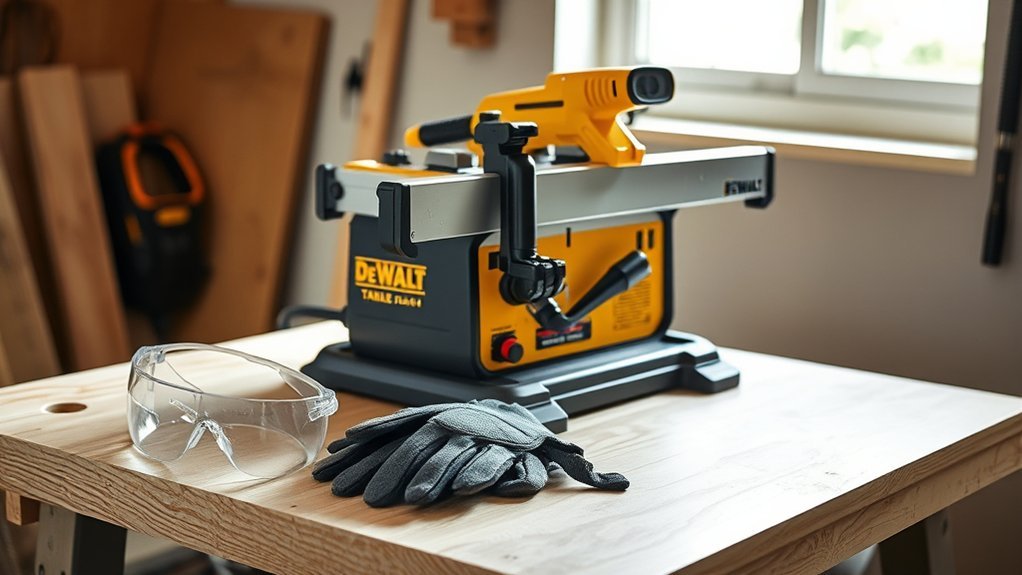
Before you start using your Dewalt table saw, it’s essential to set it up correctly to guarantee both accuracy and safety. Begin by selecting a sturdy, level surface in a well-lit area.
Organize your workspace to keep it free of clutter, guaranteeing you have ample room to maneuver large pieces of wood safely. Always unplug the saw before making adjustments or cleaning.
Check that all safety precautions are in place: install the blade guard, anti-kickback pawls, and riving knife. Confirm the blade is sharp and properly aligned.
Ensure safety by installing guards, anti-kickback pawls, riving knife, and confirming a sharp, aligned blade.
Use push sticks and keep your hands clear of the blade path. Finally, verify the saw’s power cord is safely positioned to avoid tripping or accidental unplugging during operation.
This setup forms the foundation for precise, safe cuts.
Adjust the Blade and Fence for Perfect Cuts
Once your Dewalt table saw is set up safely and your workspace is clear, the next step is to fine-tune the blade and fence to guarantee your cuts come out clean and accurate. Start by adjusting the blade height so it extends about 1/8 inch above the material thickness; this minimizes tear-out and improves cut quality.
Use the blade height wheel to raise or lower the blade precisely. Next, check the fence alignment to confirm it’s perfectly parallel to the blade. Misaligned fences cause binding and inaccurate cuts.
Loosen the fence lock, adjust the fence using the alignment scale, then lock it securely in place. Double-check with a square or measuring tool for accuracy. Proper blade height and fence alignment are essential for smooth, safe, and precise cutting every time.
Make Common Cuts With Your Dewalt Table Saw

Mastering common cuts on your Dewalt table saw will considerably expand your woodworking capabilities and efficiency. Start with rip cuts by setting the fence to the desired width and feeding the wood steadily against the blade. Keep your hands clear and maintain control throughout.
For precise crosscut techniques, use a miter gauge or crosscut sled to hold the wood firmly at a 90-degree angle. This prevents binding and guarantees clean, accurate cuts. Always adjust the blade height so it’s just above the material thickness to minimize tear-out.
Practice smooth, consistent motions without forcing the wood, and double-check measurements before cutting. By mastering these fundamental rip cuts and crosscut techniques, you’ll tackle most woodworking projects with confidence and precision using your Dewalt table saw.
Keep Your Dewalt Table Saw Running Smoothly
Regular maintenance is key to keeping your Dewalt table saw running smoothly and safely. Focus on blade maintenance tips like regularly cleaning resin buildup and checking for dullness to guarantee precise cuts.
Proper dust collection techniques not only extend the saw’s life but also maintain a clean work area.
| Task | Recommendation |
|---|---|
| Blade Cleaning | Use a soft brush and mild solvent |
| Blade Sharpening | Sharpen every 20 hours of use |
| Dust Collection | Connect a vacuum or dust extractor |
| Lubrication | Apply lubricant to moving parts |
| Inspection | Check alignment and tighten bolts |
Stick to this routine, and you’ll enjoy consistent performance and enhanced safety with your Dewalt table saw.
Fix Common Problems With Your Dewalt Table Saw
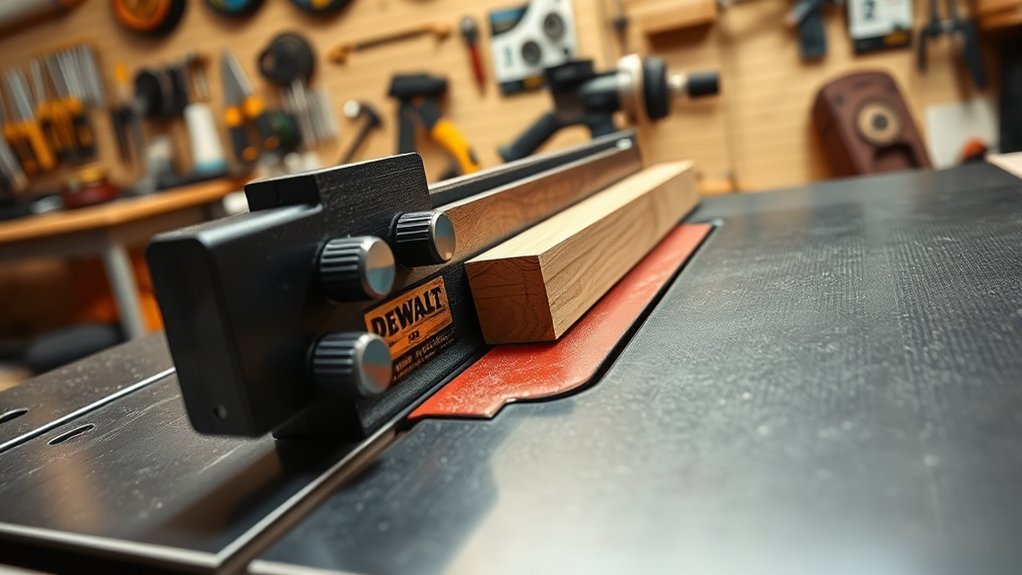
Although Dewalt table saws are built to last, you might occasionally encounter issues that affect performance or safety. One common problem is blade alignment issues. If your cuts aren’t straight or the blade binds, check the fence and blade alignment with a square.
Adjust the blade so it’s parallel to the miter slot to prevent kickback and guarantee accuracy. Motor problems can also arise, such as the saw failing to start or losing power mid-cut.
Inspect the power cord for damage, clean dust from the motor vents, and check the brushes if your model has them. Regular maintenance and addressing these issues promptly will keep your Dewalt table saw running safely and efficiently.
Frequently Asked Questions
What Safety Gear Should I Wear When Using a Dewalt Table Saw?
You should wear personal protective gear like safety glasses, hearing protection, and a dust mask.
Safety precautions also include avoiding loose clothing and using push sticks to keep your hands clear of the blade at all times.
Can I Use a Dewalt Table Saw for Cutting Metal or Only Wood?
You won’t conquer dragons with a wooden sword. Similarly, Dewalt table saws excel at wood cutting but can handle metal cutting only with specific blade types designed for metal. Always choose blades suited for your material.
What Is the Warranty Period for Dewalt Table Saws?
You get a three-year warranty coverage on Dewalt table saws, protecting against defects. Remember, following maintenance tips like regular blade cleaning helps keep your saw in top shape and guarantees your warranty stays valid.
How Much Space Do I Need to Operate a Dewalt Table Saw Safely?
You’ll need at least 10 feet of workspace layout in front and behind the saw, plus 3 feet on each side for operational clearance. This guarantees safe material handling and prevents accidents during cuts.
Are There Any Recommended Accessories for Enhancing Dewalt Table Saw Performance?
When Jake upgraded his Dewalt with precision blades and a sturdy table saw stand, his cuts became cleaner and more accurate. You’ll want these accessories. They improve stability and blade performance, making your work safer and more precise.
Conclusion
Now that you’ve got the hang of setting up, adjusting, and maintaining your Dewalt table saw, you’re ready to tackle any project with confidence.
Remember, practice makes perfect, so don’t rush your cuts or skip maintenance—these small steps keep your saw running like a well-oiled machine.
When problems pop up, nip them in the bud early to avoid bigger headaches down the road.
Stick with it, and you’ll be cutting like a pro in no time using your Dewalt table saw.