A typical table saw uses between 1,200 and 1,800 watts while running, but starting watts can surge two to three times higher to overcome motor inertia.
Your saw’s power consumption varies with motor size, blade type, and the material you cut, as denser woods or dull blades increase load and energy use.
To accurately estimate energy costs, you’ll need to know both running wattage and the time you operate it.
Understanding these details prepares you to optimize your setup and efficiency.
How Many Watts Does a Typical Table Saw Use?
How much power does a typical table saw draw during operation? Generally, most table saws consume between 1,200 to 1,800 watts while running. This range depends on motor size and design, affecting table saw efficiency.
Higher efficiency models convert more electrical energy into mechanical work, reducing power consumption without compromising cutting performance. When evaluating a table saw’s power consumption, consider both the rated wattage and actual load during use, as cutting resistance influences energy draw.
Efficient table saws maintain consistent motor speed under load, ensuring steady power usage and better operational control. Understanding these factors helps you select a saw that balances power needs with energy efficiency, optimizing both performance and electricity costs during woodworking tasks.
Why Are Starting Watts Higher Than Running Watts on Table Saws?
While a typical table saw uses between 1,200 to 1,800 watts during operation, the initial power required to start the motor is considerably higher. This phenomenon occurs due to the starting power, often called surge current, which is necessary to overcome the motor’s inertia and bring the blade up to operational speed.
When you first power on the saw, the motor demands a rapid influx of electrical energy to generate sufficient torque. This surge current can be two to three times greater than the running watts. Once the blade reaches steady rotation, the motor requires less power to maintain speed, resulting in lower running watts.
Understanding this distinction helps you anticipate electrical load demands and select appropriate circuit protection for your table saw.
Key Factors That Affect Table Saw Power Consumption

Because several variables influence a table saw’s energy use, you need to contemplate factors like motor size, blade type, cutting material, and operational speed to accurately assess its power consumption. Among these, motor efficiency plays a vital role; a highly efficient motor converts electrical energy into mechanical work more effectively, reducing wasted power.
Power ratings provide a baseline for expected consumption but don’t account for real-world variations. For instance, using a dull or inappropriate blade increases load, causing the motor to draw more current. Similarly, denser or thicker materials demand greater torque, elevating power draw.
Operational speed adjustments also impact consumption; higher RPMs usually increase wattage. By analyzing these factors collectively, you can better predict actual energy demands beyond nominal power ratings, optimizing performance and energy use.
How Motor Size Influences Table Saw Wattage
When selecting a table saw, you’ll notice motor horsepower directly correlates with wattage, affecting overall power consumption. Larger motors require more watts but provide greater cutting capacity and efficiency.
It’s essential to match motor size to your specific tasks to optimize energy use without sacrificing performance.
Motor Horsepower And Watts
Although it might seem straightforward, understanding how motor horsepower translates to watts is essential for accurately evaluating a table saw’s power consumption. One horsepower equates to approximately 746 watts, but this theoretical conversion doesn’t account for real-world motor efficiency.
When you assess a table saw’s power ratings, you need to contemplate how efficiently the motor converts electrical power into mechanical output. Motor efficiency typically ranges from 70% to 90%, meaning the actual wattage drawn can exceed the nominal horsepower-based calculation.
For example, a 1.5 HP motor might consume around 1,200 watts instead of the ideal 1,119 watts due to losses. By factoring in motor efficiency alongside horsepower, you can more precisely gauge the electrical demand and performance characteristics of the table saw’s motor.
Impact On Power Consumption
Three key factors determine how motor size impacts a table saw’s wattage: horsepower rating, operational load, and efficiency. When you select a motor with higher horsepower, expect increased power consumption, especially under heavy loads.
However, power efficiency plays a vital role; a well-designed motor converts electrical energy to mechanical output more effectively, reducing wasted energy and consequently lowering wattage demands for identical tasks.
Your energy management strategy should consider that larger motors, while capable of handling tougher cuts, may operate below peak efficiency when underutilized, leading to unnecessary power draw. Understanding how these elements interact enables you to optimize your table saw’s wattage consumption, balancing motor size with energy efficiency to prevent excessive power use during typical woodworking operations.
Matching Motor To Task
Selecting the right motor size directly impacts your table saw’s wattage consumption and overall performance. Proper motor selection guarantees efficiency and task suitability, minimizing energy waste while maintaining cutting precision.
Here’s how motor size influences wattage and effectiveness:
- Light-Duty Tasks: Small motors (around 1-1.5 HP) consume less wattage, ideal for softwood and thin materials.
- Medium-Duty Tasks: Moderate motors (1.5-2 HP) balance power and consumption for hardwoods and thicker stock.
- Heavy-Duty Tasks: Larger motors (2+ HP) draw considerably more watts but handle dense materials and prolonged use without bogging down.
- Overpowered Motors: Excessive motor size leads to unnecessary wattage use and higher costs without improving task suitability.
Choose a motor size aligned with your workload to optimize wattage efficiency and cutting performance.
How Different Cutting Materials Affect Table Saw Wattage
When you cut through denser or harder materials, your table saw demands more wattage to maintain blade speed and torque. Material density directly influences the power draw; higher density materials require increased wattage to sustain cutting speed and prevent blade stalling.
Understanding this helps you optimize your saw’s performance and avoid motor strain.
| Material Type | Relative Wattage Demand |
|---|---|
| Softwood | Low |
| Hardwood | Moderate |
| MDF/Plywood | Moderate |
| Plastic/Composite | Low to Moderate |
| Metal (thin gauge) | High |
Adjusting feed rate and blade sharpness also impacts wattage consumption, but material density remains the primary factor affecting power requirements during cutting.
Portable vs Stationary Table Saws: How Their Wattage Compares
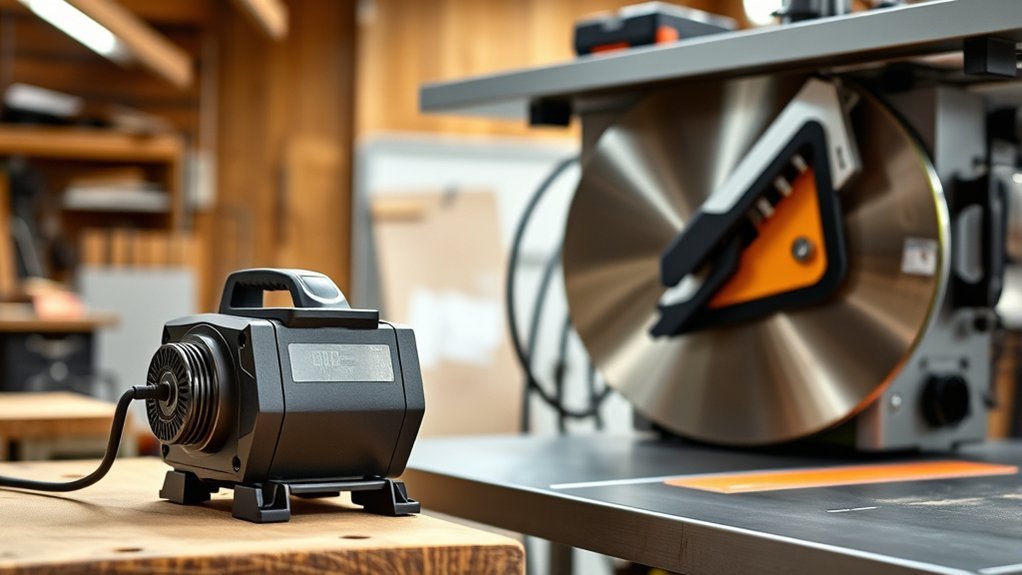
Portable and stationary table saws differ considerably in their wattage requirements due to design and intended use. When comparing a portable table to a stationary table saw, consider these factors:
- Motor Power: Portable table saws typically use motors between 1,200–1,800 watts, while stationary tables often exceed 2,000 watts for heavy-duty cutting.
- Cutting Capacity: Stationary tables handle thicker, denser materials, necessitating higher wattage.
- Duty Cycle: Portable tables are designed for intermittent use, consuming less power; stationary tables run longer, requiring more robust motors.
- Portability vs. Power: Portable tables prioritize compactness and lower wattage for mobility, whereas stationary tables focus on power and continuous operation.
Understanding these distinctions helps you select the right table saw wattage based on your workspace and project demands.
Calculating Electricity Costs From Table Saw Wattage
To calculate your table saw’s electricity cost, you first need to understand its wattage rating and how long you typically use it. By multiplying the wattage by your usage time, you can estimate the energy consumed in kilowatt-hours (kWh).
Finally, applying your local electricity rate to this value will give you a precise cost estimate.
Understanding Wattage Ratings
Although wattage ratings provide a straightforward measure of a table saw’s power consumption, understanding how to translate these figures into actual electricity costs requires analyzing both the saw’s operating wattage and your local energy rates.
Wattage definitions clarify that power ratings represent the electrical power the saw draws under specific conditions. To accurately assess costs:
- Identify the rated wattage on the saw’s label. This is the maximum power draw.
- Note the running wattage, often lower than the rated wattage during typical use.
- Obtain your electricity rate (cents per kilowatt-hour) from your utility bill.
- Use the formula: (Running Wattage ÷ 1000) × Hours Used × Rate to calculate cost.
Understanding these elements guarantees precise cost estimations based on power ratings rather than just nominal wattage.
Estimating Usage Time
Knowing the running wattage and your electricity rate sets the stage for calculating costs, but accurately estimating how long you use your table saw is equally important. To determine usage duration, record the actual time the saw operates under load, not just total session length, since power draw varies between idling and cutting.
Precise power estimates depend on this differentiation. You can track usage duration through timed observations or by using a power meter that logs active consumption. Factor in typical job cycles, how often and how long you cut, to refine your estimates.
Combining these usage duration metrics with wattage data allows you to better analyze energy consumption patterns and prepare for subsequent cost calculations. This analytical approach guarantees your power estimates reflect real-world operation rather than theoretical maximums.
Calculating Energy Costs
Calculating energy costs from your table saw’s wattage requires combining power consumption data with your local electricity rates and actual usage time. To perform an accurate cost analysis, follow these steps:
- Identify the table saw’s wattage rating (W).
- Estimate the total usage time in hours (h).
- Multiply wattage by hours to get energy consumption in watt-hours (Wh), then convert to kilowatt-hours (kWh) by dividing by 1,000.
- Multiply the kWh by your local electricity rate ($/kWh) to determine the cost.
This method quantifies your saw’s energy efficiency in monetary terms, enabling you to optimize usage or select models that reduce operating expenses. Understanding these calculations helps guarantee your cost analysis is precise and supports informed decisions about tool operation and energy consumption.
How to Choose a Table Saw Based on Your Power Supply
When selecting a table saw, you’ll need to match its power requirements with your available power supply to guarantee peak performance and safety. Start by evaluating the voltage and amperage capacity of your workspace’s electrical system.
Table saw features such as motor size and horsepower directly influence wattage consumption, which typically ranges between 1,200 to 2,000 watts for standard models. Evaluate power supply options; 120V circuits are common but may limit saw power. 240V circuits support higher-capacity motors suited for heavy-duty cutting.
Also, confirm that your circuit breaker can handle the saw’s startup current surge to prevent tripping. By aligning the table saw’s electrical demands with your power supply capabilities, you optimize operational efficiency and minimize electrical hazards. This technical matching ensures reliable, safe functionality tailored to your specific setup.
Energy-Saving Tips for Table Saw Users
To reduce your table saw’s energy consumption, focus on optimizing motor efficiency by maintaining proper lubrication and avoiding overload. Selecting energy-efficient blades with low resistance can greatly decrease power draw during cuts. These adjustments help you maximize performance while minimizing electricity use.
Optimize Motor Efficiency
Although table saws are designed for high power output, you can greatly reduce energy consumption by optimizing motor efficiency. Performing regular motor maintenance is essential to guarantee that the saw operates at peak performance. Conducting energy audits helps identify inefficiencies and allows targeted improvements.
To optimize motor efficiency, consider these steps:
- Inspect and clean motor components regularly to prevent dust buildup that impedes cooling.
- Lubricate bearings and moving parts to reduce friction and energy loss.
- Verify electrical connections and voltage supply to maintain consistent motor performance.
- Monitor motor load during operation to avoid overloading, which increases wattage draw unnecessarily.
Use Energy-Efficient Blades
Because the blade directly influences cutting efficiency, choosing energy-efficient blades can markedly reduce your table saw’s power consumption. Blades with ideal blade material and energy efficient features minimize resistance and motor load, improving cutting speed and accuracy while lowering wattage use.
Selecting carbide-tipped or high-speed steel blades enhances durability and maintains sharpness longer, reducing energy waste from frequent blade changes.
| Blade Material | Energy Efficient Features |
|---|---|
| Carbide-Tipped | Longer sharpness retention |
| High-Speed Steel | Reduced friction during cuts |
| Diamond-Coated | Superior cutting precision |
When Should You Upgrade Your Workshop’s Electrical Setup?
How do you determine the right moment to upgrade your workshop’s electrical setup? Prioritizing workshop upgrades guarantees ideal electrical safety and equipment performance. Consider these key indicators:
1. Frequent Circuit Breaker Trips
Repeated trips suggest your current system can’t handle the load.
2. Adding High-Power Tools
New machinery like table saws with high wattage demands may exceed existing capacity.
3. Outdated Wiring
Older wiring may not meet today’s safety codes, increasing fire risks.
4. Insufficient Outlets
Limited outlets force unsafe extension cord use, compromising electrical safety.
If you notice these issues, upgrading your electrical setup is critical to support your tools efficiently and maintain a safe workshop environment.
Frequently Asked Questions
What Safety Features Should I Look for in a Table Saw?
You should look for blade guards to prevent accidental contact, and an emergency stop feature for immediate power cut-off. These safety features minimize injury risk while ensuring precise, controlled operation during cutting tasks.
How Often Should I Sharpen the Table Saw Blade?
You should adjust blade sharpening frequency based on usage, typically every 20-30 hours of cutting. Employ precise sharpening techniques like diamond honing or professional grinding to maintain peak cutting performance and prolong blade life.
Can I Use a Table Saw Outdoors Safely?
You can use a table saw outdoors safely if you guarantee proper outdoor safety measures, including stable surfaces and weather protection to prevent moisture damage and electrical hazards.
Always use GFCI outlets and avoid wet conditions for safe operation.
What Maintenance Is Required for a Table Saw Motor?
Think of your table saw motor as a heart; regular motor cleaning and following a strict lubrication schedule keep it beating efficiently.
Neglecting these steps risks overheating, wear, and decreased performance, so stay vigilant and precise.
Are There Quieter Table Saw Models Available?
Yes, you’ll find table saw models designed for quiet operation, featuring advanced noise reduction technologies like insulated motors and vibration dampening. These technical enhancements considerably minimize sound without sacrificing performance or power.
Conclusion
Understanding how many watts your table saw uses is essential to keeping your workshop running smoothly without overloading circuits. Since starting watts can be markedly higher than running watts, you should always factor in these peaks when planning your power needs.
Remember, cutting through the noise means choosing the right motor size and power source for your materials and tasks. By doing so, you’ll avoid costly surprises and keep your projects on the cutting edge.
In conclusion, knowing how many watts a table saw uses helps ensure you select the proper equipment and power setup for safe and efficient operation.