When you’re working with an M12 bolt, selecting the correct drill bit size is more critical than you might think. Using the wrong bit can cause an improper fit or weaken the joint.
You’ll need to decide whether you’re drilling a clearance hole or a tapped hole, as each requires a different bit diameter. Understanding these subtle differences can save you from costly mistakes and guarantee a reliable assembly.
But how do you determine the exact sizes? Knowing the right drill bit size for an M12 bolt is essential for a successful project.
For clearance holes, the drill bit size should be slightly larger than the bolt diameter to allow the bolt to pass through smoothly. Typically, a 13 mm drill bit is used for an M12 bolt clearance hole.
On the other hand, if you’re drilling a tapped hole to thread the bolt into, the drill bit size needs to be smaller. For tapping an M12 bolt, a drill bit size of approximately 10.2 mm is generally recommended.
This allows enough material for the threads to form properly without compromising the strength of the joint. Choosing the correct drill bit size for an M12 bolt ensures your assembly is both secure and durable.
What Drill Bit Size Matches an M12 Bolt Hole?
When selecting a drill bit for an M12 bolt hole, you need to match the bit size to the bolt’s outer diameter for a proper fit. According to M12 thread specifications, the nominal diameter is 12 millimeters.
For most M12 bolt applications, you’ll require a drill bit slightly larger than 12 mm to accommodate the bolt’s threads or a clearance hole. Typically, a 13 mm drill bit is used for clearance holes to allow the bolt to pass through without binding.
If you’re preparing for tapping threads, the drill bit size must correspond to the minor diameter, often around 10.2 mm. Understanding these distinctions guarantees your drilled hole aligns with the functional requirements of your M12 bolt application, maintaining structural integrity and proper fit.
How to Pick the Right Drill Bit for Your M12 Bolt
Selecting the right drill bit for your M12 bolt involves understanding the specific requirements of your application, including whether you need a clearance hole or a tapped hole. To ascertain effective bolt installation, follow these steps:
- Identify the hole type: clearance holes require a slightly larger drill bit, tapped holes need a bit matching the thread size.
- Choose the appropriate drill bit types: twist bits for metal, cobalt or carbide for harder materials.
- Verify the drill bit diameter: for clearance, use 13mm; for tapping, refer to M12 tap drill size, typically 10.2mm.
- Confirm material compatibility: select drill bits suited to your material to prevent wear and guarantee precision.
This methodical approach ensures the best bolt fit and structural integrity.
Drill Bit Sizes to Avoid When Working With M12 Bolts
Although it might seem tempting to use drill bits close to the M12 bolt size, you should avoid those that are too small or too large, as they compromise fit and strength. Using a drill bit smaller than the recommended size restricts bolt installation, causing excessive friction or thread damage.
Conversely, oversized drill bits create loose holes, reducing load capacity and risking joint failure. When selecting drill bit types, avoid generic bits that don’t match the material or hole precision required for M12 bolts. For example, high-speed steel bits may not be suitable for hardened steel plates.
Instead, stick to drill bits specifically designed for the material and thread clearance. Proper sizing guarantees secure bolt installation and structural integrity, so avoiding improper drill bit sizes is critical for performance and safety.
Tips for Drilling Precise Holes for M12 Bolts
Ensuring precise holes for M12 bolts requires careful preparation and technique to maintain alignment and dimensional accuracy. To optimize your drilling techniques and achieve flawless hole alignment, follow these steps:
- Secure the workpiece firmly to prevent movement that could skew hole placement.
- Mark the exact drill point using a center punch to guide the drill bit accurately.
- Use a drill press or guide to maintain perpendicularity and consistent hole depth.
- Drill at a steady speed with appropriate lubrication to reduce bit wear and prevent overheating.
Using Pilot Holes and Countersinks for M12 Bolts
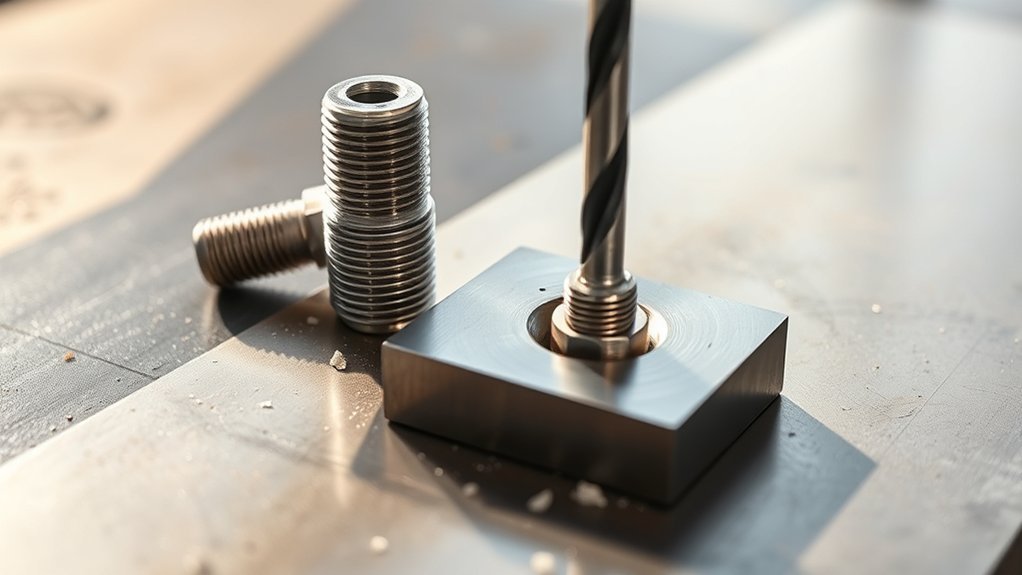
Once you’ve secured accurate hole placement for your M12 bolts, incorporating pilot holes and countersinks enhances both alignment and fastening strength. Pilot hole techniques reduce material stress and prevent bolt thread damage by guiding the larger drill bit.
Countersink depth must be precisely calculated to allow the bolt head to sit flush without compromising material integrity. Use the table below to determine ideal pilot hole diameter and countersink depth for common M12 applications:
| Bolt Type | Pilot Hole Diameter (mm) | Countersink Depth (mm) |
|---|---|---|
| Standard M12 | 10.0 | 3.5 |
| High-Tensile | 9.8 | 4.0 |
| Fine Thread | 10.2 | 3.2 |
Apply these parameters to guarantee reliable, structurally sound fastening with your M12 bolts.
How Material Type Affects Your M12 Bolt Drill Bit Choice
Because different materials respond uniquely to drilling, selecting the correct drill bit size for your M12 bolt depends heavily on the material you’re working with. You need to take into account:
- Material density: Denser materials require slightly smaller drill bits to guarantee a tight bolt fit, while softer materials may need a slightly larger hole for proper engagement.
- Thermal conductivity: High-heat materials demand drill bit coatings like titanium nitride to reduce wear and maintain hole precision.
- Material brittleness: Brittle materials require slower drill speeds and possibly specialized bits to prevent cracking.
- Surface hardness: Hard surfaces necessitate hardened steel or carbide drill bits with specific coatings to penetrate effectively without dulling.
Conclusion
Choosing the right drill bit size for your M12 bolt is like fitting a key to its lock—precision guarantees strength and reliability. Use a 13 mm bit for clearance holes to let the bolt glide smoothly, or a 10.2 mm bit for tapped holes to achieve a secure thread engagement.
Avoid undersized or oversized bits to maintain structural integrity. Matching the drill size to the bolt’s purpose and the material you’re working with is essential.
Remember, selecting the correct size drill bit for a M12 bolt keeps your assembly tight and dependable every time.