Think of a 15/64 drill bit as a precise key designed to release specific engineering challenges. A 15/64 drill bit measures approximately 0.234375 inches in diameter, or about 5.95 millimeters.
This size fits neatly between common fractional and metric increments. Understanding this equivalency isn’t just academic—it’s essential for ensuring a perfect fit in your project.
But how does this size function in practical terms? When should you opt for a 15/64 drill bit?
What Size Is a 15/64 Drill Bit in Inches?
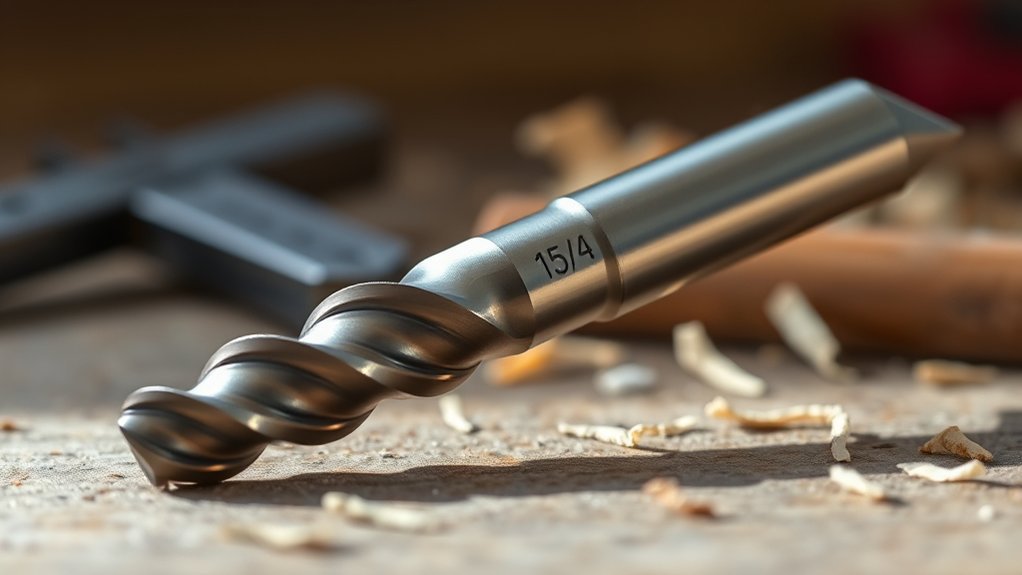
A 15/64 drill bit measures exactly 0.234375 inches in diameter. When selecting drill bit types, understanding this precise size helps you match the bit to your project requirements accurately.
This fractional size falls between common drill bit increments, making it crucial for tasks demanding tight tolerances. Usage guidelines recommend employing a 15/64 bit when the hole diameter must be slightly larger than 15/64 inches but smaller than 1/4 inch.
Ideal for precision work where hole size is just above 15/64 inches yet below 1/4 inch.
This size is particularly useful in metalworking and woodworking applications where precision is critical. By knowing the exact decimal equivalent of the 15/64 drill bit, you can guarantee compatibility with fasteners and components, minimizing errors during assembly or fabrication processes.
Always verify bit size against your material specifications before drilling.
How to Convert 15/64 Inches to Decimal and Metric Sizes
When converting 15/64 inches to decimal and metric sizes, you’ll first express the fraction as a decimal by dividing 15 by 64, resulting in 0.234375 inches. This decimal is vital for accurate measurement techniques when selecting drill bit types for precision tasks.
To convert this decimal to metric, multiply 0.234375 inches by 25.4 (the millimeters per inch conversion factor), yielding approximately 5.953 mm. This precise metric equivalent helps you identify compatible drill bits in metric sets, ensuring consistent hole sizes.
Using decimal and metric conversions streamlines your workflow when working with diverse drill bit types and specifications, allowing you to maintain accuracy regardless of the measurement system. Accurate conversions are critical for achieving ideal results in machining and construction projects.
How Does a 15/64 Drill Bit Compare to Common Sizes?
You’ll find that a 15/64 drill bit measures approximately 0.2344 inches, which closely aligns with a 6 mm metric size.
When comparing fractional sizes, it sits just between 15/64 and 3/16 inches, offering a precise intermediate option. Understanding these equivalents helps guarantee you select the right bit for your project’s exact requirements.
Metric Size Equivalent
Understanding the metric size equivalent of a 15/64 drill bit helps you select the right tools for projects requiring precise measurements. The 15/64 inch drill bit converts to a decimal size of approximately 0.2344 inches.
When you convert this decimal to metric, it equates to roughly 5.953 millimeters. In practical terms, this means the 15/64 drill bit closely aligns with a 6 mm metric drill bit, though it is slightly smaller by about 0.047 mm.
This subtle difference can be critical in applications demanding high precision. By knowing the exact decimal conversion and its metric size counterpart, you can guarantee compatibility with metric fasteners and components, avoiding mismatches that could compromise assembly integrity or performance.
Use this information to refine your drill bit selection in metric contexts.
Closest Fractional Sizes
Several closely related fractional drill bit sizes bracket the 15/64 inch diameter, allowing you to gauge its position among common sizes. Understanding these fractional comparisons helps you select the right drill bit type for precise applications.
- 1/4 inch (0.250″) Slightly larger, often used for more substantial holes.
- 7/32 inch (0.219″) Just smaller, suitable for slightly tighter fits.
- 1/16 inch (0.0625″) Much smaller, typically for delicate tasks.
- 1/2 inch (0.500″) Noticeably larger, for heavy-duty drilling.
The 15/64 bit (0.2344″) sits between 7/32 and 1/4 inch sizes, providing a fine balance in fractional comparisons. Choosing the correct drill bit type guarantees ideal hole size and material integrity in your projects.
When Should You Choose a 15/64 Drill Bit?
You should choose a 15/64 drill bit when working with materials that require a slightly larger hole than 1/4 inch, such as certain metals or hardwoods. Its precise diameter makes it ideal for applications demanding tight tolerances and smooth finishes.
Use it in scenarios where accuracy in hole size directly impacts assembly or performance.
Ideal Material Applications
Selecting a 15/64 drill bit is ideal when working with materials that require a hole diameter of approximately 0.234 inches, such as medium-density woods, soft metals like aluminum, and certain plastics. Understanding the drill bit materials and application techniques guarantees peak performance and precision.
You should choose a 15/64 drill bit when:
- Drilling pilot holes in hardwood furniture, where accuracy avoids splitting.
- Creating clearance holes in aluminum sheets, maintaining structural integrity.
- Fabricating components from acrylic or PVC, preventing material cracking.
- Preparing holes for dowels or fasteners in medium-density fiberboard (MDF).
These scenarios highlight the importance of selecting the right drill bit size and material compatibility to enhance efficiency and reduce wear during your projects.
Precision Drilling Scenarios
Although the 15/64 drill bit size may seem unconventional, it provides precise control when creating holes that demand exact diameters near 0.234 inches. You should choose this bit in precision applications where tolerance margins are tight, such as in aerospace components or intricate metalwork.
Its specific diameter allows you to achieve consistent hole sizes without oversizing or undersizing, critical in assembly fitments or press fits. When employing advanced drilling techniques, including peck drilling or step drilling, the 15/64 bit guarantees accuracy while minimizing material stress.
If your project requires holes that standard fractional sizes can’t accommodate, this bit offers a tailored solution. Using it enhances your control over hole dimensions, improving the quality and reliability of your finished workpiece.
What Materials Work Best With a 15/64 Drill Bit?
Several materials respond most effectively to drilling with a 15/64 drill bit due to its specific diameter and structural properties. Understanding material compatibility is essential for optimizing drilling techniques and ensuring clean, precise holes. This bit excels in applications requiring moderate hole size and strength.
- Softwoods Ideal for woodworking projects where clean cuts and reduced splintering matter.
- Aluminum Its moderate hardness pairs well with this bit, preventing bit wear and material deformation.
- Plastic composites The bit’s diameter allows controlled penetration without cracking sensitive surfaces.
- Mild steel Suitable for light metal fabrication tasks, balancing speed and hole accuracy.
You’ll find the 15/64 bit versatile when matched with these materials, enhancing your drilling precision and efficiency.
How to Measure a 15/64 Drill Bit Accurately
Understanding which materials suit a 15/64 drill bit helps highlight the importance of measuring the bit accurately before use. For precise drill bit measurement, start by cleaning the bit to remove debris that may affect sizing.
Use a digital caliper to measure the diameter at the widest point of the cutting edge, ensuring you obtain an exact reading. Avoid relying on visual estimation or conventional rulers, as these can lead to inaccuracies. Confirm the measurement is consistent along the bit’s length to rule out tapering.
Accurate sizing guarantees compatibility with your project’s specifications, preventing drilling errors. By following this methodical approach, you’ll maintain drill bit integrity and optimize performance for tasks requiring a 15/64 inch diameter.
Matching Fractional and Metric Drill Bit Sizes
You need to grasp how fractional drill sizes relate to metric measurements to find accurate equivalents. By converting fractional inches to millimeters, you can identify common drill bits that closely match.
This process guarantees you select the right tool when switching between measurement systems.
Understanding Fractional Drill Sizes
Although fractional drill sizes are common in many workshops, matching them to their metric equivalents requires careful measurement and reference to standardized charts. When you work with various drill bit types, understanding fractional conversion becomes essential to guarantee precision.
You’ll often encounter these key challenges:
- Variations in fractional sizes that don’t directly align with metric increments
- The need to verify drill diameter tolerances for exact fits
- Differences in drill bit types affecting compatibility and application
- Reliance on accurate fractional-to-metric charts to avoid costly errors
Converting Fractional To Metric
When converting fractional drill sizes to metric equivalents, you must rely on precise measurements and standardized conversion tables to affirm accuracy. Fractional measurement techniques involve expressing drill bit diameters as fractions of an inch, requiring exact decimal conversion before applying metric conversion methods.
To match fractional sizes with metric counterparts, first convert the fraction to a decimal inch value, then multiply by 25.4 to obtain millimeters. This two-step process minimizes errors inherent in direct estimation.
Standardized conversion charts streamline this workflow by listing exact metric equivalents for common fractional sizes. Employing these methods assures your drill bit selection meets tight tolerances, essential for engineering applications where dimensional precision impacts performance and fit.
Common Equivalent Drill Bits
Several fractional drill bit sizes have closely matching metric equivalents that you can use interchangeably in many applications. Understanding these common equivalent drill bits guarantees accuracy in your projects and optimizes your drilling techniques. Here are four key matches to keep in mind:
- A 15/64 inch drill bit equals approximately 5.95 mm, closely matching a 6 mm metric bit.
- A 1/8 inch bit corresponds nearly to a 3 mm metric bit.
- A 1/4 inch bit aligns well with a 6.35 mm metric bit.
- A 5/16 inch bit is close to an 8 mm metric bit.
Knowing these equivalents helps you select the right drill bit types quickly, maintaining precision without switching tools unnecessarily. This knowledge enhances efficiency and reduces errors in your drilling tasks.
Common Projects That Use a 15/64 Drill Bit
Many woodworking and metalworking tasks require the precise size of a 15/64 drill bit to guarantee accurate hole diameters. In woodworking projects, this bit is ideal for drilling pilot holes for screws, making sure tight joins without splitting the wood.
It’s also used when creating dowel holes that demand exact diameters to maintain structural integrity. In metalworking applications, the 15/64 drill bit is commonly employed for drilling clearance holes in light-gauge metal sheets, allowing bolts or fasteners to pass through smoothly.
Additionally, it suits tasks requiring precise hole dimensions for machine components or assembly parts. Using this drill bit size guarantees consistent fit and finish across diverse project requirements, making it a versatile tool in both woodworking and metalworking environments.
Tips for Using a 15/64 Drill Bit Safely and Effectively
Although a 15/64 drill bit may seem straightforward to use, applying proper technique guarantees both safety and accuracy. You must integrate safety precautions and effective techniques to maximize performance and minimize risks.
- Always secure your workpiece firmly to prevent movement that could cause bit breakage or injury.
- Use the appropriate drill speed; excessive speed generates heat, dulling the bit and compromising precision.
- Wear safety goggles and gloves to protect against flying debris and sharp edges.
- Apply steady, moderate pressure. Too much force risks bit damage, while too little reduces drilling efficiency.
Where to Buy Quality 15/64 Drill Bits and What to Look For
Finding quality 15/64 drill bits requires evaluating material composition, manufacturing standards, and brand reputation. When sourcing these bits, prioritize quality brands known for using high-speed steel (HSS) or cobalt alloys, which guarantee durability and precision.
Check for adherence to ISO or ANSI standards to assure consistent dimensions and performance. Online retailers offer a broad selection, but verify seller credibility through reviews and product specifications.
Avoid ambiguous listings lacking detailed descriptions or material data. Additionally, consider drill bit coatings like titanium nitride for enhanced wear resistance.
Conclusion
Now that you know a 15/64 drill bit measures precisely 0.234375 inches—or about 5.953 mm—you can see how it fits neatly between common sizes like 7/32 inch and 1/4 inch.
This fractional size offers a significant middle ground when you need a hole slightly smaller than 6 mm. Choosing the right drill bit size with this level of precision guarantees your projects, whether metal or wood, achieve a perfect fit and maintain structural integrity.
Understanding what a 15/64 drill bit is equal to helps ensure accuracy and quality in your drilling tasks every time.