You might not realize that an I drill bit measures exactly 0.272 inches in diameter. This size is larger than the more familiar #1 drill bit but smaller than some standard fractional bits.
This precise measurement translates to about 6.91 millimeters, a detail that can greatly impact your project’s fit and finish. Understanding where this size fits among others is essential, especially when working with tight tolerances or specific materials.
But how exactly does the I drill bit compare to other sizes, and when should you choose it for your drilling needs?
What Size Is an I Drill Bit in Inches and Millimeters
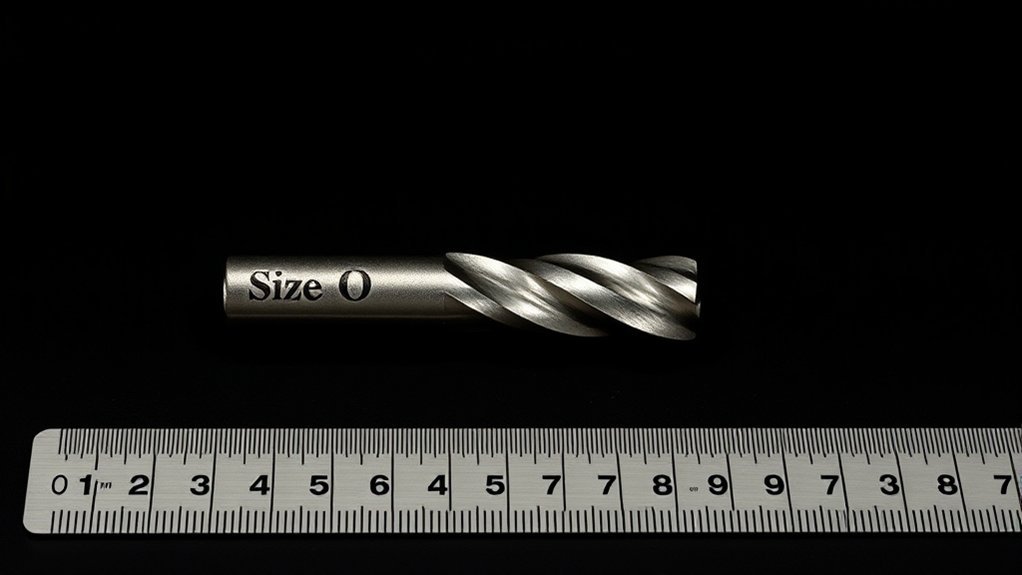
An I drill bit measures exactly 0.272 inches in diameter, which converts to approximately 6.91 millimeters. When reviewing drill bit specifications, you must understand these precise measurement conversions to guarantee compatibility with your project requirements.
Drill bit sizes often use inches in the U.S. but converting to millimeters helps maintain accuracy in international contexts or metric-based designs. You can calculate the conversion by multiplying the inch measurement by 25.4, the exact number of millimeters per inch.
For the I drill bit, 0.272 inches × 25.4 equals 6.9088 millimeters, commonly rounded to 6.91 mm. These precise values are critical when selecting drill bits for engineering applications, guaranteeing you meet dimensional tolerances and avoid errors in component assembly or material penetration.
Comparing I Drill Bits to Common Sizes Like #1
When comparing I drill bits to common sizes like #1, you’ll notice that the I bit, with its 0.272-inch diameter, is slightly larger than the #1 drill bit, which typically measures 0.228 inches. This size comparison highlights a significant difference in bit dimensions that can affect drill selection and application precision.
The I drill bit’s increased diameter provides a larger hole size, which is critical when exact tolerances matter. Understanding these precise bit dimensions allows you to choose the correct drill bit for your project requirements.
When to Use an I Drill Bit for Woodworking and Metalworking
Although the I drill bit’s 0.272-inch diameter may seem specific, you’ll find it particularly useful in both woodworking and metalworking applications that demand moderately sized, precise holes. In woodworking techniques, this bit size is ideal for creating dowel joints or pilot holes for screws where accuracy is essential to avoid splitting.
Its dimension supports consistent hole depth and diameter, ensuring structural integrity. For metalworking, the I drill bit suits tasks requiring intermediate hole sizes, such as fabricating brackets or mounting components, where precision affects assembly fit.
Understanding drill bit applications helps you select the I bit when standard sizes don’t meet tolerance requirements. Using it strategically enhances the quality and reliability of your projects across materials by balancing hole size with material strength and tool control.
Tips for Selecting the Right Drill Bit Size for Your Project
Selecting the right drill bit size requires careful consideration of your project’s material properties and the intended hole function. Proper drill bit selection guarantees precision and avoids material damage or tool wear.
To match your project requirements, follow these steps:
- Analyze Material Density: Harder materials demand smaller pilot holes or specialized bits; softer materials allow for more flexibility in size.
- Determine Hole Purpose: If the hole must accommodate fasteners, measure the fastener’s core diameter and choose a bit slightly smaller to guarantee a tight fit.
- Account for Tolerances: Consider manufacturing or assembly tolerances; select a drill bit size that maintains dimensional accuracy without compromising structural integrity.
Where to Buy I Drill Bits for Your Toolbox
Finding the right source for I drill bits involves evaluating quality, availability, and price. You’ll want to compare the best online retailers known for thorough selections and reliable specifications, such as industrial suppliers or specialty tool stores.
These platforms often provide detailed product descriptions and customer reviews, helping you verify bit size accuracy and material composition. Alternatively, local hardware stores offer immediate access and the chance to physically inspect the bits, guaranteeing the I size matches your project requirements.
However, local outlets may have limited stock and higher prices. Balancing these factors, you can prioritize convenience, cost, or assurance of authenticity. By analyzing both best online options and local hardware availability, you confirm your toolbox contains precisely the I drill bits necessary for peak performance.
Conclusion
Choosing the right drill bit size is like selecting the perfect key to release a precise fit. The I drill bit, measuring 0.272 inches (6.91 mm), offers a larger diameter than a #1 bit, making it ideal for detailed woodworking and metalworking tasks.
By understanding its exact dimensions and applications, you’ll guarantee structural integrity and ideal assembly. Always match your drill bit choice to your material and project needs for the best results.
When selecting a drill bit, remember that knowing the size of an I drill bit is crucial for accuracy and efficiency in your work.