Did you know that over 60% of electricians rely on needle nose pliers for intricate wiring tasks?
If you want to use needle nose pliers with precision and avoid common pitfalls, mastering the correct grip and technique is essential.
Whether you’re bending, twisting, or cutting wire, the way you handle the pliers directly affects your control and the quality of your work.
Let’s explore how to maximize their effectiveness in your projects.
What Needle Nose Pliers Are and When to Use Them
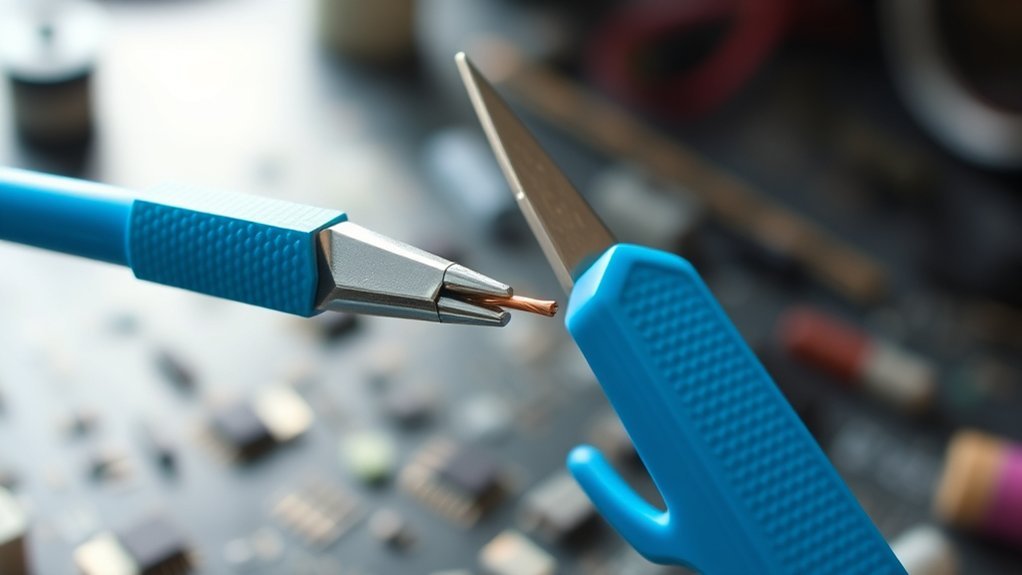
Needle nose pliers are a specialized hand tool designed with long, slender jaws that taper to a fine point. These needle nose plier features allow you to reach tight spaces and manipulate small objects with precision. Their slim profile and serrated inner surfaces provide a secure grip on wires, pins, or delicate components.
In crafting, these tools excel in bending, shaping, and holding fine materials like wire, beads, and metal findings. You’ll find them indispensable for detailed tasks requiring accuracy and control. Use needle nose pliers when you need to grasp, twist, or cut in confined areas where standard pliers can’t fit.
Understanding these applications in crafting guarantees you choose the right tool to enhance your project’s quality and efficiency.
How to Hold Needle Nose Pliers for Precise Control
To achieve precise control when using needle nose pliers, you should grip them firmly but not too tightly, positioning your thumb on one handle and your index finger along the opposite handle for stability. This grip technique offers balanced leverage and reduces hand fatigue.
Make certain your middle finger supports the handle from below, enhancing control during delicate tasks. Avoid wrapping all fingers around the handles, as this lessens precision handling.
Use your middle finger to support the handle for better control; avoid gripping with all fingers.
Maintain a relaxed wrist to allow smooth, controlled movements. When you adjust your grip to accommodate different angles, keep the pliers’ tips aligned with your line of sight for accuracy.
Practicing these grip techniques will improve your ability to maneuver the pliers with exactness, making intricate tasks more manageable and reducing the risk of slipping or damaging components.
How to Bend Wire With Needle Nose Pliers
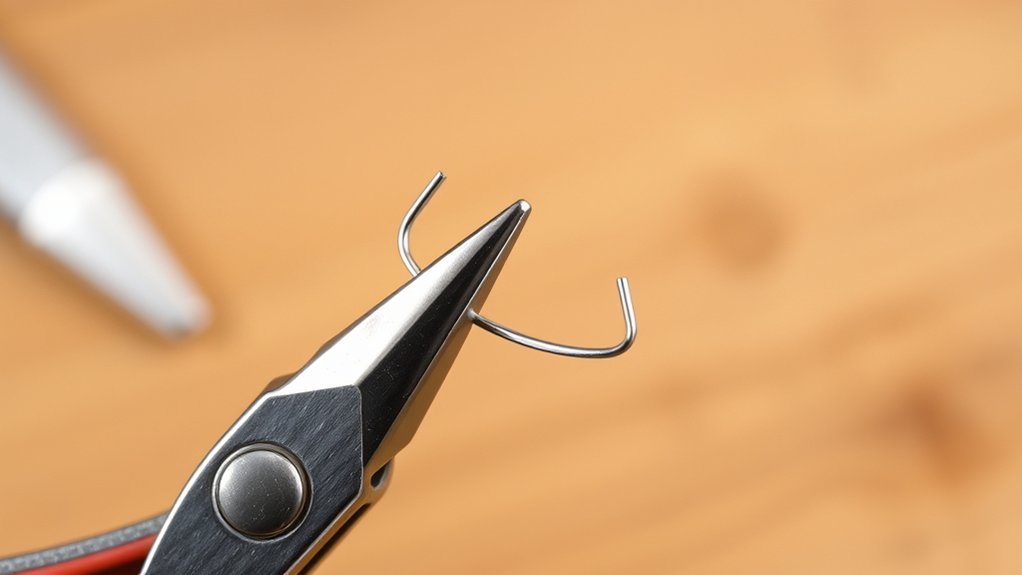
Start by selecting a wire gauge compatible with your needle nose pliers to prevent damage or slipping.
Grip the wire firmly near the bend point, then apply steady pressure to achieve a clean, precise angle. Use controlled, incremental movements to maintain accuracy and avoid kinking the wire.
Choosing Wire Gauge
Selecting the appropriate wire gauge is essential for effective bending with needle nose pliers. Start by evaluating wire thickness considerations, as thicker wires require more force and may exceed your pliers’ capacity. Generally, wires between 18 to 24 gauge work well for detailed bending tasks.
When selecting wire types, consider their material properties. Softer metals like copper bend easily, while harder metals like steel demand sturdier pliers and may fatigue your hands. Match the wire gauge to the pliers’ jaw size to maintain control and precision.
Avoid gauges that are too thin, as they can deform or break during bending. By carefully choosing the correct wire gauge, you’ll guarantee smooth, accurate bends without damaging the wire or your tools.
Proper Bending Techniques
Knowing the right wire gauge helps you apply the proper amount of force when bending with needle nose pliers. Begin by securely gripping the wire close to the bend point with the pliers’ jaws.
For precise bends, position the wire perpendicular to the jaws and apply steady pressure to avoid kinking. Use the tip of the pliers for tight bends or intricate shaping, while the broader jaws help with gradual curves.
When shaping materials, make incremental adjustments rather than forcing the wire to prevent damage or breakage. Rotate the pliers smoothly to achieve uniform bends, maintaining control throughout.
Mastering these bending wire techniques guarantees clean, accurate results essential for electrical work, jewelry making, or crafting. Proper handling extends the tool’s lifespan and preserves material integrity.
How to Grip and Twist Wires Safely
To grip and twist wires safely with needle nose pliers, position the jaws firmly around the wire close to the insulation to maintain control and prevent damage. Verify that your grip is secure but not overly tight, which could deform or break the wire strands.
When twisting, apply even pressure and rotate the pliers smoothly to avoid kinking or stressing the wire. Always wear appropriate safety gear, such as gloves and eye protection, to follow essential safety precautions during wire handling.
Keep the work area clean and free from obstructions to reduce the risk of accidental slips. By adhering to these techniques, you’ll maintain wire integrity and protect yourself from injury while using needle nose pliers effectively.
How to Cut Wire and Small Components
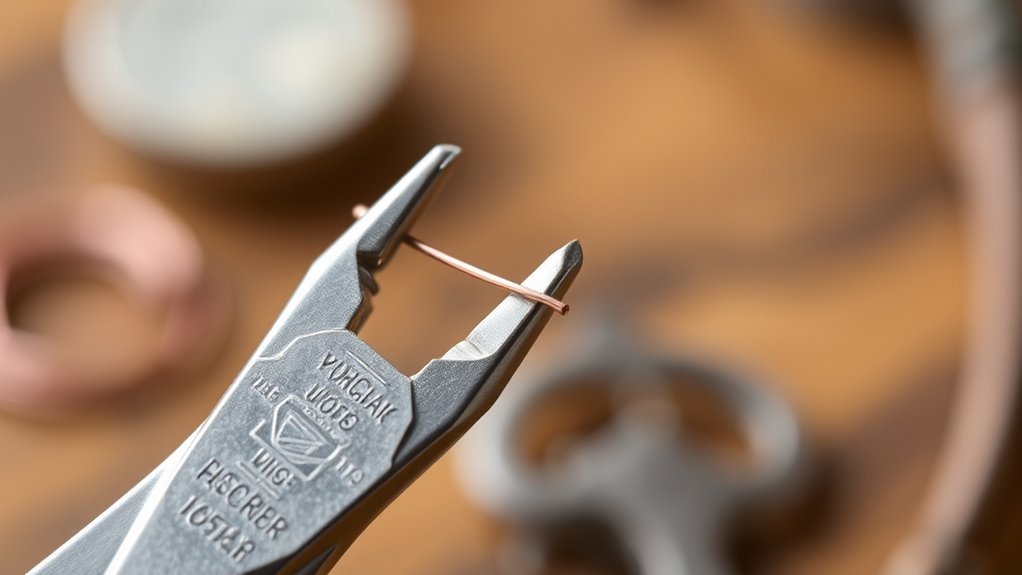
Cut wire and small components cleanly by positioning the needle nose pliers’ cutting edge close to the base of the material. First, identify the wire type: soft copper, aluminum, or harder steel, since cutting techniques vary accordingly.
For softer wires, a firm squeeze with the pliers’ cutting edge will suffice. For tougher wire types, apply steady pressure to avoid bending or fraying. Always hold the wire firmly with one jaw while cutting with the integrated cutter near the joint to maximize leverage.
Avoid twisting during the cut, as that can damage the component or tool. After cutting, inspect the edge to guarantee a smooth finish, trimming again if necessary. Mastering these cutting techniques guarantees precise, clean cuts critical for electrical and mechanical applications.
Tips for Reaching Tight Spaces With Needle Nose Pliers
You can easily access tight spaces by leveraging the slim profile of your needle nose pliers. Angling the tips strategically helps you grip components without obstruction.
Maintain flexible wrist movements to navigate confined areas smoothly and maintain control.
Slim Profile Advantages
Needle nose pliers feature a slim profile that enables access to narrow, confined spaces where standard tools can’t reach. This slender design provides increased access, allowing you to maneuver within tight components without obstruction.
The reduced bulk improves your grip on small objects, enhancing control during delicate tasks. When working in cramped environments, the slim profile guarantees you can position the tips accurately, leading to improved precision in bending, gripping, or cutting wires.
To maximize these advantages, hold the pliers close to the pivot point for better leverage and steadiness. Avoid applying excessive force, as the narrow construction prioritizes finesse over brute strength. By leveraging the slim profile effectively, you’ll perform intricate jobs with greater accuracy and efficiency.
Angled Tip Techniques
Three key angled tip techniques help you navigate tight spaces with needle nose pliers effectively. Mastering angled precision is essential for accessing confined areas without compromising grip. Follow these steps:
- Align the Tips: Position the angled tip parallel to the target component to maximize contact surface, ensuring a secure hold.
- Apply Multi Angle Bends: Use the pliers’ flexibility to create controlled bends, allowing you to reach around obstacles while maintaining tool stability.
- Leverage the Angle: Insert the pliers tip at an angle that minimizes wrist strain and improves access, especially in deep or recessed spaces.
Flexible Wrist Movements
Building on angled tip techniques, incorporating flexible wrist movements enhances your ability to maneuver needle nose pliers into tight spaces. To achieve this, focus on wrist flexibility exercises that improve your range of motion, allowing subtle adjustments without repositioning your entire arm.
Combine this with wrist strength training to maintain control and precision under tension. When working, rotate your wrist gently rather than forcing the pliers, reducing fatigue and increasing accuracy. Practice controlled, small rotations to align the tips exactly where needed.
Common Mistakes When Using Needle Nose Pliers
Although needle nose pliers are versatile tools, users often make errors that reduce effectiveness and can damage both the tool and the workpiece. To avoid common mistakes, you should focus on proper technique and troubleshooting techniques.
Here are three frequent errors to watch for:
- Applying excessive force, which can deform delicate components or bend the plier tips.
- Using the pliers for cutting hard materials, leading to dull jaws and compromised grip.
- Holding the tool incorrectly, causing poor leverage and increased hand fatigue.
How to Care for and Maintain Your Needle Nose Pliers
To keep your needle nose pliers functioning effectively, you should regularly clean and lubricate them to prevent rust and guarantee smooth operation. Begin by wiping off debris and residue using a dry cloth or a brush for detailed cleaning techniques. For stubborn grime, apply a mild solvent and gently scrub the joints and gripping surfaces.
After cleaning, dry your pliers thoroughly to avoid moisture buildup, which accelerates rust formation. Next, apply a light machine oil to the pivot joint and wipe away any excess to maintain smooth movement. Store your pliers in a dry, cool environment to further safeguard against rust prevention.
Regular maintenance not only extends tool life but also preserves precision and reliability during use.
How to Choose the Right Needle Nose Pliers for Your Projects
When selecting needle nose pliers, what specific features should you prioritize to match your project’s demands? First, consider the needle nose types available. Long, bent, or tapered jaws each serve different precision tasks.
Prioritize needle nose types like long, bent, or tapered jaws to suit your project’s precision needs.
Second, evaluate plier materials. High-carbon steel offers durability, while stainless steel resists corrosion. Third, assess handle ergonomics and insulation if working with electrical components.
To choose effectively:
- Match the jaw shape to the task’s accessibility and precision requirements.
- Select plier materials based on strength and environmental exposure.
- Verify handle comfort and safety, especially for prolonged or specialized use.
Conclusion
Mastering needle nose pliers boosts your precision and efficiency—did you know professionals use them in over 60% of detailed electrical and jewelry tasks? By gripping the handles firmly, aligning the tips with your sight, and applying steady pressure near bend points, you’ll avoid common mistakes and protect delicate components.
Keep practicing proper technique and maintenance to extend your tool’s life and enhance your project’s quality. Precision starts with control—make every movement count.
For best results, always remember that precision starts with control when using needle nose pliers.