You might think a drill bit is just a simple piece of metal, but how a drill bit is made involves a series of meticulous steps that transform raw steel into a precision tool.
From selecting the right alloy to shaping and heat treating, each phase impacts performance and durability.
Understanding these processes reveals how even small differences in manufacturing can affect the bit’s effectiveness—something you’ll want to contemplate before your next project.
What Steel Makes a Great Drill Bit?
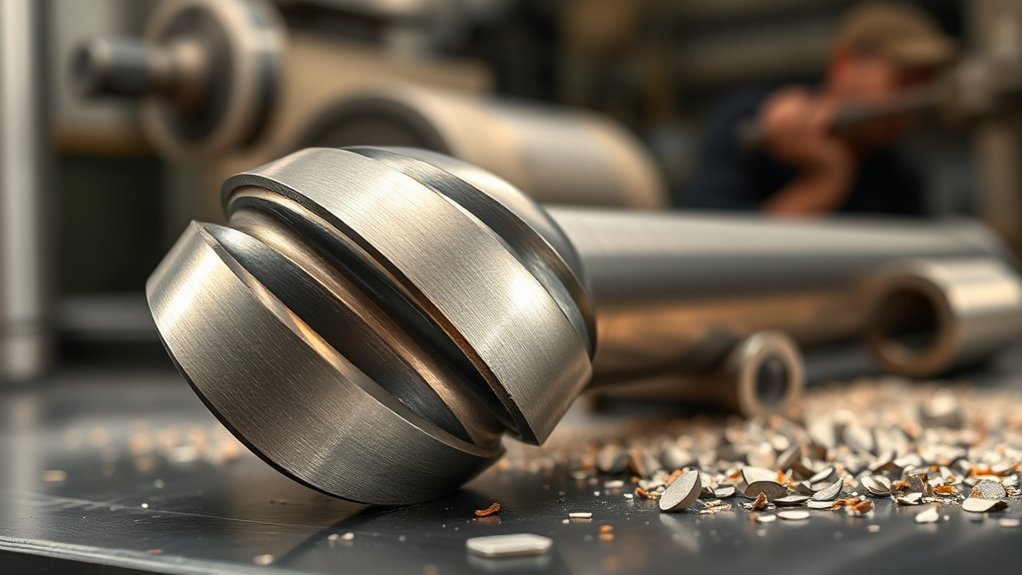
Several types of steel can create a high-quality drill bit, but high-speed steel (HSS) stands out for its durability and heat resistance. When you choose HSS, you guarantee the drill bit withstands high temperatures generated during cutting without losing hardness.
High-speed steel drill bits offer superior durability and heat resistance for demanding cutting tasks.
For enhanced performance, cobalt alloy is often added to HSS. This cobalt alloy increases hardness and wear resistance, allowing you to drill through tougher materials like stainless steel.
The manufacturing process involves precise alloy composition control to maintain the balance between toughness and hardness. By selecting HSS with cobalt alloy, you get a drill bit that maintains sharpness longer and resists deformation under stress, ultimately improving drilling efficiency and lifespan.
This combination is ideal when you need reliable, high-performance drill bits for demanding applications.
Manufacturing Differences Among Drill Bit Types
When you manufacture drill bits, you’ll need to select materials based on the intended application, as different steels and coatings affect durability and performance. You’ll also shape cutting edges uniquely to optimize efficiency for specific tasks, whether it’s wood, metal, or masonry.
These variations directly impact the machining processes and finishing techniques you’ll employ.
Material Variations
Anyone selecting a drill bit should understand that material composition directly influences performance and durability. Different material types, such as high-speed steel (HSS), cobalt alloys, and carbide, offer distinct performance variations tailored to specific applications.
HSS provides balanced toughness and heat resistance, suitable for general-purpose drilling. Cobalt alloys enhance hardness and maintain strength at elevated temperatures, ideal for tougher metals. Carbide, being extremely hard and wear-resistant, excels in high-speed and abrasive conditions but is more brittle.
The manufacturing process adjusts heat treatment and coating techniques according to the material to optimize hardness and longevity. By recognizing these material variations, you can select drill bits that maximize efficiency, reduce wear, and match the operational demands of your drilling tasks precisely.
Cutting Edge Designs
The cutting edge design determines a drill bit’s efficiency and suitability for specific materials and tasks. When manufacturing drill bits, you must select precise cutting edge materials, such as carbide or high-speed steel, to enhance durability and sharpness.
Innovative designs like split points reduce walking, improving accuracy, while parabolic flutes enhance chip removal during drilling. You’ll notice that masonry bits feature tungsten carbide tips for hardness, whereas wood bits use brad points for clean entry.
The geometry of the cutting edge—angle, lip relief, and flute shape—directly impacts cutting performance. By tailoring these parameters, you guarantee the drill bit performs effectively under intended conditions.
Understanding these manufacturing differences lets you choose or produce drill bits engineered for specific applications, maximizing efficiency and lifespan.
How We Shape Drill Bits: Forging and Cutting
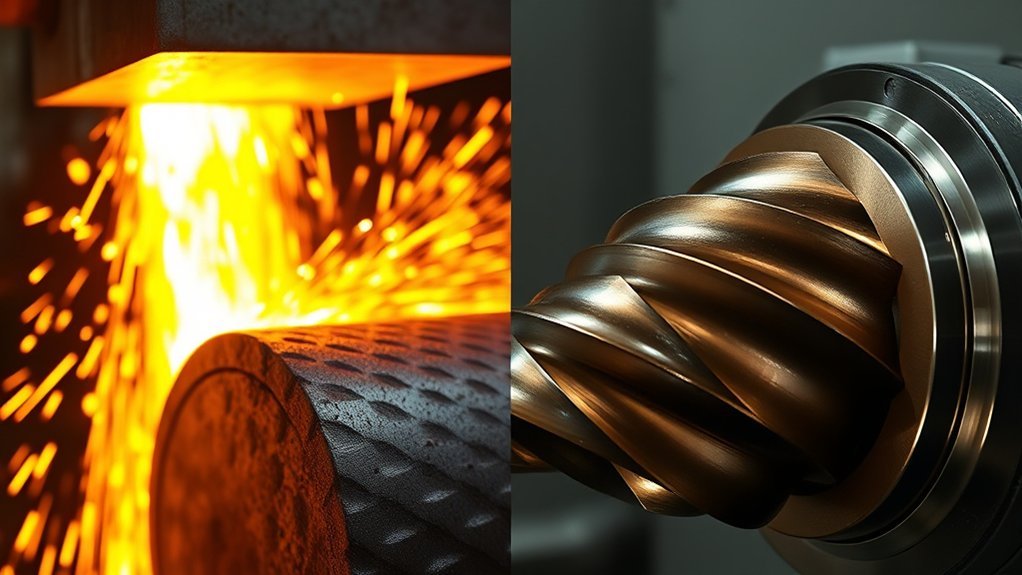
Forging and cutting transform raw metal into the precise shapes required for drill bits to perform effectively. You start by heating metal blanks to high temperatures, then apply forging techniques that shape the material under controlled pressure, enhancing its structural integrity. This process aligns the metal’s grain, improving durability and toughness essential for drilling tasks.
Next, you employ cutting methods to define the drill bit’s geometry, including the flutes and overall profile. Precision cutting tools remove excess material, ensuring exact dimensions and balanced form. These steps are critical because any deviation can affect the bit’s performance and lifespan.
Grinding the Drill Tip for Sharpness
You’ll start by grinding the drill tip to achieve precise tip geometry, which is essential for effective cutting performance. Using abrasive grinding techniques, you carefully shape the tip while controlling speed and pressure.
Throughout this process, you must manage heat buildup to prevent damage to the drill bit’s hardness and structure.
Tip Geometry Precision
Although shaping the drill tip requires meticulous attention, grinding it to achieve precise tip geometry is vital for ideal cutting performance. You start by focusing on the tip design, guaranteeing the cutting edges are symmetrical and meet at the correct angles.
Angle optimization plays a significant role here; even slight deviations can affect drilling efficiency and increase wear. You carefully control the clearance and chisel angles during grinding to balance sharpness and durability.
Using precise measurements, you adjust the grinding wheel to maintain consistent geometry across drill bits. This process guarantees that the tip penetrates material cleanly and minimizes heat buildup.
Abrasive Grinding Techniques
Master abrasive grinding techniques to sharpen the drill tip effectively, guaranteeing ideal cutting performance. Begin by selecting suitable abrasive materials, such as aluminum oxide or silicon carbide, tailored to the drill’s hardness.
Position the drill bit precisely against the grinding wheel, maintaining the correct angle to preserve tip geometry. Employ controlled grinding methods, either peripheral or face grinding, to remove material uniformly from the cutting edges. Use steady, consistent pressure to avoid uneven surfaces or tip distortion.
Monitor the process closely to achieve a sharp, symmetrical point that enhances cutting efficiency. By mastering these abrasive grinding techniques, you guarantee the drill tip attains peak sharpness and durability, ready for high-precision applications without compromising structural integrity or dimensional accuracy.
Heat Management During Grinding
When grinding the drill tip for sharpness, managing heat generation is critical to prevent material damage and preserve hardness. You need to control heat distribution precisely to avoid localized overheating, which can alter the drill bit’s microstructure.
Employing coolant fluids during grinding helps dissipate heat effectively, maintaining ideal thermal management. You should use intermittent grinding techniques, allowing the material to cool between passes, reducing thermal buildup.
Monitoring the grinding wheel’s speed and feed rate also contributes to consistent heat control. By balancing these parameters, you guarantee the drill tip retains its hardness and sharpness without warping or tempering.
Proper thermal management during grinding ultimately extends the drill bit’s service life and performance in demanding drilling applications.
Heat Treatment: Hardening and Tempering for Durability
Since the raw drill bit lacks the necessary strength and wear resistance, heat treatment plays a critical role in enhancing its durability. You start by heating the bit to a specific temperature to alter its microstructure, then rapidly cool it through the quenching process.
This sudden cooling hardens the steel but leaves it brittle. To reduce brittleness and improve toughness, you subject the bit to tempering cycles, reheating it to a lower temperature and holding it there for a precise duration.
These cycles relieve internal stresses and optimize hardness. By carefully controlling the quenching process and subsequent tempering cycles, you guarantee the drill bit achieves the right balance of hardness and toughness, essential for long-lasting performance under demanding drilling conditions.
Making Drill Bits Last Longer: Coating and Finishing
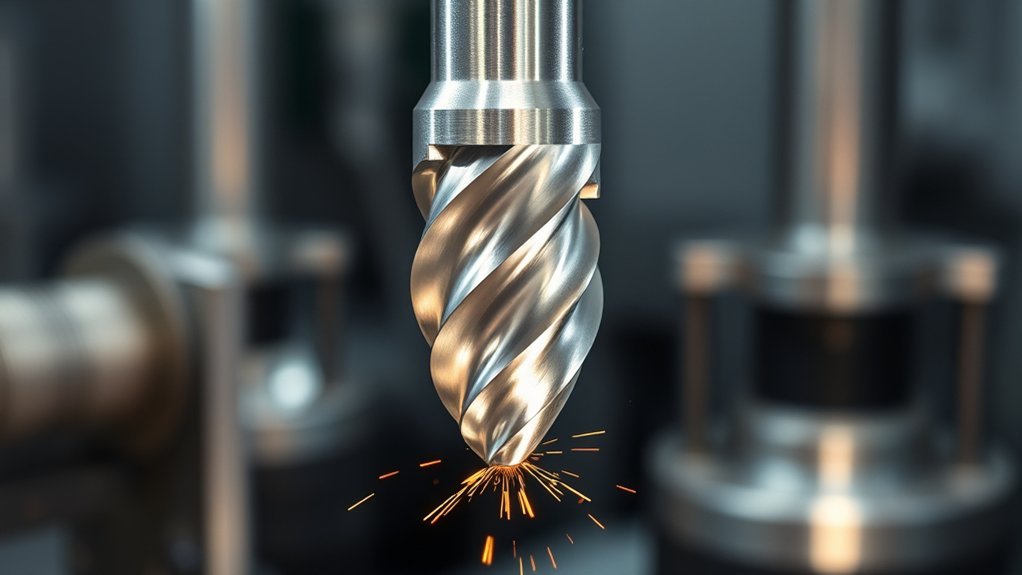
Although heat treatment greatly enhances a drill bit’s core properties, applying specialized coatings and finishing processes further extends its lifespan by reducing friction, improving wear resistance, and preventing corrosion. You start by selecting appropriate coating materials such as titanium nitride (TiN), titanium carbonitride (TiCN), or diamond-like carbon (DLC), each offering distinct hardness and thermal stability.
These coatings are typically applied using physical vapor deposition (PVD) or chemical vapor deposition (CVD) methods, ensuring uniform coverage and strong adhesion. After coating, finishing techniques like precision grinding and polishing refine the drill bit’s surface, minimizing micro-abrasions that can initiate failure.
How Drill Bits Are Tested for Precision
Applying advanced coatings and finishing techniques enhances a drill bit’s durability, but verifying its precision assures reliable performance during use. You begin by employing precision measurement tools such as coordinate measuring machines (CMM) and optical comparators to assess dimensions like diameter, flute geometry, and tip angle.
These testing methods assure adherence to strict tolerances specified in design blueprints. Next, you conduct runout tests by mounting the drill bit on a spindle to measure concentricity and balance, which prevents wobbling during operation. Additionally, hardness testing confirms material integrity after heat treatment.
Each drill bit undergoes these rigorous testing methods to detect deviations early, assuring consistent quality and performance. By systematically applying precision measurement techniques, you assure that every drill bit meets exacting standards before it reaches the market.
How Technology Is Changing Drill Bit Manufacturing
When you integrate cutting-edge technologies like CNC machining and additive manufacturing into drill bit production, you greatly enhance precision and efficiency. Automation integration streamlines repetitive tasks, reducing human error and boosting throughput.
3D printing advancements allow for rapid prototyping, enabling you to test complex geometries before full-scale manufacturing. You’ll notice improved consistency in drill bit dimensions and material properties, thanks to real-time process monitoring systems.
Key technological impacts include:
Precise cutting edges, rapid design iteration, automated inspections, and continuous manufacturing optimization transform drill bit production.
Precise control of cutting edge geometry through CNC controls
Rapid iteration of drill bit designs via 3D printing
Automated quality inspections using machine vision
Continuous feedback loops optimizing manufacturing parameters
Conclusion
Now that you’ve mastered how a humble drill bit transforms from raw steel to precision-engineered marvel, you can appreciate the symphony of forging, grinding, heat treating, and coating that keeps your projects on point.
Sure, it’s not rocket science—just metallurgy, mechanical finesse, and quality control working overtime.
So next time you drill, remember: behind every perfect hole lies a drill bit that’s been through more processes than your average smartphone.
Precision isn’t accidental—it’s engineered, and that’s how a drill bit is made.