A rick of firewood typically holds about 80 to 100 pieces, assuming standard 16-inch lengths and uniform cutting. This estimate gives you a general idea of what to expect when purchasing or stacking a rick.
However, the piece count can vary due to differences in wood size, species, and stacking depth. A rick isn’t a standardized volume like a cord, so these factors influence the total amount.
Understanding these variables helps you accurately estimate how much wood you’re getting. If you want to get deeper into how firewood measurements work and why the numbers shift, there’s more detail to explore.
What Is a Rick of Firewood?
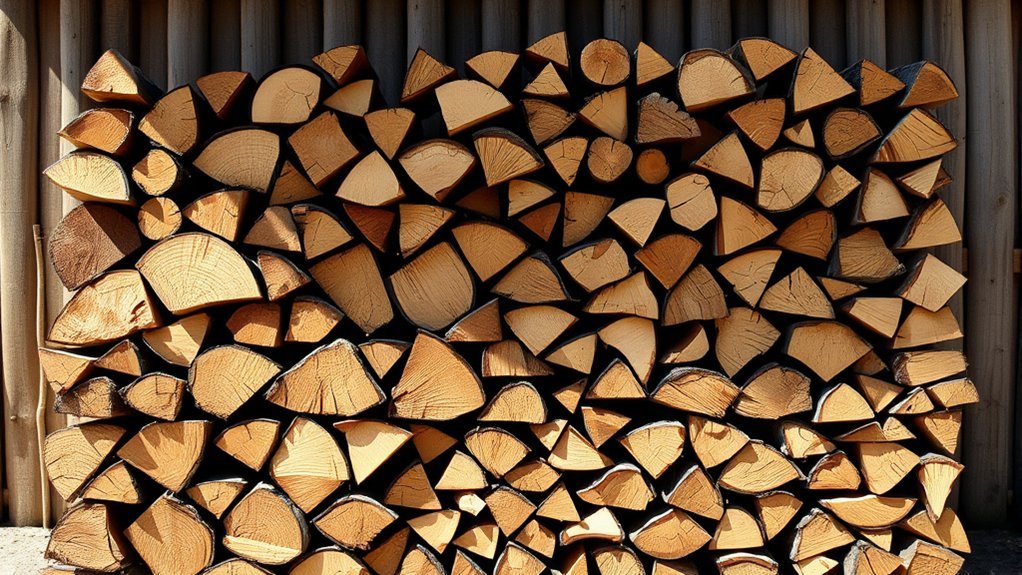
A rick of firewood refers to a specific volume measurement used primarily in the United States to quantify stacked firewood. In firewood terminology, a rick is often understood as a stack measuring 4 feet high by 8 feet long, with varying depths.
However, the rick definition isn’t standardized; it can represent different volumes depending on regional practices, typically ranging from 1/3 to 1/2 cord. Unlike a full cord, which is precisely 128 cubic feet, a rick’s depth might be 16 to 24 inches, affecting the total volume.
When you encounter the term “rick” in firewood sales, you should clarify the exact dimensions, since this impacts the amount of wood you’re purchasing. Understanding this terminology helps you make informed decisions about firewood quantities.
How Many Pieces of Wood Typically Make Up a Rick?
Determining how many pieces of wood make up a rick depends largely on the size and cut of each piece, as well as the rick’s specific dimensions. Typically, a rick measures 4 feet high by 8 feet long and 16 inches deep, but wood length and piece size can vary.
Standard firewood pieces are often cut to 16 inches in length to fit common wood stoves, which influences the number of pieces per rick. If each piece is uniformly 16 inches long and stacked tightly, you can expect roughly 80 to 100 pieces in a rick.
However, if the piece size varies, such as longer or shorter wood lengths, this count shifts accordingly. Understanding these variables helps you accurately estimate the quantity of wood in your rick.
Why the Number of Pieces in a Rick Isn’t Always the Same
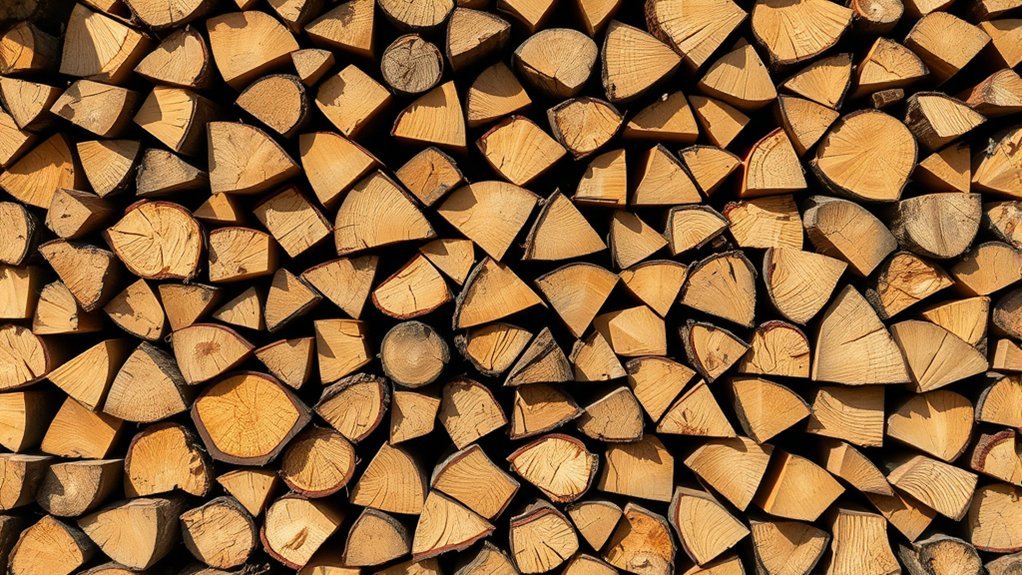
You’ll notice that the number of pieces in a rick varies due to regional measurement standards, which can define a rick differently depending on location. Additionally, the type and size of wood influence how many pieces fit within the typical volume.
Understanding these factors is key to accurately evaluating wood quantities in a rick.
Regional Measurement Differences
Although the term “rick” is broadly used to describe stacked firewood, the actual number of pieces it contains can vary considerably depending on regional practices and local standards. You’ll find that regional customs heavily influence how a rick is defined, with some areas measuring by volume, others by face cords, or even by piece count.
Measurement standards differ: in some regions, a rick is standardized as a 4-foot high, 8-foot long, and 16-inch deep stack, while elsewhere dimensions and wood lengths fluctuate. These variations mean that when you purchase or measure a rick, it’s crucial to clarify the local definition to guarantee accuracy.
Understanding these regional measurement differences helps you avoid confusion and guarantees fair transactions.
Wood Type Variability
Because different wood species vary in density, size, and typical cut length, the number of pieces in a rick can fluctuate greatly. You’ll notice that hardwoods like oak tend to be denser and cut into smaller pieces, while softwoods such as pine often come in larger, less dense segments.
These density differences affect both the volume and the number of pieces per rick, making a universal count impossible.
| Wood Species | Typical Piece Count in a Rick |
|---|---|
| Oak | 80 – 100 |
| Pine | 60 – 80 |
| Maple | 90 – 110 |
| Birch | 85 – 105 |
| Cedar | 70 – 90 |
Understanding wood species helps you anticipate the variability in piece count due to density differences.
Rick vs. Cord: What’s the Difference?
Several key distinctions separate a rick from a cord, and understanding these differences is essential for accurately measuring firewood. A cord is a standardized measurement in firewood terminology, defined as 128 cubic feet (4 ft high × 8 ft long × 4 ft deep) of tightly stacked wood and air space.
In contrast, rick measurements are less precise and vary regionally, often referring to a stack of wood 4 feet high and 8 feet long but with a depth typically of 16 to 24 inches. This means a rick contains roughly half to a third of a cord’s volume, depending on the depth.
When evaluating firewood quantities, recognizing these distinctions helps you avoid confusion and guarantees you get the expected amount of wood for your needs.
How to Estimate Firewood When Buying a Rick
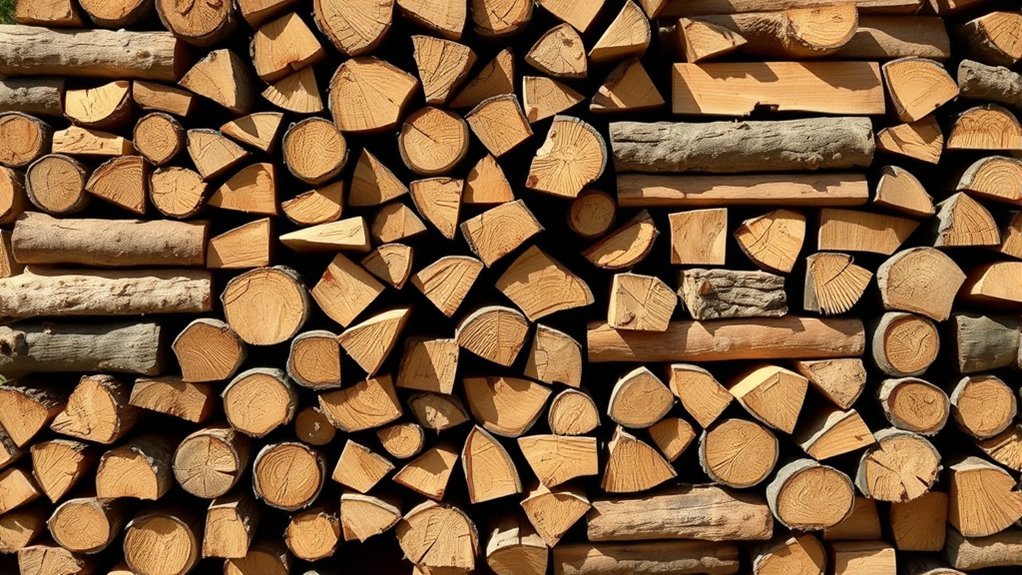
When estimating firewood in a rick, you’ll need to account for the typical dimensions, usually 4 feet high by 8 feet long, with a depth ranging from 16 to 24 inches. These measurements help you calculate volume and anticipate firewood pricing accurately, especially considering seasonal demand fluctuations. The number of pieces depends on log size and stacking efficiency.
| Depth (inches) | Approximate Volume (ft³) |
|---|---|
| 16 | 42.7 |
| 18 | 48.0 |
| 20 | 53.3 |
| 22 | 58.7 |
| 24 | 64.0 |
Estimating volume lets you compare sellers and budget accordingly, ensuring you get fair pricing during peak seasonal demand.
Tips for Stacking and Counting Firewood in a Rick
When stacking firewood in a rick, you’ll want to measure each piece’s dimensions accurately to maintain consistency. Use efficient stacking techniques, such as alternating the orientation of logs, to maximize space and stability.
This approach makes it easier to estimate the total piece count and guarantees a precise calculation of your firewood volume.
Measuring Wood Dimensions
Accurately measuring the dimensions of your firewood is essential for efficiently stacking and counting pieces in a rick. To do this, you’ll apply precise measuring techniques, focusing on length, width, and thickness of each piece. Consistent wood dimensions help you calculate total volume and estimate the number of pieces per rick accurately.
Here’s a quick reference for standard wood dimensions:
| Dimension | Typical Range |
|---|---|
| Length | 16–20 inches |
| Width | 3–6 inches |
| Thickness | 2–4 inches |
Use a tape measure or calipers to guarantee accuracy. Record measurements systematically to maintain consistency. This approach prevents errors when estimating volume and counting firewood in your rick.
Efficient Stacking Techniques
Although proper measuring lays the foundation, efficient stacking techniques are crucial for maximizing space and simplifying the counting process in a rick. When you apply precise stacking techniques, you guarantee efficient firewood arrangement that reduces gaps and improves stability.
Start by aligning logs uniformly with cut ends facing outward to maintain consistent dimensions. Use a crisscross pattern at the ends to lock the stack, enhancing structural integrity. Maintain consistent log length and diameter to avoid voids that waste space.
Visualize the stack as a grid of uniform units:
- Straight rows with minimal gaps
- Alternating layers for stability
- Evenly sized pieces for uniform height
These methods help you maintain an organized rick, making it easier to estimate volume and count pieces accurately.
Estimating Piece Quantity
Mastering efficient stacking techniques sets the stage for accurately estimating the number of pieces in a rick. When you know the wood length and piece diameter, you can better approximate quantity.
Start by measuring the average wood length since variations impact how many pieces fit per row. Next, consider piece diameter, as thicker logs reduce total count. To estimate, count pieces in one layer, then multiply by the number of layers.
| Wood Length (ft) | Piece Diameter (in) | Estimated Pieces per Rick |
|---|---|---|
| 16 | 4 | 85 |
| 16 | 6 | 70 |
| 18 | 4 | 95 |
Using these parameters simplifies your calculations and helps you plan your firewood needs precisely.
Frequently Asked Questions
What Types of Wood Are Best for a Firewood Rick?
You’ll want hardwood over softwood for your firewood rick since hardwood burns longer and hotter. Guarantee proper firewood seasoning, drying wood for at least 6-12 months, to maximize efficiency and reduce smoke during burning.
How Long Does a Rick of Wood Typically Last?
A rick of wood typically lasts one heating season, around 3-6 months, depending on firewood longevity factors like wood type, moisture content, and your usage intensity during seasonal usage for maximum energy efficiency.
Can a Rick of Wood Be Delivered and Stacked?
You’d think delivering a rick of wood is like moving mountains, but with precise delivery options, professionals can handle it efficiently. They use expert stacking techniques to guarantee stability, proper airflow, and longevity of your woodpile.
What Tools Are Needed to Cut Wood Into a Rick?
You’ll need a chainsaw or handsaw, gloves, safety goggles, ear protection, and sturdy boots.
Master cutting techniques like proper grip and controlled strokes to guarantee accuracy and prevent accidents while preparing wood for a rick.
Is a Rick of Wood Suitable for Outdoor Wood Stoves?
You’ll find a rick of wood ideal for outdoor heating, provided it’s properly seasoned, meaning dried to reduce moisture content.
Seasoned wood burns efficiently, producing more heat and less creosote, ensuring safe, effective outdoor stove performance.
Conclusion
Now that you know a rick isn’t a fixed number of pieces but more about volume, you won’t be guessing in the dark next time. While the wood count can vary wildly, understanding the difference between a rick and a cord lets you measure firewood like a pro.
With precise stacking and careful counting, you’ll avoid piles that look like mountains but don’t quite fill your stove. Master this, and you’ll never be short on firewood again.
In conclusion, knowing how many pieces of wood are in a rick helps you plan better and ensures you get the right amount for your needs.