Radial arm saw vs miter saw is a common comparison for woodworkers deciding on the right tool for their projects.
If you need versatile cutting options—such as crosscuts, rip cuts, and more—a radial arm saw offers broad capabilities. However, it requires ample space and routine calibration to maintain precision.
For compact, quick, and highly accurate angled cuts, a miter saw excels. It is especially effective for trim or molding work and benefits from simpler maintenance.
Your choice depends on your project’s complexity, available workspace, and required accuracy.
Keep exploring to understand which saw aligns perfectly with your woodworking demands and budget.
Both tools have unique strengths that can greatly enhance your work when used appropriately.
What Is a Radial Arm Saw and How Does It Work?
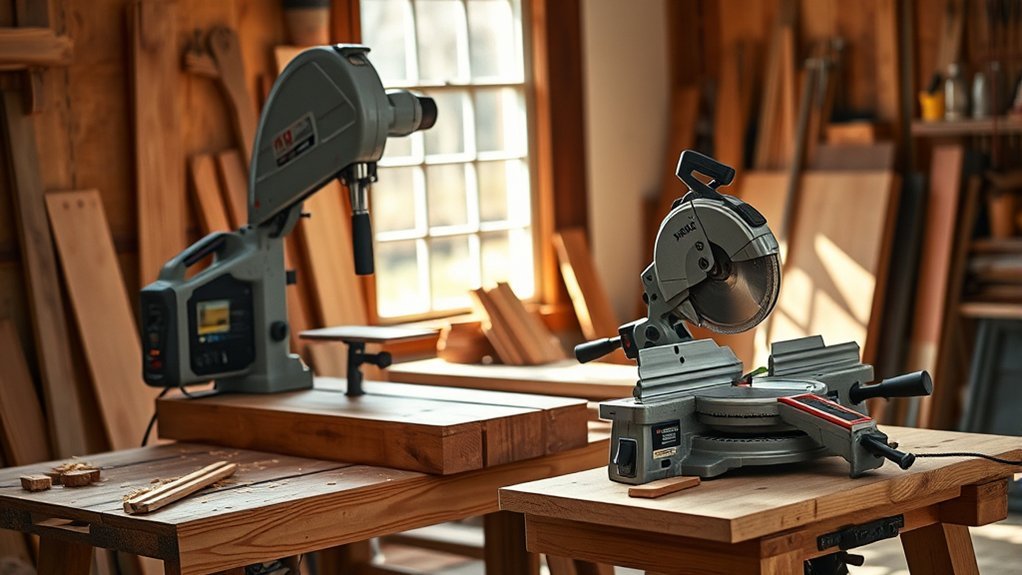
A radial arm saw is a versatile woodworking tool designed for making precise crosscuts, rip cuts, and miter cuts. Understanding the radial arm saw history reveals its origin in the early 20th century, marking a significant tool evolution in woodworking.
Unlike fixed saws, the radial arm saw features a motorized blade mounted on a horizontal arm that can slide, tilt, and pivot, providing enhanced cutting precision. When you operate a radial arm saw, you benefit from its ability to handle various cuts with accuracy and efficiency, making it ideal for complex woodworking projects.
The radial arm design improves workflow by combining multiple cutting functions into one tool, reducing setup time and increasing productivity while maintaining consistent, precise cuts.
What Is a Miter Saw and How Does It Work?
A miter saw consists of a motorized circular blade mounted on a pivoting arm, with a base that includes angle markings for precise cuts. When you lower the blade onto the material, it spins rapidly to make clean, accurate crosscuts or angled cuts.
Understanding these components and the cutting action helps you use the saw effectively for woodworking or framing tasks.
Miter Saw Components
Understanding the key components of a miter saw will help you operate it safely and effectively. Familiarizing yourself with essential miter saw features and accessories guarantees precision and efficiency in your cuts. The core components include:
Base and Table: Provides a stable platform and often includes angle markings for accurate miter adjustments.
Saw Arm and Blade Guard: Houses the motor and blade, with a guard that protects you from debris and accidental contact.
Fence and Clamps: Secure your workpiece in place, critical for maintaining alignment during cuts.
Each component works together to deliver precise angle cuts. Knowing these parts allows you to select appropriate miter saw accessories and maintain peak performance while minimizing risks during operation.
Cutting Mechanism Explained
Two primary movements define how a miter saw operates: the pivoting arm and the spinning blade. You lower the arm, bringing the blade down onto the material to execute precise cuts.
The saw supports various cutting techniques, including crosscuts, miter cuts, and bevel cuts. Different blade types, such as carbide-tipped or fine-toothed blades, impact the cut quality and material suitability.
| Cutting Technique | Description | Suitable Blade Type |
|---|---|---|
| Crosscut | Cuts across the grain | Fine-toothed blade |
| Miter Cut | Angled cuts left or right | Carbide-tipped blade |
| Bevel Cut | Tilts blade for angled edge | Combination blade |
Understanding these mechanisms guarantees you optimize accuracy and efficiency in your woodworking projects.
Main Differences Between Radial Arm and Miter Saws
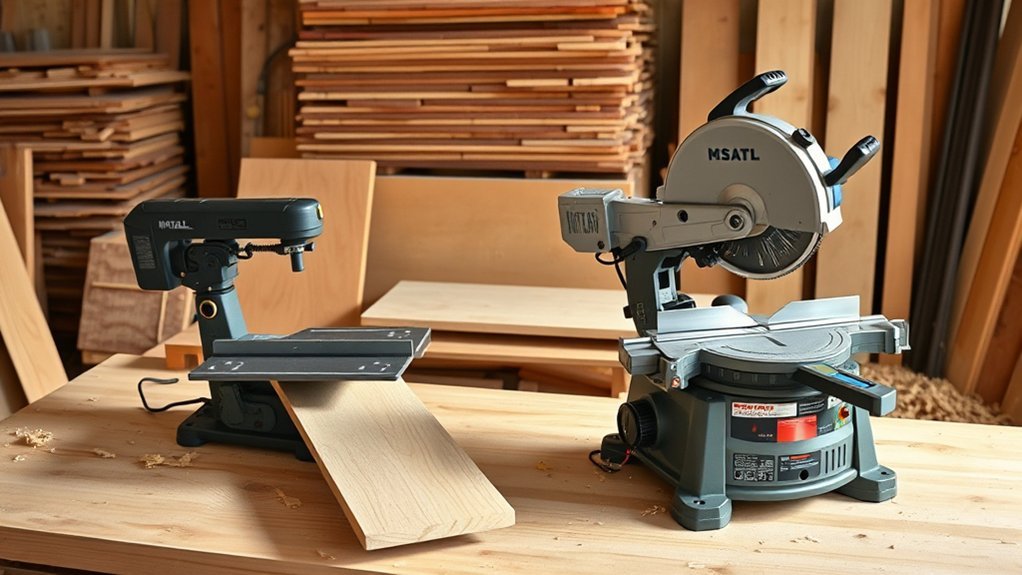
Choosing between a radial arm saw and a miter saw depends on the specific cuts you need to make and the type of projects you’re working on. Both excel in cutting accuracy but differ greatly in design and blade types.
The radial arm saw features a horizontally mounted blade on an adjustable arm, allowing versatile cuts including rip and crosscuts. Miter saws use a fixed blade that pivots to make precise angled cuts, primarily in molding and framing.
Key differences include:
- Cutting versatility: Radial arm saws handle a wider range of cuts.
- Portability: Miter saws are more compact and easier to move.
- Blade types: Radial arm saws accommodate larger blades for ripping; miter saws use smaller blades optimized for angle cuts.
Your choice should align with the project’s cutting demands.
Best Saw for Crosscutting, Miter, and Rip Cuts?
When choosing between a radial arm saw and a miter saw, you need to evaluate crosscutting accuracy and their ability to handle miter and rip cuts. Miter saws excel at precise crosscuts and angled cuts but aren’t designed for ripping lumber.
Radial arm saws offer versatility with effective crosscutting and ripping, though they require careful setup to maintain accuracy.
Crosscutting Accuracy Comparison
Although both radial arm saws and miter saws are designed for crosscutting, their accuracy varies based on blade stability and fence alignment. When you need precise crosscut precision, the stability of the blade and the rigidity of the fence are critical factors.
Radial arm saws offer adjustable fences and extended reach but can suffer from blade wobble if not properly maintained. Miter saws provide consistent blade stability due to their fixed pivot and solid fence design, enhancing repeatable accuracy.
Consider these points:
- Radial arm saws require frequent calibration for peak crosscut precision
- Miter saws maintain blade stability through a fixed pivot system
- Fence alignment is generally more robust on miter saws, reducing deviation
Choosing the right saw depends on your tolerance for accuracy and maintenance commitment.
Miter And Rip Capabilities
While miter saws excel in maintaining blade stability and fence alignment for accurate crosscuts, their capabilities extend beyond just this function. Miter saws versatility allows you to perform precise angled cuts, making them ideal for trim work and framing.
However, their ability to rip boards is limited due to smaller blade sizes and cutting capacity. In contrast, radial arm saw precision shines when executing rip cuts. The adjustable arm lets you push the blade through wider stock with consistent accuracy, making it a better choice for ripping larger panels.
If your project demands frequent ripping alongside miters and crosscuts, a radial arm saw offers superior functionality. But for focused miter and crosscut tasks, miter saws deliver unmatched consistency and ease of use.
Which Saw Is More Accurate: Radial Arm or Miter?
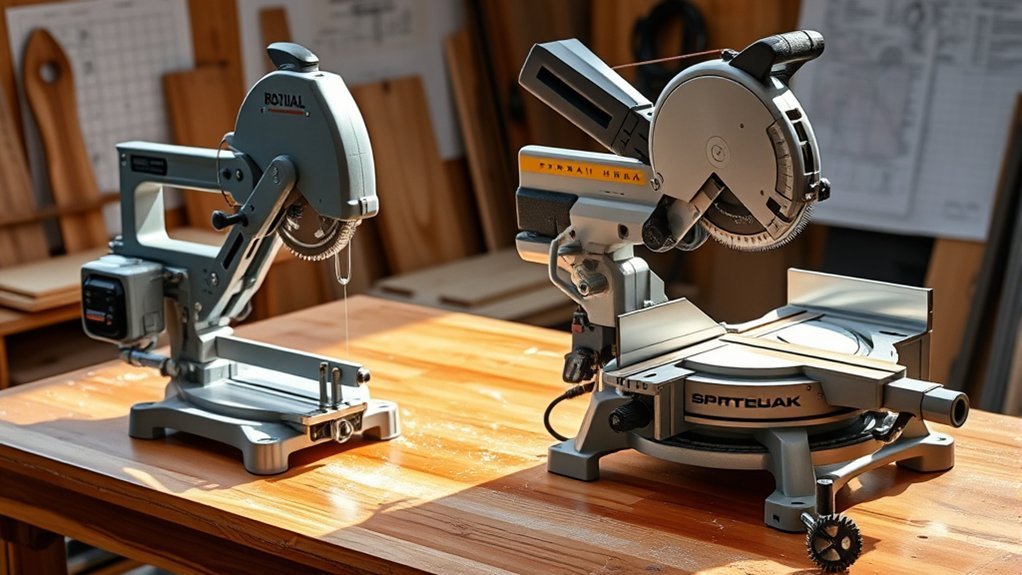
How do radial arm saws and miter saws compare regarding accuracy? When evaluating accuracy factors, miter saws generally offer superior cutting precision due to their fixed blade and stable arm design. Radial arm saws, while versatile, can be prone to slight misalignments over time, impacting repeatability.
Consider these accuracy factors:
- Blade Stability: Miter saw blades are fixed, reducing vibration and enhancing precision.
- Cutting Angle Consistency: Miter saws maintain consistent angles, critical for precise miters.
- Calibration Ease: Miter saws are simpler to calibrate, ensuring sustained accuracy.
If you prioritize consistent, precise cuts, especially for angled work, the miter saw typically provides better accuracy than the radial arm saw.
Safety Tips for Radial Arm and Miter Saws
When using radial arm or miter saws, always maintain a firm grip and control the feed rate to prevent kickback. You’ll need to wear safety glasses, hearing protection, and avoid loose clothing to minimize injury risks.
Following these handling techniques and wearing the right protective gear guarantees safer operation.
Proper Handling Techniques
Because both radial arm saws and miter saws involve rapidly spinning blades, you must maintain strict control and focus during operation to prevent accidents. Proper handling starts with ensuring saw blade maintenance is up to date. Inspect for dullness or damage before each use.
Precise cutting angle adjustments are critical. Always verify angles with a reliable gauge to avoid binding or kickback. When handling the saw:
- Secure the workpiece firmly against guides and fences to prevent shifting.
- Operate the saw with a firm, steady grip, avoiding sudden movements.
- Always keep hands clear of the blade path and use push sticks when necessary.
Adhering to these techniques will improve accuracy while minimizing the risk of injury during cutting tasks.
Protective Gear Essentials
Three essential pieces of protective gear you should always wear when operating radial arm or miter saws are safety glasses, hearing protection, and dust masks. Safety goggles are critical for shielding your eyes from flying debris and dust particles generated during cutting.
Hearing protection, such as earmuffs or earplugs, reduces the risk of hearing damage caused by the saws’ loud noise levels. Dust masks prevent inhalation of fine sawdust, which can cause respiratory issues.
Additionally, wearing protective gloves offers a secure grip and guards your hands against splinters and accidental contact with sharp edges. Always verify your gear fits properly and is in good condition before starting work. Proper use of protective equipment minimizes injury risks, allowing you to focus on precision and safety during radial arm and miter saw operations.
Space and Portability: Radial Arm vs Miter Saw
Although both radial arm saws and miter saws serve cutting purposes, their spatial requirements and portability differ considerably, which impacts where and how you can use them. Radial arm saws typically demand more workspace due to their larger footprint and extended arms, limiting portability.
Radial arm saws require more space and are less portable than compact, easier-to-move miter saws.
Miter saws, being more compact, are easier to transport and fit into smaller work areas. When considering space requirements and portability factors, keep these points in mind:
- Radial arm saws need a stable, spacious bench or stand for safe operation.
- Miter saws often come with foldable stands or can be handheld for quick jobs.
- Weight differences favor miter saws for mobility, whereas radial arm saws are more stationary.
Your choice will depend on your workspace constraints and whether you need to move the saw frequently.
Price and Maintenance: Radial Arm vs Miter Saws
When evaluating price and maintenance, you’ll find that radial arm saws generally come with a higher upfront cost and more complex upkeep due to their intricate mechanisms. Conducting a detailed cost analysis helps you weigh initial investment against long-term upkeep requirements. Miter saws tend to be more budget-friendly and require less frequent maintenance.
| Feature | Radial Arm Saw | Miter Saw |
|---|---|---|
| Initial Cost | Higher | Lower |
| Maintenance | Complex, frequent | Simpler, less frequent |
| Parts Replacement | More costly, specialized | Affordable, widely available |
Understanding these factors guarantees you budget accurately for both purchase and ongoing care, making your choice practical and efficient.
How to Choose the Right Saw for Your Woodworking Projects
How do you determine which saw best suits your woodworking needs? Start by evaluating your project requirements and applying strict saw selection criteria.
Consider the type and complexity of cuts you’ll perform regularly. For instance:
- Cut Variety: Choose a radial arm saw for versatility in crosscuts, rip cuts, and dadoes; opt for a miter saw if precise angled cuts dominate.
- Workspace Constraints: Assess available space since radial arm saws need more room compared to compact miter saws.
- Precision Needs: If accuracy for trim and molding is essential, miter saws offer superior repeatability.
Final Comparison: Which Saw Fits Your Needs Best?
After evaluating your project requirements and workspace limitations, it’s time to directly compare radial arm saws and miter saws to identify which one aligns best with your specific woodworking needs. Radial arm saws offer superior saw versatility, capable of crosscuts, rip cuts, and dadoes, making them ideal if you require multifunctional tools.
However, they demand more skill and space, affecting the overall user experience. Conversely, miter saws excel in precision crosscuts and angled cuts with user-friendly operation, perfect for trim work and framing. If you prioritize accuracy and ease of use in a compact setup, a miter saw fits best.
For broader cut types and adaptability, a radial arm saw serves better. Assess your cutting needs against these factors to optimize your workshop efficiency.
Frequently Asked Questions
Can a Radial Arm Saw Be Used for Dado Cuts?
Yes, you can use a radial arm saw for dado cuts by applying proper dado blade techniques. Its radial arm versatility allows precise depth control and clean grooves, making it practical for accurate dado joinery in woodworking projects.
Are Miter Saw Blades Interchangeable With Other Saw Types?
Think of saw blades as puzzle pieces; they fit only where designed. You can’t swap miter saw blades freely since blade compatibility hinges on saw blade types, arbor size, and speed ratings. Always check specs before interchanging.
What Accessories Are Compatible With Radial Arm Saws?
You can use various blade types like crosscut, ripping, and dado blades on your radial arm saw. Additionally, table extensions are compatible accessories, enhancing support for larger workpieces and improving cutting accuracy and safety during operation.
How Loud Are Radial Arm Saws Compared to Miter Saws?
You’ll find radial arm saws produce higher noise levels, often due to their motor size, while miter saws emit comparatively lower decibels. This sound comparison helps you choose based on your workshop’s noise tolerance and safety needs.
Can Either Saw Be Used for Metal Cutting Tasks?
You can use either saw for metal cutting, but you’ll need a specialized saw blade designed for metal. Guarantee the blade’s speed and tooth configuration match the metal type for efficient, safe cutting performance.
Conclusion
When choosing between a radial arm saw and a miter saw, consider your project’s demands and workspace. The radial arm saw offers versatility and rip-cutting power, while the miter saw excels in precision crosscuts and miters.
Though the radial arm might feel like a contraption from the Renaissance, it still holds value for certain tasks. It can handle a variety of cuts that make it a useful tool in the workshop.
Ultimately, when deciding between a radial arm saw vs miter saw, pick the tool that aligns with your accuracy needs, portability, and maintenance preferences to optimize your woodworking workflow.